Analytics & ML · Study deck
Time-Series Anomalies: Evaluation and Types
A detector may catch nine faults and still waste the operator's day with false alarms.
Data Dora is your guide for this deck.

After studying this chapter
Learning objectives
You will be able to:
- Explain: A device has produced messy evidence, an analytic step is about to change an alert or control decision, and someone has to explain why the result should be trusted.
- Explain: Point anomalies are unusual single values, contextual anomalies are unusual only under specific conditions, and collective anomalies are unusual patterns across windows or groups.
- Explain: In: Collective Anomaly, Sensor 1 through Sensor 4 are individually plausible while the labelled: Pattern: Increasing variance is abnormal only as a group.
- Explain: Sensor faults should remain a separate boundary so operations teams do not confuse measurement failure with process failure.
Major section
Start With the Decision · Anomaly Detector Evaluation
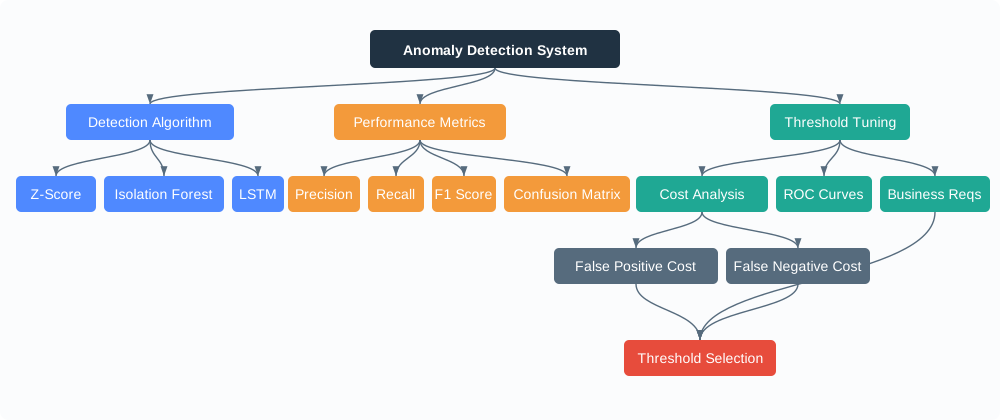
A detector may catch nine faults and still waste the operator's day with false alarms.
- Confusion counts and anomaly type show whether the model is useful.
- Twelve point to real faults, while eight real fault windows are missed.
- Latency means the time from enough evidence existing to the reviewed action that matters.
Major section
Point, Contextual, Collective Anomalies
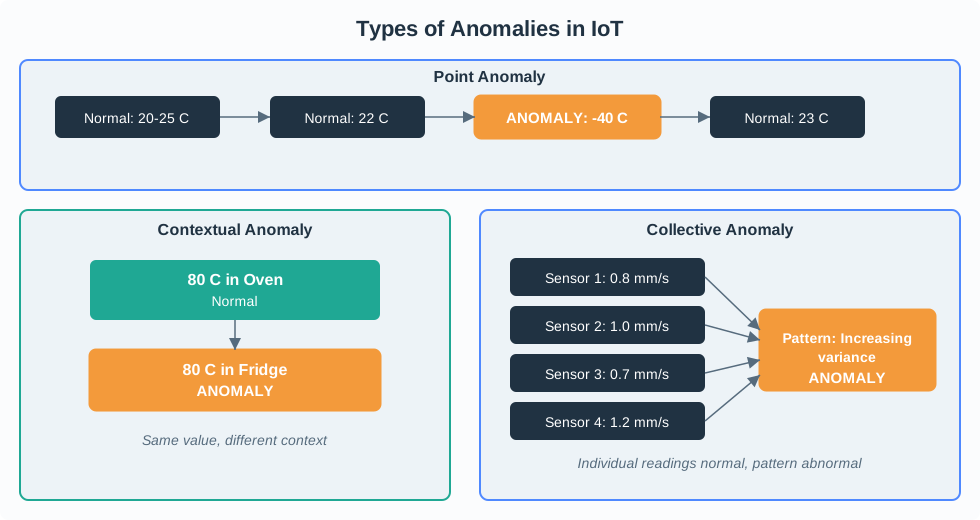
That may be a bad point.
- Yet the same value may be normal while the door is open for loading.
- A slow rise across many readings may matter even when no single value crosses a limit.
- The alert should show why this evidence set was used.
- A wide group can reveal drift, but it may react late.
Major section
Point, Contextual, Collective Anomalies (continued)
In: Collective Anomaly, Sensor 1 through Sensor 4 are individually plausible while the labelled: Pattern: Increasing variance is abnormal only as a group.
- A tight rule can catch a clear fault fast, but it may raise false alarms.
- This first pass does not choose a maths method or prove the cause.
- Anomaly type is an engineering decision.
Major section
Point, Contextual, Collective Anomalies (continued)
A device has produced messy evidence, an analytic step is about to change an alert or control decision, and someone has to explain why the result should be trusted.
- Point anomalies are unusual single values, contextual anomalies are unusual only under specific conditions, and collective anomalies are unusual patterns across windows or groups.
- Sensor faults should remain a separate boundary so operations teams do not confuse measurement failure with process failure.
- Classify the anomaly type first, then select the detector, evidence record, deployment tier, and retest trigger.
- Statistical Methods Use simple statistical scores for point anomalies and edge-friendly candidate alerts.
Deck summary
Key takeaways
A detector may catch nine faults and still waste the operator's day with false alarms.
- That may be a bad point.
- In: Collective Anomaly, Sensor 1 through Sensor 4 are individually plausible while the labelled: Pattern: Increasing variance is abnormal only as a group.
- A device has produced messy evidence, an analytic step is about to change an alert or control decision, and someone has to explain why the result should be trusted.
Retrieval practice
Recall check 1 of 6

Data Dora says: answer from memory, then check your reasoning.
Q1Why can ordinary accuracy mislead an IoT anomaly-detection review?
Show answer
Answer: A Class imbalance can make accuracy look strong even when anomaly detection is operationally weak.
Retrieval practice
Recall check 2 of 6

Data Dora says: answer from memory, then check your reasoning.
Q2A validation set has 20 real incidents, 30 alerts, 12 true positives, and 18 false positives. What does precision measure?
Show answer
Answer: A Precision is TP divided by all alerts, while recall is TP divided by all real incidents.
Retrieval practice
Recall check 3 of 6

Data Dora says: answer from memory, then check your reasoning.
Q3Why should an anomaly-metrics pipeline define event matching and duplicate suppression before computing precision and recall?
Show answer
Answer: B IoT anomalies often span windows and repeated alerts, so metrics need an explicit mapping from alerts to incidents.
Retrieval practice
Recall check 4 of 6

Data Dora says: answer from memory, then check your reasoning.
Q4Twelve conveyor-speed sensors all stay inside their normal individual bands, but every sensor drifts upward together over two hours. Which anomaly type best describes the evidence?
Show answer
Answer: A Anomaly type follows the evidence: single value, context-conditioned value, or group pattern.
Retrieval practice
Recall check 5 of 6

Data Dora says: answer from memory, then check your reasoning.
Q5Why is a plain point threshold a poor first choice for a contextual anomaly problem?
Show answer
Answer: A Detector choice follows the type of evidence required by the anomaly.
Retrieval practice
Recall check 6 of 6

Data Dora says: answer from memory, then check your reasoning.
Q6Why should the anomaly type be stored with the alert record in a production IoT system?
Show answer
Answer: A A production alert needs reviewable evidence, and anomaly type defines the evidence boundary.
Print reference
Answers 1 of 2
Answer key.
- A · Class imbalance can make accuracy look strong even when anomaly detection is operationally weak.
- A · Precision is TP divided by all alerts, while recall is TP divided by all real incidents.
- B · IoT anomalies often span windows and repeated alerts, so metrics need an explicit mapping from alerts to incidents.
- A · Anomaly type follows the evidence: single value, context-conditioned value, or group pattern.
- A · Detector choice follows the type of evidence required by the anomaly.
Print reference
Answers 2 of 2
Answer key.
- A · A production alert needs reviewable evidence, and anomaly type defines the evidence boundary.