AMQP · Study deck
AMQP Operations: Capacity Tools and Diagnostics
Production AMQP is the discipline of keeping a busy message factory honest.
Broker Bex is your guide for this deck.

After studying this chapter
Learning objectives
You will be able to:
- Explain: If the alert queue receives 5% of traffic and has two consumers that each process 40 messages/s, its capacity is 80 messages/s against 60 messages/s of ingress, so it drains.
- Explain: If a new binding doubles alert traffic to 120 messages/s without adding consumers, backlog grows by 40 messages/s: a 50,000-message queue fills in about 21 minutes.
- Explain: Production adds two harder requirements: the queue must survive a broker node failing, and the publisher must sustain thousands of messages per second without blocking on each confirm.
Major section
Visual: AMQP Routing Topology
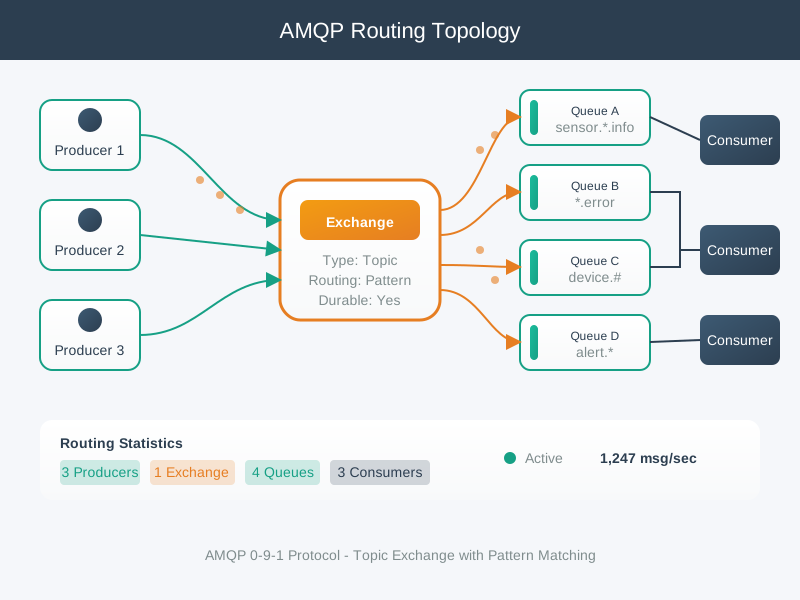
The view shows where routing flexibility lives and where backlog can accumulate.
- It connects topology design to binding tests, queue monitoring, and unroutable-message policy.
Major section
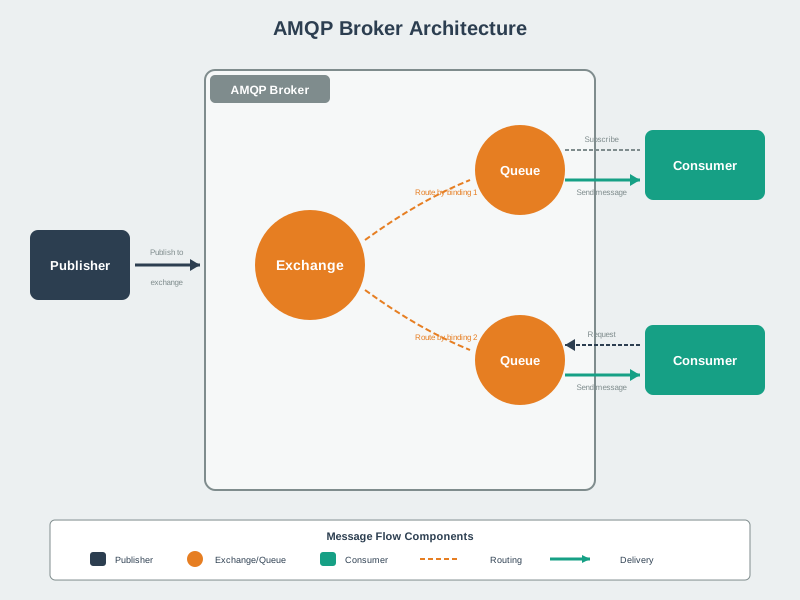
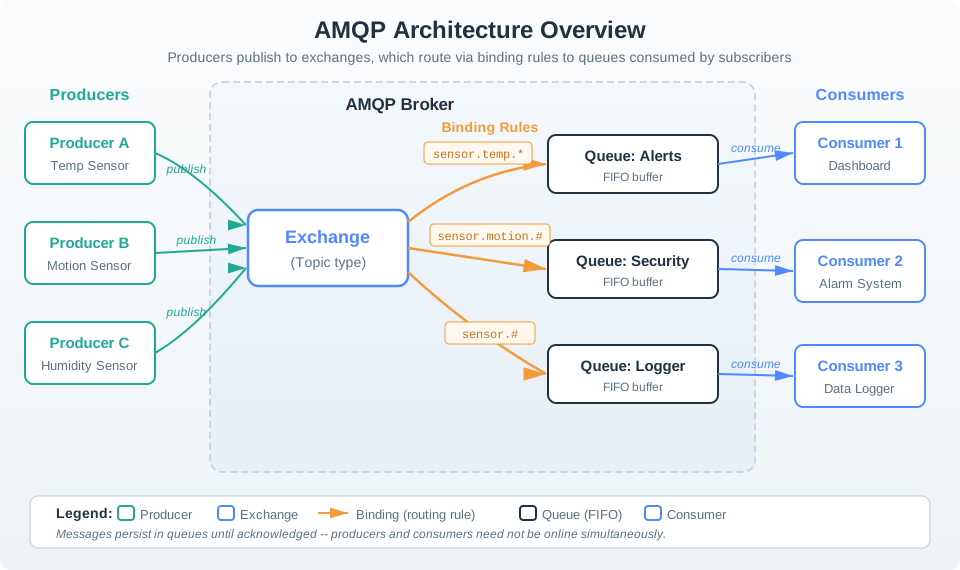
Visual: AMQP Protocol Overview
This placement explains why availability, confirmation, persistence, acknowledgment, and monitoring must cover separate parts of the same path.
- AMQP's broker-mediated architecture provides the reliable, transactional messaging capabilities required for enterprise IoT backend integration scenarios.
Major section
Availability and Confirms
A durable disk file is not enough if no live member can keep serving the message.
- A protocol is an agreed set of rules for an exchange.: Advanced Message Queuing Protocol, or AMQP, is a protocol for exchanging messages.
- A broker is the service that receives, routes, and holds those messages.
- Practitioner sets up the queue and connection plan.
Major section
Availability and Confirms (continued)
For a critical queue, name how many members hold it, which loss it can survive, and what the sender learns about each accepted message.
- Delay confirmations, refuse one message, and return one that has no valid route.
- Track each message until it is confirmed, retried, rejected, or left unknown.
- Everything so far makes a single broker correct.
Major section
Availability and Confirms (continued)
This small test does not prove every high-load case.
- Under the Hood tracks confirmation state at speed and explains the remaining loss windows.
- AMQP Production Operations teaches durable declarations, client-library implementations, dead-letter queues, monitoring, and capacity calculators.
- The two answers are replicated queues and asynchronous publisher confirms.
- Two connection habits prevent self-inflicted outages.
Major section
Availability and Confirms (continued)
Production operations is mostly the discipline of keeping those four numbers visible and bounded.
- Production adds two harder requirements: the queue must survive a broker node failing, and the publisher must sustain thousands of messages per second without blocking on each confirm.
- Those thresholds make the broker observable as a production service.
- The throughput difference is large.
Major section
Availability and Confirms (continued)
A durable queue on one node is still a single point of failure; a synchronous "publish, wait for confirm, repeat" loop is safe but slow.
- The goal of this layer is to get both safety and throughput at once while keeping publishing healthy when consumers or the broker fall behind.
- For data-safety-critical queues, the modern choice in RabbitMQ is the quorum queue.
- Connection hygiene has the same measurable shape.
Major section
Availability and Confirms (continued)
It replaces the older classic mirrored queues, which are deprecated for high availability.
- If the alert queue receives 5% of traffic and has two consumers that each process 40 messages/s, its capacity is 80 messages/s against 60 messages/s of ingress, so it drains.
- If a new binding doubles alert traffic to 120 messages/s without adding consumers, backlog grows by 40 messages/s: a 50,000-message queue fills in about 21 minutes.
- Second, pool connections and channels rather than opening one per message; a channel is cheap but not free, and per-message churn exhausts the broker.
Deck summary
Key takeaways
The view shows where routing flexibility lives and where backlog can accumulate.
- This placement explains why availability, confirmation, persistence, acknowledgment, and monitoring must cover separate parts of the same path.
- A durable disk file is not enough if no live member can keep serving the message.
- For a critical queue, name how many members hold it, which loss it can survive, and what the sender learns about each accepted message.
- This small test does not prove every high-load case.
Retrieval practice
Recall check 1 of 5

Broker Bex says: answer from memory, then check your reasoning.
Q1An event-driven system uses AMQP for order processing. Rank these AMQP operations by increasing complexity (simplest to most complex): A. Publishing a message to an exchange with routing key B. Declaring a queue and binding it to an exchange C. Setting up a transaction with multiple publish/consume operations and rollback capability D. Consuming messages with manual acknowledgment Which ranking correctly orders these operations from simplest to most complex?
Show answer
Answer: B Explanation: Ranking AMQP operations by complexity: A.
Retrieval practice
Recall check 2 of 5

Broker Bex says: answer from memory, then check your reasoning.
Q2Place each AMQP responsibility where it lives so you can trace which production boundary must recover when a message stalls.
Show answer
Answer: A Production recovery depends on ownership: publishers confirm acceptance, the broker cluster protects routing and queued state, and consumers acknowledge only after successful processing.
Q3Complete the production AMQP consumer with prefetch control and error handling:
Show answer
Answer: A basic_nack with requeue=False sends failed messages to the dead letter queue.
Retrieval practice
Recall check 3 of 5

Broker Bex says: answer from memory, then check your reasoning.
Q4Per this chapter's Overview section, which four thresholds does it say should be defined before a RabbitMQ release, to make the broker "observable as a production service"?
Show answer
Answer: A see answers page
Retrieval practice
Recall check 4 of 5

Broker Bex says: answer from memory, then check your reasoning.
Q5Per this chapter's connection-hygiene worked example, what happens if 500 edge gateways each open a new connection per message instead of reusing a pooled publishing connection, at 2 messages/second per gateway?
Show answer
Answer: A see answers page
Retrieval practice
Recall check 5 of 5

Broker Bex says: answer from memory, then check your reasoning.
Q6A production publisher must not lose messages and must sustain high throughput to a RabbitMQ cluster. Which combination is correct?
Show answer
Answer: A Quorum queues plus asynchronous confirms (delivery-tag tracking, resend on nack) plus the mandatory flag deliver durability, throughput, and unroutable detection together.
Print reference
Answers 1 of 3
Answer key.
- B · Explanation: Ranking AMQP operations by complexity: A.
- A · Production recovery depends on ownership: publishers confirm acceptance, the broker cluster protects routing and queued state, and consumers acknowledge only after successful processing.
- A · basic_nack with requeue=False sends failed messages to the dead letter queue.
Print reference
Answers 2 of 3
Answer key.
- A · The chapter's production observability rule is to define four thresholds before release -- max queue depth, max age of the oldest message, min active consumers, and max unconfirmed publishes -- so a queue that is 'already failing the product promise' (like a 90-second-old message against a 30-second SLA) is caught by an alert, not discovered after data loss.
Print reference
Answers 3 of 3
Answer key.
- A · The chapter's connection-hygiene example: 500 gateways publishing at 2 msg/s each, if each opens a fresh connection per message, produces 1,000 TCP handshakes/second (500 x 2) before any payload is processed -- versus hundreds of stable, reused sockets if connections are pooled and channels reused per stream.
- A · Quorum queues plus asynchronous confirms (delivery-tag tracking, resend on nack) plus the mandatory flag deliver durability, throughput, and unroutable detection together.