AMQP · Study deck
AMQP Core Architecture: Brokers and Routing
AMQP is easiest to understand as a sorting office for messages.
Broker Bex is your guide for this deck.

After studying this chapter
Learning objectives
You will be able to:
- Describe AMQP Architecture: Explain the roles of producers, brokers, exchanges, queues, and consumers in the AMQP messaging model
- Configure Exchange Types: Set up direct, fanout, topic, and headers exchanges for different message routing patterns
- Implement Message Routing: Design binding rules that route messages from exchanges to queues based on routing keys
- Demonstrate Channel Multiplexing: Explain how multiple logical channels share a single TCP connection and calculate the resource savings of multiplexing over separate connections
Major section
Start With the Decision
AMQP 0-9-1 is a messaging protocol for clients and brokers.
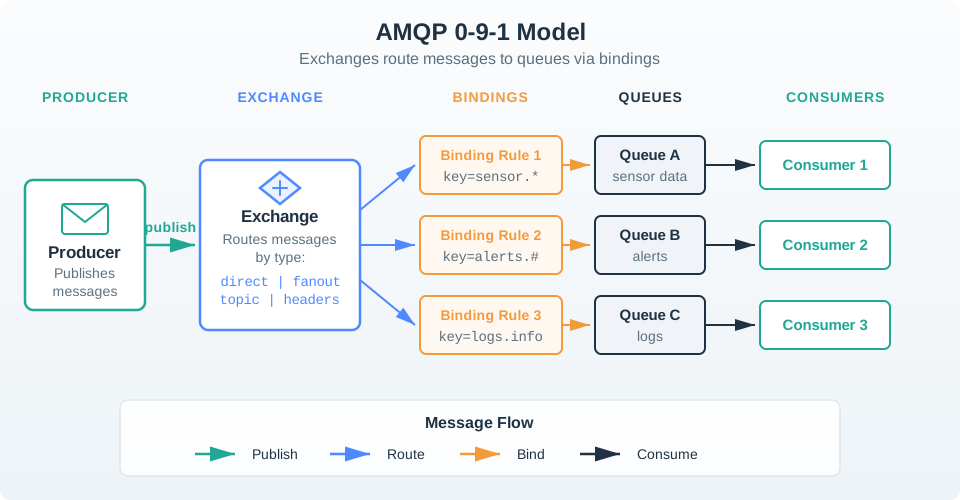
- A publisher sends a message to an exchange, which routes it to zero or more queues using bindings.
- A queue holds messages for consumers.
- A binding connects an exchange to a queue; some exchange types compare a message's routing key with a binding rule.
Major section
In 60 Seconds
AMQP means Advanced Message Queuing Protocol.
- A broker is the service that accepts and routes messages.
- Telemetry means measurements and status sent from a remote device for review.
- MQTT means Message Queuing Telemetry Transport.
- TCP means a connected byte stream that tracks order and loss.
Major section
In 60 Seconds (continued)
A live connection does not prove correct routing.
- This runway does not select one message system for every workload.
- AMQP's architecture centers on the broker, which receives messages from producers, routes them through exchanges (direct, fanout, topic, or headers) to bound queues, and delivers them to consumers.
- Unlike MQTT's simple topic matching, AMQP exchanges use binding rules and routing keys for sophisticated server-side message routing, with channel multiplexing allowing multiple logical channels over a single TCP connection.
Major section
For Beginners: AMQP Architecture
Direct application-to-application connections would be a nightmare - each app would need code to talk to dozens of others.
- AMQP (Advanced Message Queuing Protocol) solves this with a message broker - a central post office that routes messages.
- Producers (publishers) send messages to the broker.
- Queues store messages until consumers are ready.
Major section
The Message Sorting Office
the battery nodded approvingly. "And since Sammy only talks to one exchange instead of three different systems, he uses way less power.
- the microcontroller grinned. "You don't have to figure that out yourself, Sammy.
- That's what the AMQP broker does!
- Nobody loses any data!".
Major section
Common Misconception: "Publishing to Queues Directly"
Key principle: AMQP exchanges enable location transparency - producers don't know (or care) who consumes messages.
- Misconception: "I should publish messages directly to queues for better performance, bypassing exchanges.".
- Reality: Publishing with a queue name uses the default direct exchange; it does not bypass an exchange.
- A named exchange can keep producer code stable as bindings change.
Major section
AMQP 0-9-1 Model: Exchanges, Queues, and Bindings
With the broker roles in place, the next question is how AMQP 0-9-1 represents routing rules inside that broker.
- Exchanges match; bindings express the match rules; queues store independently consumable copies.
- That division explains why broker acceptance, successful routing, durable storage, and consumer completion require different checks.
Deck summary
Key takeaways
AMQP 0-9-1 is a messaging protocol for clients and brokers.
- AMQP means Advanced Message Queuing Protocol.
- A live connection does not prove correct routing.
- Direct application-to-application connections would be a nightmare - each app would need code to talk to dozens of others.
- the battery nodded approvingly. "And since Sammy only talks to one exchange instead of three different systems, he uses way less power.
Retrieval practice
Recall check 1 of 2
Broker Bex says: answer from memory, then check your reasoning.
Q1A factory producer publishes a temperature message, but the intended queue receives no copy. Which routing detail should the team inspect?
Show answer
Answer: B Bindings determine which queues match the published routing key.
Q2A broker client needs concurrent message streams with less connection setup overhead. Which arrangement fits the chapter?
Show answer
Answer: D Lightweight channels let concurrent streams share a TCP connection.
Retrieval practice
Recall check 2 of 2
Broker Bex says: answer from memory, then check your reasoning.
Q3A gateway needs six independent streams. How many TCP connections are saved by putting all streams on one shared connection instead of one connection per stream?
Show answer
Answer: C Six separate TCP connections minus one shared TCP connection saves five TCP connections.
Print reference
Answers
Answer key.
- B · Bindings determine which queues match the published routing key.
- D · Lightweight channels let concurrent streams share a TCP connection.
- C · Six separate TCP connections minus one shared TCP connection saves five TCP connections.