Emerging Paradigms · Study deck
Ad-Hoc Deployment Framework
A protocol means an agreed set of rules for passing data.
Blueprint Bina is your guide for this deck.

After studying this chapter
Learning objectives
You will be able to:
- Build Production Frameworks: Implement comprehensive multi-hop ad-hoc network management systems
- Assess Link Quality: Design link quality classification and monitoring for dynamic networks
- Implement Multi-Path Routing: Create load-balanced routing across multiple paths
- Monitor Network Performance: Build real-time topology discovery and health monitoring
Major section
Begin With the Service That Must Survive
A protocol means an agreed set of rules for passing data.
- Latency means the time from a needed event to a useful result.
- Received signal strength means the power seen at the radio input.
- RSSI is one common reading for that strength.
- Their devices still need to send one urgent status note.
Major section
Begin With the Service That Must Survive (continued)
A route that works once is only a demo.
- A route that leaves a review record can support a decision.
- Extra paths can aid recovery, but they add traffic and state.
- A weak radio reading can warn of risk, but it is not distance or proof of a good link.
Major section
Begin With the Service That Must Survive (continued)
This first pass does not size a fleet or secure every peer.
- The deeper work tests whether the simple service can survive real field change.
- A weak link may work when the air is quiet.
- A strong link may still fail when a queue is full.
- A short path may use a weak node.
Major section
Start With the Field Constraint
Production ad-hoc design starts with a constraint the network cannot wish away: movement, sparse power, blocked radio, emergency setup, hostile terrain, or missing infrastructure.
- The chapter's −55.3, −70.2, and −87.8 dBm examples are 14.9 and 32.5 dB apart.
Major section
Network Control Tower
If the main road is busy, I have a back road ready.
- It's like having GPS suggest three routes to grandma's house!".
- If one sensor is doing ALL the work passing messages, Max reroutes traffic so nobody burns out.".
Major section
Introduction
Production ad-hoc networks require robust management systems that go beyond simple routing protocols.
- Real-world IoT deployments face challenges including variable link quality, node mobility, battery constraints, and the need for continuous monitoring.
- This chapter provides a comprehensive production-ready Python framework that addresses these challenges through modular, extensible components.
Major section
Advanced Multi-Hop Management
With the roadmap in mind, the implementation starts by separating state from decisions.
- This section provides a comprehensive production-ready Python framework for managing multi-hop ad-hoc networks in real-world IoT deployments.
- This avoids magic strings in monitoring code and keeps metrics comparable across nodes.
Major section
Link Quality Threshold Tuning
Result: Re-classification reduces packet loss from 25% to 8% by avoiding marginally-viable links.
- Scenario: Factory deployment shows 25% packet loss on "GOOD" classified links.
- Industrial environments need 5-10 dB margin for metal/multipath effects.
Major section
Tune Production Protocol Parameters
Simulation defaults for routing protocols (update intervals, cache timeouts, zone radii) are tuned for generic scenarios, not production deployments.
- Production networks require parameter tuning based on actual node density, mobility patterns, and traffic loads.
Major section
Add Distributed Ad Hoc Security
Traditional PKI requires a trusted central authority.
- Production deployments need distributed trust establishment (web of trust, threshold cryptography, or pre-distributed certificates) to authenticate nodes without central infrastructure.
Major section
3. Ignoring Resource Exhaustion Attacks
Ad hoc networks are vulnerable to routing disruption by malicious nodes advertising false routes or consuming all bandwidth.
- Production deployments need intrusion detection and rate limiting for routing control traffic.
- Resource exhaustion from a compromised node can collapse the entire network's routing.
Major section
Putting Numbers to It
RSSI (Received Signal Strength Indicator) uses dBm where more negative = weaker.
- Path loss follows $RSSI = P_{tx}: 10n\log_{10}(d) + X$ where $n \approx 2-4$ (environment factor), $d$ is distance.
- The EXCELLENT threshold (-70 dBm) means signals can travel $\approx 215m$ with $n=3$ factory propagation.
- GOOD threshold (-80 dBm) supports $\approx 460m$.
Major section
Test Your Understanding
Question 1:: A 20-node ad-hoc network has three paths from source to gateway.
- Path A has 3 hops with nodes at 40% battery, Path B has 4 hops with nodes at 80% battery, and Path C has 5 hops with nodes at 95% battery.
Deck summary
Key takeaways
A protocol means an agreed set of rules for passing data.
- A route that works once is only a demo.
- This first pass does not size a fleet or secure every peer.
- Production ad-hoc design starts with a constraint the network cannot wish away: movement, sparse power, blocked radio, emergency setup, hostile terrain, or missing infrastructure.
- If the main road is busy, I have a back road ready.
Retrieval practice
Recall check 1 of 6

Blueprint Bina says: answer from memory, then check your reasoning.
Q1In the link quality estimation output above, the 'poor' link shows PDR of 44%, RSSI of -87.8 dBm, and stability score of 0.312. What routing action should the framework take for this link?
Show answer
Answer: B Links with PDR below 50% are classified as POOR and should be avoided for primary routing.
Retrieval practice
Recall check 2 of 6

Blueprint Bina says: answer from memory, then check your reasoning.
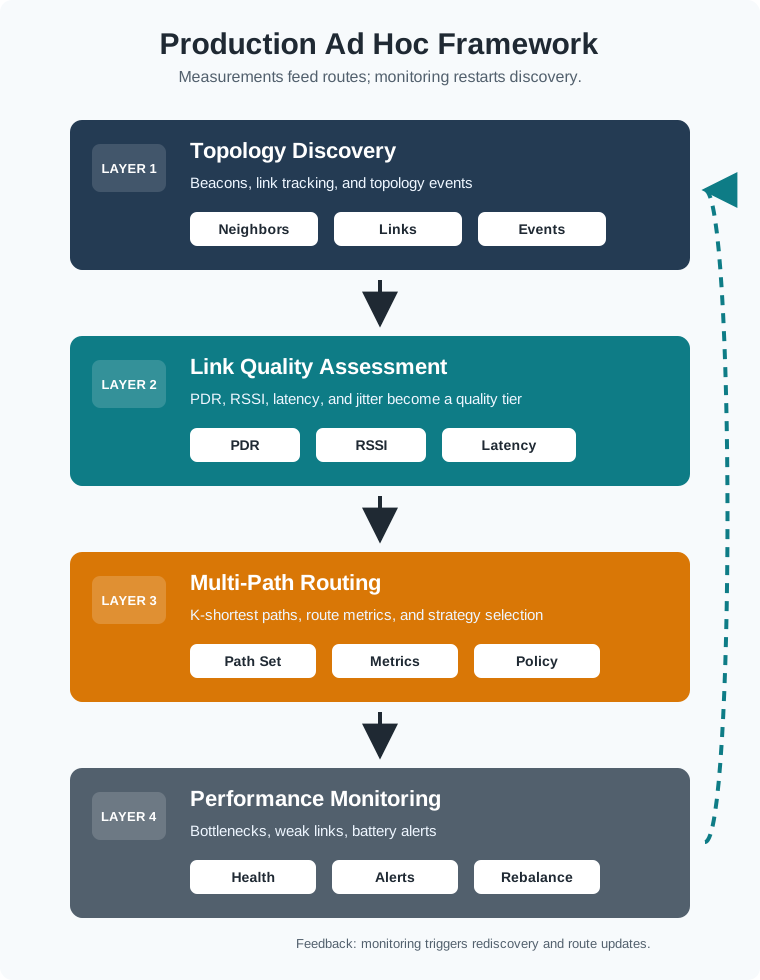
Q2Place each production-framework function where it lives so you can keep ad hoc routes useful as links and load change.
Show answer
Answer: A Separate topology and quality observation, route computation, and live monitoring so you can close the adaptation loop after deployment.
Retrieval practice
Recall check 3 of 6

Blueprint Bina says: answer from memory, then check your reasoning.
Q3An ad-hoc network production framework must handle 'network partitioning' -- when the network splits into two disconnected groups because intermediate nodes fail or move. What strategy maintains functionality during a partition?
Show answer
Answer: B Network partitioning is inevitable in mobile ad-hoc networks.
Retrieval practice
Recall check 4 of 6

Blueprint Bina says: answer from memory, then check your reasoning.
Q4A production ad-hoc network deployment for wildlife tracking uses solar-powered sensor nodes. During cloudy days, node batteries deplete faster. The framework should adapt routing to avoid low-battery nodes. What routing metric enables this?
Show answer
Answer: D Energy-aware routing extends network lifetime by distributing traffic load away from energy-depleted nodes.
Retrieval practice
Recall check 5 of 6

Blueprint Bina says: answer from memory, then check your reasoning.
Q5In the link quality classification system, a link with 85% PDR, -73 dBm RSSI, and 30 ms latency would be classified as:
Show answer
Answer: B
Retrieval practice
Recall check 6 of 6

Blueprint Bina says: answer from memory, then check your reasoning.
Q6Why does the production framework use K-shortest paths with disjoint routes rather than simply finding the single best path?
Show answer
Answer: B
Print reference
Answers
Answer key.
- B · Links with PDR below 50% are classified as POOR and should be avoided for primary routing.
- A · Separate topology and quality observation, route computation, and live monitoring so you can close the adaptation loop after deployment.
- B · Network partitioning is inevitable in mobile ad-hoc networks.
- D · Energy-aware routing extends network lifetime by distributing traffic load away from energy-depleted nodes.
- B
- B