Emerging Paradigms · Study deck

Ad-Hoc Production: Readiness Checks

This first route defines production evidence and transfers it across realistic ad-hoc scenarios.

Blueprint Bina is your guide for this deck.

adhocprod
Blueprint Bina, the module guide, in a scene from this chapter.
iotclass.org

After studying this chapter

Learning objectives

You will be able to:

  • Explain: Temperature Terry needed to send an urgent temperature reading to the Gateway across the farm, but the direct path was blocked by a tractor!
  • Explain: The assessment then becomes a chain of evidence: what must be measured, what threshold is acceptable, and what action follows when the evidence fails.
  • Explain: The lesson: Smart networks plan backup routes BEFORE problems happen, and they share the work so no single helper gets worn out!
  • Explain: Think of it like knowing three different ways to get to school -- if one road is blocked, you just take another!".
iotclass.org

Major section

Start Simple

A protocol is an agreed set of rules for how devices exchange information.

  • That name alone cannot prove that a field network is ready.
  • People move, a relay loses power, and two groups meet after a long break.
  • The system must still carry the right report to the right place without hiding old or copied data.

Why it matters

It proves that the team measured named failures and knows when to reduce the service claim.

iotclass.org

Major section

Start Simple (continued)

It proves that the team measured named failures and knows when to reduce the service claim.

  • A missing answer is a test result, not a reason to guess.
  • Passing this review does not prove every route will work.
  • The deeper material compares routing methods, energy costs, mobility, and release records.
iotclass.org

Major section

Start With the Readiness Question

Mobility, interference, battery limits, node loss, and operator mistakes all count as normal conditions.

  • The assessment then becomes a chain of evidence: what must be measured, what threshold is acceptable, and what action follows when the evidence fails.
iotclass.org

Major section

The Route Relay Race

Temperature Terry needed to send an urgent temperature reading to the Gateway across the farm, but the direct path was blocked by a tractor!

  • "No worries!" said the microcontroller. "We have THREE different paths planned ahead of time.
  • Think of it like knowing three different ways to get to school -- if one road is blocked, you just take another!".
  • the battery added, "But not all paths are equal!
iotclass.org

Major section

The Route Relay Race (continued)

I prefer the one where my friends along the way have plenty of energy left.

  • If we always use the same shortcut, those friends get tired really fast.".
  • Spreading notes across different rows keeps everyone happy and willing to help!".
  • The lesson: Smart networks plan backup routes BEFORE problems happen, and they share the work so no single helper gets worn out!
iotclass.org

Major section

Ad-Hoc Routing Protocol Comparison
Understanding the trade-offs between routing protocol types is essential for production deployments.

  • Maintains routes continuously with periodic updates.
  • Best for frequent, predictable traffic where routes are needed often.
  • Discovers routes only when traffic needs a path.
  • Maintains proactive routes inside a local zone and discovers distant routes reactively.
Ad-hoc routing-family selection starts with observed mobility, traffic frequency, and control-budget evidence, then compares proactive, reactive, and hybrid candidates before a shared measurement gate.
iotclass.org

Major section

Multi-Path Link Failure Recovery

The gateway receives data from sensors via multi-hop ad-hoc network.

  • The energy-aware path selection preserves Node G's battery for future backup duty.
  • The key is pre-computing and caching backup paths, not discovering them after failure.
  • Path selection should consider both latency and node energy to maintain backup availability throughout deployment lifetime.

Why it matters

Result: Implementing multi-path routing with automatic failover reduces packet loss from 16.7% to <1%, meeting the 2% reliability requirement.

iotclass.org

Major section

Hop Counts for Critical Alerts

Scenario: An industrial safety monitoring system detects gas leaks and must deliver alerts to the control room within 500 ms.

  • The default energy-aware routing uses 6-hop paths to preserve battery, but this may violate latency requirements.
  • Unexpectedly, the 3-hop path also uses 52% less energy per packet than the 6-hop "energy-optimized" path.
  • Longer paths consume more cumulative energy (more transmissions + receptions) even if each link is energy-efficient.

Numbers to remember

500 msand must deliver alerts to the control room within 500 ms.
iotclass.org

Major section

Adaptive Route Caching

Scenario:: Disaster response team uses DSR routing.

  • Command post (stationary) communicates with mobile rescue teams (3-5 m/s).
  • Device caches 5 routes.
  • After 10 minutes, 40% of routes have stale/broken links due to mobility.
  • Key Insight:: Static timeout fails: 10min timeout -> 40% stale routes -> packet failures.

Numbers to remember

40%40% of routes have stale/broken links due to mobility.
<100 msReal-time voice needs <100 ms.

Why it matters

Adaptive solution:: Monitor ROUTE_ERROR rate: High errors (>5/min) -> reduce timeout to 2-3min (high mobility).

iotclass.org

Deck summary

Key takeaways

A protocol is an agreed set of rules for how devices exchange information.

  • It proves that the team measured named failures and knows when to reduce the service claim.
  • Mobility, interference, battery limits, node loss, and operator mistakes all count as normal conditions.
  • Temperature Terry needed to send an urgent temperature reading to the Gateway across the farm, but the direct path was blocked by a tractor!
  • I prefer the one where my friends along the way have plenty of energy left.
iotclass.org

Retrieval practice

Recall check 1 of 5

Blueprint Bina says: answer from memory, then check your reasoning.

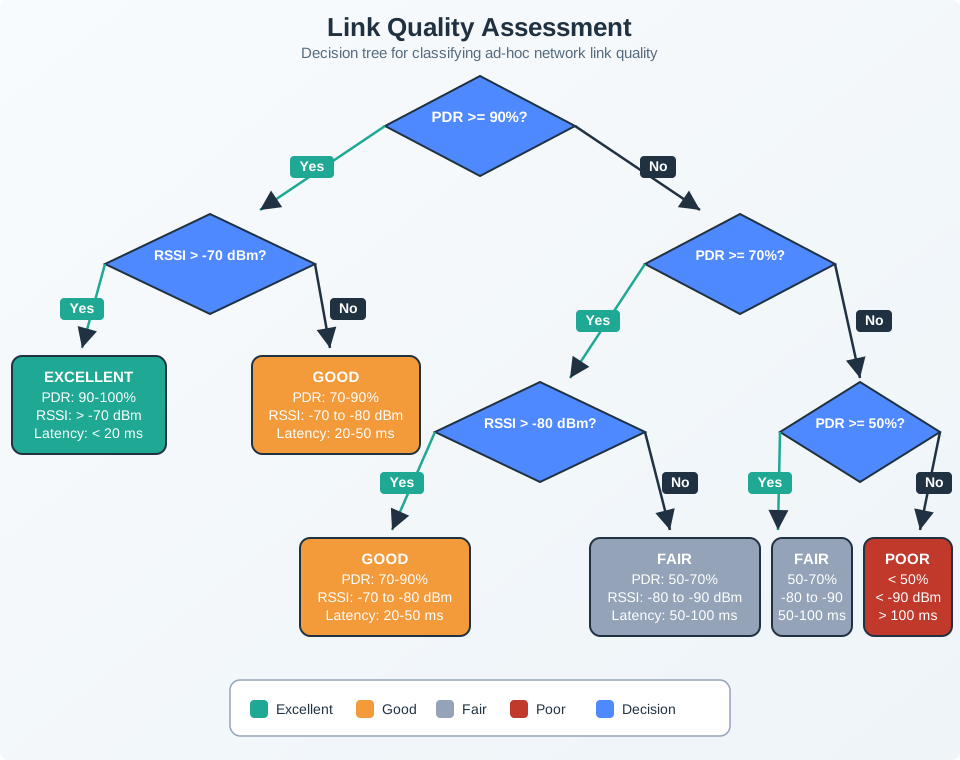
Q1A link between two nodes shows 82% PDR, -74 dBm RSSI, and 35ms latency. Based on the quality classification table, how should this link be classified?

AEXCELLENT -- an 82% PDR and 35ms latency clear the top-tier thresholds
BGOOD -- PDR is 70-90%, RSSI is between -70 and -80 dBm, and latency is 20-50ms
CFAIR -- any link that fails the 90% PDR excellent bar drops to marginal
DPOOR -- an RSSI of -74 dBm falls below the -70 dBm mark, which indicates a weak signal
Show answer

Answer: B Link quality classification uses PDR, RSSI, and latency thresholds.

iotclass.org

Retrieval practice

Recall check 2 of 5

Blueprint Bina says: answer from memory, then check your reasoning.

Q21. A primary reason multi-hop can be more energy-efficient than a single long-range hop is that:

Amulti-hop eliminates the need for routing protocols
Brequired transmit power grows quickly with distance
Cmulti-hop uses wired Ethernet for intermediate links
Dmulti-hop always increases throughput compared to single-hop
Show answer

Answer: B Path loss increases with distance; achieving a much longer link can require disproportionately higher power.

iotclass.org

Retrieval practice

Recall check 3 of 5

Blueprint Bina says: answer from memory, then check your reasoning.

Q32. Proactive routing protocols like OLSR are generally best when:

Atraffic is extremely sparse and routes are rarely needed by any node in the network
Bdevices are completely disconnected from each other most of the time, as in DTN scenarios
Clow latency for route availability is important and periodic overhead is acceptable
Dthe design goal is to avoid sending any periodic control messages at all
Show answer

Answer: C Proactive protocols maintain routes continuously, which reduces route setup delay but increases overhead through periodic updates.

iotclass.org

Retrieval practice

Recall check 4 of 5

Blueprint Bina says: answer from memory, then check your reasoning.

Q43. A key advantage of reactive routing (e.g., AODV/DSR) is:

Alower control overhead when there is little traffic
Broutes are always immediately available with zero delay
Cit guarantees delivery even in disconnected networks
Dit does not require nodes to forward packets
Show answer

Answer: A Reactive protocols discover routes only when needed, reducing idle overhead at the cost of route discovery latency when traffic starts.

iotclass.org

Retrieval practice

Recall check 5 of 5

Blueprint Bina says: answer from memory, then check your reasoning.

Q54. For intermittently connected networks (DTN scenarios), "store-and-forward" multi-copy approaches (like epidemic routing) typically trade:

Alower control and storage overhead in exchange for a lower end-to-end delivery ratio
Blower per-node energy consumption in exchange for higher usable bandwidth
Cfaster route convergence in exchange for fewer packet replicas in flight
Dhigher overhead for higher delivery probability when connectivity is sparse
Show answer

Answer: D Multi-copy DTN approaches improve delivery under intermittent connectivity by replicating packets, but that replication increases overhead and energy use.

iotclass.org

Print reference

Answers 1 of 2

Answer key.

  1. B · Link quality classification uses PDR, RSSI, and latency thresholds.
  2. B · Path loss increases with distance; achieving a much longer link can require disproportionately higher power.
  3. C · Proactive protocols maintain routes continuously, which reduces route setup delay but increases overhead through periodic updates.
  4. A · Reactive protocols discover routes only when needed, reducing idle overhead at the cost of route discovery latency when traffic starts.
iotclass.org

Print reference

Answers 2 of 2

Answer key.

  1. D · Multi-copy DTN approaches improve delivery under intermittent connectivity by replicating packets, but that replication increases overhead and energy use.
iotclass.org