Emerging Paradigms · Study deck

ZRP Routing: Zones and Bordercast

This first route builds ZRP from local zones through bordercast discovery and a checkable radius calculation.

Blueprint Bina is your guide for this deck.

adhochybrid
Blueprint Bina, the module guide, in a scene from this chapter.
iotclass.org

After studying this chapter

Learning objectives

You will be able to:

  • Explain ZRP Architecture: Describe how Zone Routing Protocol combines proactive and reactive approaches with its three components (IARP, IERP, BRP)
  • Design Zone Configurations: Select appropriate zone radius values for different network characteristics and justify the choice
  • Analyze Intra-Zone Routing: Explain proactive table maintenance within each node's zone and calculate zone size
  • Apply Inter-Zone Routing: Demonstrate reactive discovery for destinations outside the zone using bordercast
iotclass.org

Major section

Neighborhood Map Strategy

"I'm confused," said Temperature Terry. "Proactive routing keeps maps of EVERYWHERE (exhausting!).

  • Reactive routing has NO map and asks for directions every time (slow!).
  • I know exactly how to reach everyone in my zone (proactive).
  • the LED added the best part: "When I need to find someone far away, I don't shout to the ENTIRE network.
iotclass.org

Major section

Key Concepts

Routing Zone: Each node's local neighborhood within radius ρ hops; routes are maintained proactively within this zone.

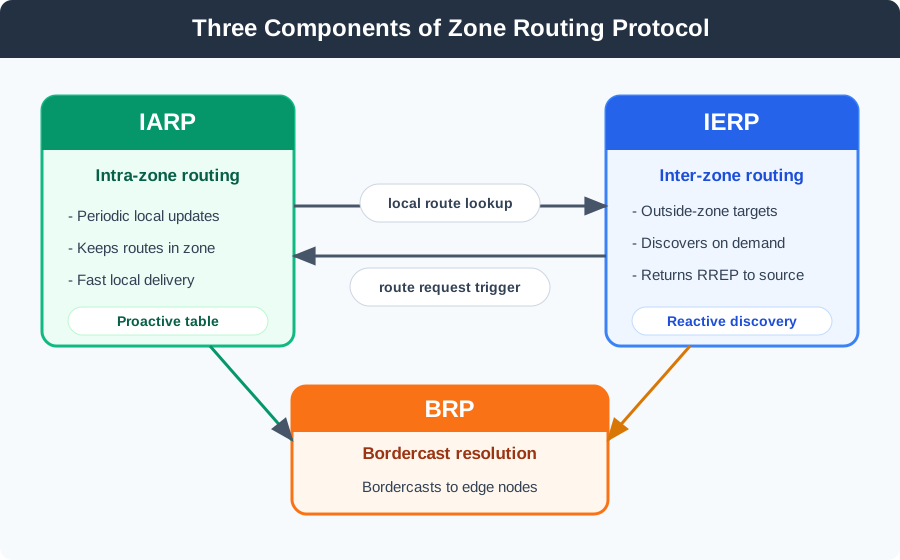
  • IARP (IntraZone Routing Protocol): Proactive component of ZRP maintaining routes within the routing zone.
  • IERP (InterZone Routing Protocol): Reactive component of ZRP discovering routes to nodes outside the routing zone.
  • Bordercast: ZRP optimization where route requests are forwarded only to border nodes (at the edge of the zone) rather than flooded.

Why it matters

Zone Overlap: Nodes within ρ hops of each other share zone membership; enables route caching from zone neighbors.

iotclass.org

Major section

For Beginners: Hybrid Routing (ZRP)

For nearby places (your neighborhood), you keep routes in your head constantly.

  • Proactive (DSDV): Too much overhead (maintains routes to everywhere continuously).
  • Maintains routes only to nearby nodes, discovers distant routes on-demand.
  • Example with Zone Radius = 2:: Result: A maintains ~10-12 routes instead of 100 routes (saves 90% memory and overhead!).
iotclass.org

Major section

For Beginners: Hybrid Routing (ZRP) (continued)
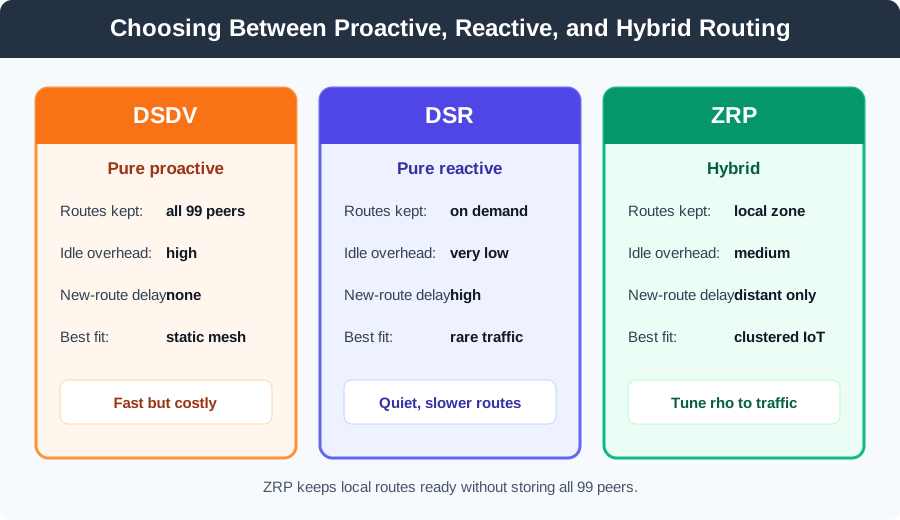
Zone routing: combine proactive nearby routes with reactive distant discovery, like knowing your neighborhood and using a map for trips across town.

  • DSDV maintains routes to all nodes.
  • DSR maintains no proactive routes.
  • ZRP maintains only nearby zone routes.
  • It keeps nearby latency low while using reactive discovery for distant nodes.
iotclass.org

Major section

Zone Routing Protocol (ZRP)

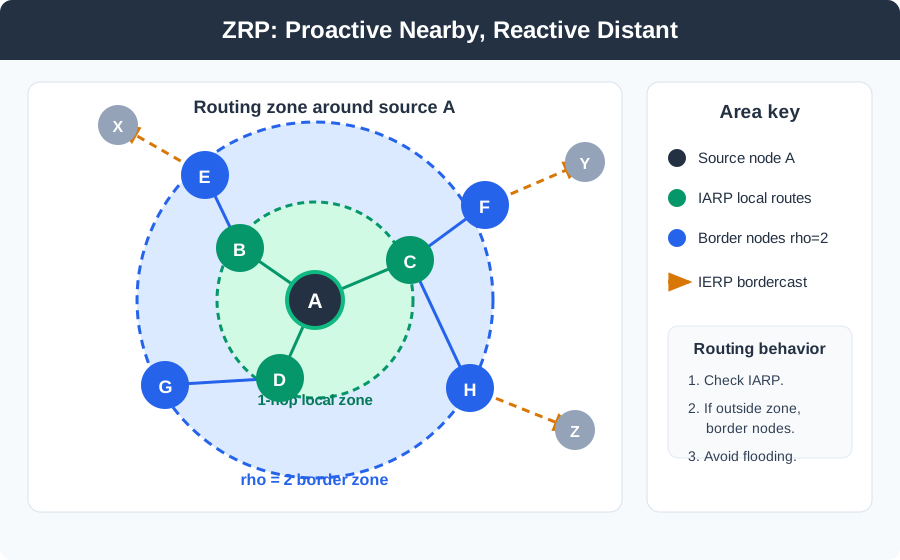
The local/distant split is the mechanism the later radius decision must tune from traffic locality and measured control cost.

  • A larger radius shifts work toward IARP maintenance; a smaller radius makes more destinations pay the IERP discovery path.
  • A known local destination uses the maintained IARP route immediately; an external destination triggers IERP discovery through border nodes.
Zone Routing Protocol diagram showing source node A, one-hop neighbors, two-hop border nodes, proactive IARP links inside the zone, and reactive inter-zone discovery paths beyond the zone boundary.
iotclass.org

Major section

Zone Routing Protocol (ZRP) (continued)
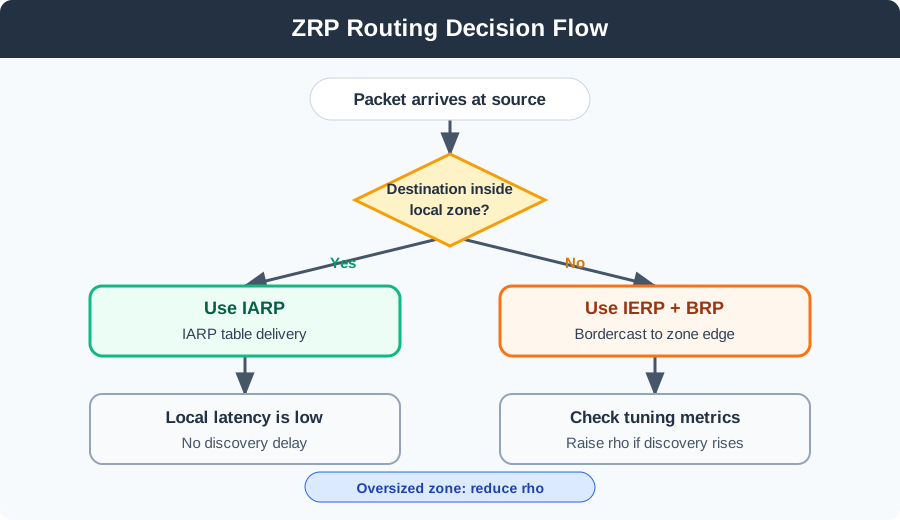
Figure: Decision flow showing how ZRP chooses between IARP shows that ZRP does not apply both routing modes to every packet.

  • The tuning feedback connects observed overhead and discovery delay back to radius selection, so the hybrid balance is measured rather than assumed.
  • ZRP deliberately occupies the middle: it spends state on frequently useful local routes and accepts discovery for distant ones.
  • Intra-Zone (Proactive):: Within zone radius, maintain routes proactively using table-driven protocol (like DSDV).
iotclass.org

Major section

Putting Numbers to It

If rho = 3 already covers nearly the full network, ZRP degenerates toward pure DSDV and loses its hybrid benefit.

  • Maintain routes to all nodes within ρ hops.
  • Scenario:: Node A needs to communicate with Node H.
  • BRP bordercast RREQ" and "A's IARP zone" is evidence that "3.
  • Data transmission: Source uses discovered route.
Block diagram showing the three ZRP components: IARP maintaining proactive intra-zone tables, IERP discovering inter-zone routes on demand, and BRP directing route requests to border nodes.
iotclass.org

Major section

Putting Numbers to It (continued)

BRP bordercast RREQ" carries into the next decision.

  • Local lookup: A checks IARP table (proactive zone routes).
  • Bordercast: A sends RREQ to zone border nodes (not full flood).
  • If H not found, forward RREQ to their borders.
  • Zone overlap: Eventually RREQ reaches zone containing H.
iotclass.org

Major section

Checkpoint: Route Discovery Mechanics

The route trace proves ZRP can search efficiently.

  • The remaining design work is deciding when that efficiency justifies a larger local zone.
  • ZRP is not automatically better than proactive or reactive routing.
  • Its benefit exists only while the configured zone boundary matches the network's topology and traffic pattern.
iotclass.org

Major section

Checkpoint: Route Discovery Mechanics (continued)
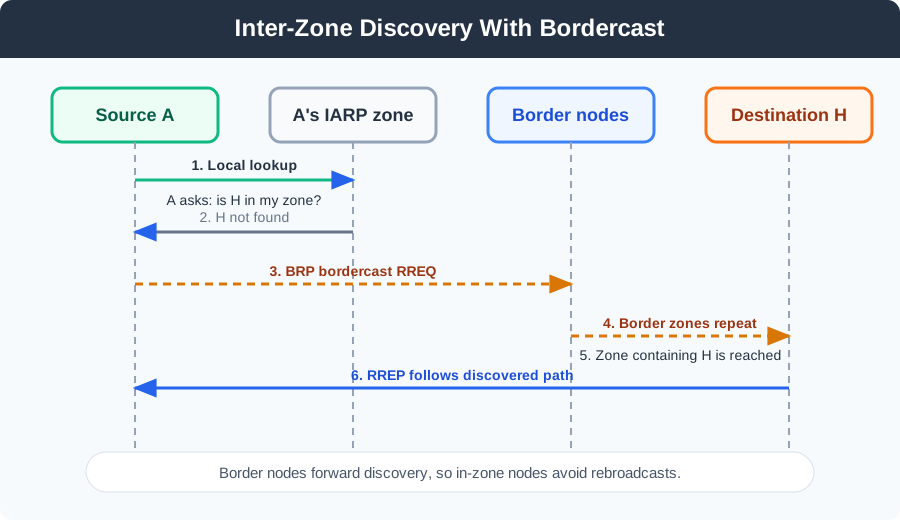
Oversized zones: if the radius approaches the network diameter, every node is in-zone, IERP stops doing useful work, and ZRP behaves like DSDV with extra complexity.

  • Undersized zones: if most destinations are outside the zone, local route tables are cheap but nearly every useful packet triggers reactive discovery.
  • Moving borders: mobility changes zone membership, border-node identity, cached routes, and IARP freshness at the same time.
  • Bad bordercast: if BRP falls back to full flooding or misses true border nodes, the measured overhead no longer matches the design record.
iotclass.org

Deck summary

Key takeaways

"I'm confused," said Temperature Terry. "Proactive routing keeps maps of EVERYWHERE (exhausting!).

  • Routing Zone: Each node's local neighborhood within radius ρ hops; routes are maintained proactively within this zone.
  • For nearby places (your neighborhood), you keep routes in your head constantly.
  • Zone routing: combine proactive nearby routes with reactive distant discovery, like knowing your neighborhood and using a map for trips across town.
  • The local/distant split is the mechanism the later radius decision must tune from traffic locality and measured control cost.
iotclass.org

Retrieval practice

Recall check 1 of 3

Blueprint Bina says: answer from memory, then check your reasoning.

Q1Zone Routing Protocol (ZRP) combines proactive (within zone) and reactive (between zones) routing. For a 100-node network with zone radius=2, approximately how many nodes does each node proactively track?

A2 nodes - one for each hop of the configured zone radius
B4 nodes - the zone radius squared under a grid assumption
C8-12 nodes - neighbors within 2 hops in typical mesh topology
D100 nodes - every node in the entire network, exactly as in DSDV
Show answer

Answer: C Explanation: Zone radius=2 means proactive routing within 2 hops.

iotclass.org

Retrieval practice

Recall check 2 of 3

Blueprint Bina says: answer from memory, then check your reasoning.

Q2In ZRP, which component maintains proactive routing information within a node's zone (intra-zone)?

AIARP (Intra-zone Routing Protocol)
BIERP (Inter-zone Routing Protocol)
CBRP (Bordercast Resolution Protocol)
DBGP (Border Gateway Protocol)
Show answer

Answer: A Explanation: A.

Q3What is the primary trade-off when increasing the zone radius (ρ) in ZRP?

AReactive discovery overhead increases; proactive overhead decreases
BProactive overhead increases; reactive discovery overhead decreases
CBoth proactive and reactive overhead decrease
DZone radius has no effect on overhead; only latency changes
Show answer

Answer: B Explanation: B.

iotclass.org

Retrieval practice

Recall check 3 of 3

Blueprint Bina says: answer from memory, then check your reasoning.

Q4ZRP uses 'bordercasting' during inter-zone route discovery. What problem does bordercasting solve?

AEliminates the need for any routing tables to be maintained inside the local zone
BEncrypts route discovery packets end-to-end so border nodes cannot read the query contents
CReduces flooding by forwarding queries only to border nodes instead of the entire network
DGuarantees exactly-once delivery for every route request crossing between neighbouring zones
Show answer

Answer: C Explanation: C.

iotclass.org

Print reference

Answers

Answer key.

  1. C · Explanation: Zone radius=2 means proactive routing within 2 hops.
  2. A · Explanation: A.
  3. B · Explanation: B.
  4. C · Explanation: C.
iotclass.org