Emerging Paradigms · Study deck
ZRP Routing: Tuning and Deployment
A campus route now reaches beyond its local zone, the nearby nodes kept on known routes.
Blueprint Bina is your guide for this deck.

After studying this chapter
Learning objectives
You will be able to:
- Explain: For this upper-bound illustration only, assume every packet to an out-of-zone destination needs a fresh query; real routes can be reused, so actual query counts may be lower.
- Explain: The position is a design contract, not a promise of automatic balance; the later sizing record must prove that both halves are doing useful work under the observed topology.
- Explain: Discovery latency may still remain because topology changes and implementations impose work of their own; the presence of three protocol components does not guarantee that their costs balance.
- tune zone radius with measured network evidence
Major section
Start With the Situation
A campus route now reaches beyond its local zone, the nearby nodes kept on known routes.
- Its radius is the hop limit of that zone.
- Working once does not prove the limit is right.
- A radius that is too small repeatedly discovers distant routes; a radius that is too large spends airtime maintaining neighbors the application rarely uses.
Major section
ZRP Benefits for IoT
Low latency for nearby: Proactive routes to local nodes.
- Overhead: Still maintains proactive routes (better than DSDV, worse than DSR for sparse traffic).
- Border management: Identifying and maintaining border nodes adds overhead.
Major section
ZRP Radius Trade-offs
Misconception: Students often believe that increasing zone radius always improves ZRP performance by reducing route discovery overhead.
- Risk: high proactive overhead from maintaining routes to 50-100 nodes continuously.
- Risk: the protocol approaches pure DSDV overhead and loses its hybrid purpose.
- Risk: increased latency because even nearby nodes may require discovery.
Major section
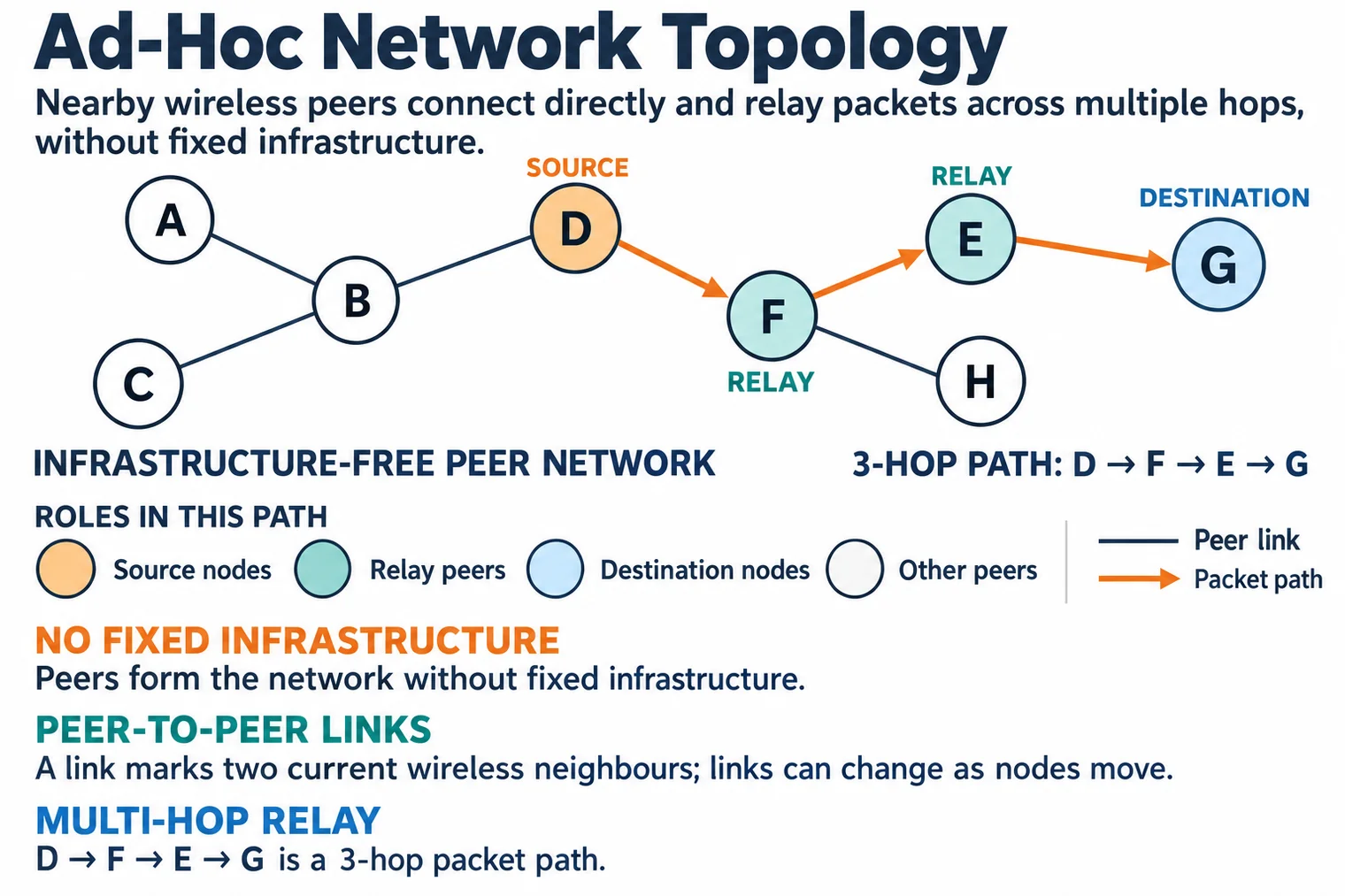
Visual: Ad Hoc Network Schematic
The nodes organize through peer links without a fixed routing authority, so every zone and border decision is derived from changing neighbour relationships.
- Its nearby peers are candidates for proactive intra-zone state; nodes beyond that neighbourhood require a reactive search through border nodes.
- This returns the gallery to the running argument that zone radius must be justified from measured density, mobility, traffic, and control cost rather than fixed by habit.
Major section
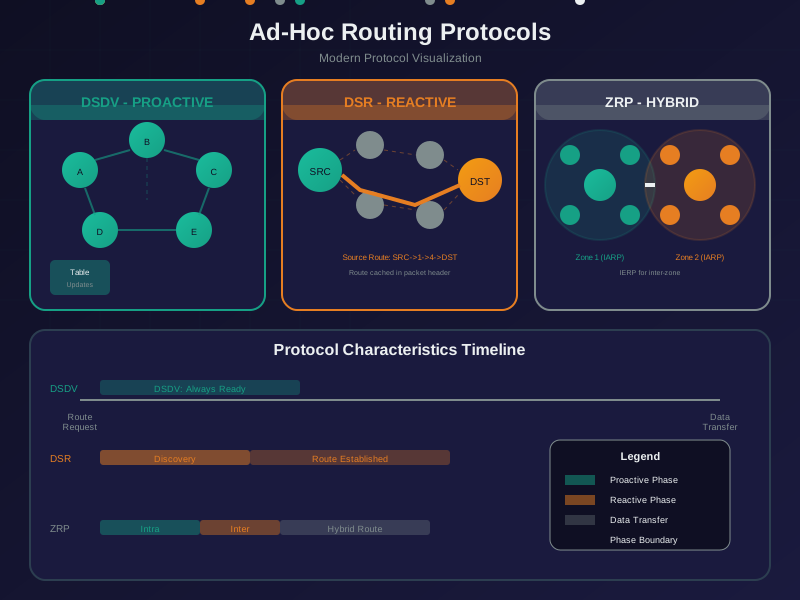
Ad Hoc Routing Protocols
ZRP only makes sense relative to the costs paid by the two routing families it combines.
- The position is a design contract, not a promise of automatic balance; the later sizing record must prove that both halves are doing useful work under the observed topology.
Major section
ZRP Zone Radius for Campus
For this upper-bound illustration only, assume every packet to an out-of-zone destination needs a fresh query; real routes can be reused, so actual query counts may be lower.
- Alternative: If latency were critical (fire alarms), choose ρ=3 despite 3× overhead.
- Key Insight: Optimal zone radius depends on traffic locality pattern.
Major section
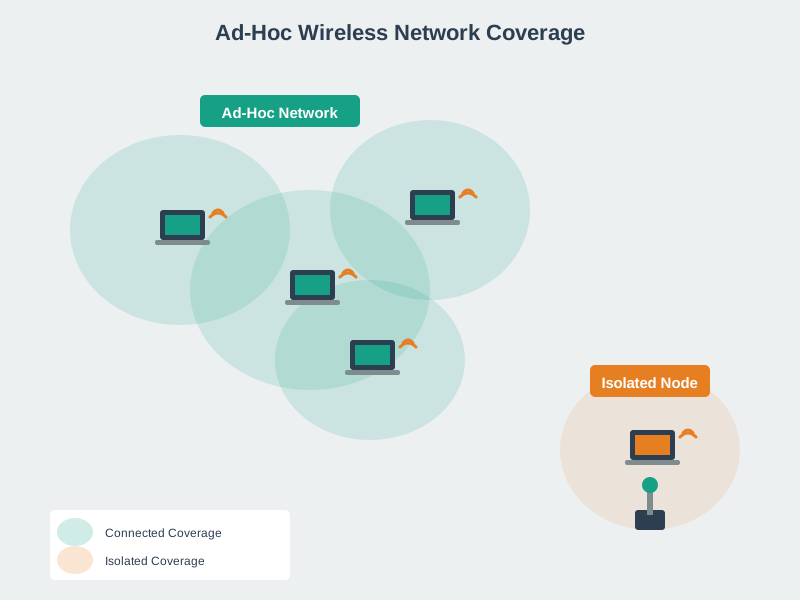
ZRP Zone Radius Selection
Large zone (rho = 4-6): best for 200-1000 nodes only when local traffic is above 80%, network diameter is 4-6 hops, latency must stay below 200 ms, and nodes have enough power budget.
- In this large-zone planner example, it can cover 60-80% of the network, so watch for proactive degeneration.
- Key Insight: Zone radius is not a fixed protocol parameter - it should be dynamically tuned based on observed traffic patterns and network density.
Major section
Overlarge ZRP Zones
If the radius covers almost every destination, IARP is maintaining nearly a complete routing table.
- High periodic control traffic with almost no reactive discoveries is evidence that the hybrid has collapsed toward proactive operation.
- A useful comparison keeps node positions, traffic, radio assumptions, and observation window fixed while changing only the radius.
- Finish with an operating rule that can be monitored after deployment.
Major section
Overlarge ZRP Zones (continued)
Zone size constraint: Zone should cover 30-50% of network.
- Discovery latency may still remain because topology changes and implementations impose work of their own; the presence of three protocol components does not guarantee that their costs balance.
- The exact radius is deployment evidence, not a universal constant; density, mobility, traffic locality, and link asymmetry can all move the useful boundary.
- Reactive traffic target: 20-40% of traffic should require inter-zone discovery.
Major section
Overlarge ZRP Zones (continued)
Re-run the same trace across candidate radii and reject settings that merely transfer too much cost from periodic maintenance into repeated discovery.
- Result: ZRP with oversized zone is strictly worse than DSDV - same overhead, more complexity, more bugs, more maintenance.
- Key Lesson: ZRP's benefit comes from the hybrid behavior - proactive for common local routes, reactive for rare distant routes.
- At that point the reactive half of ZRP has little useful work left, because IERP rarely discovers an inter-zone route and BRP has few meaningful border nodes through which to direct a query.
Major section
Choose ZRP Radius by Performance
The optimal zone radius ρ depends on network density, mobility, and traffic pattern.
- Setting ρ too large causes excessive proactive overhead; ρ too small eliminates the benefit of local pre-computed routes.
Major section
ZRP Zones Change With Mobility
As nodes move, the composition of each node's routing zone changes.
- Nodes entering and leaving zones require updating the IARP routing tables.
- High mobility causes frequent zone membership changes and associated overhead — ZRP performs worst in high-mobility scenarios where zones are unstable.
Major section
3. Not Implementing Bordercast Correctly
ZRP's bordercast reduces flooding by sending inter-zone route requests only to border nodes.
- The bordercast mechanism requires identifying border nodes — nodes at exactly ρ hops from the source.
Deck summary
Key takeaways
A campus route now reaches beyond its local zone, the nearby nodes kept on known routes.
- Low latency for nearby: Proactive routes to local nodes.
- Misconception: Students often believe that increasing zone radius always improves ZRP performance by reducing route discovery overhead.
- The nodes organize through peer links without a fixed routing authority, so every zone and border decision is derived from changing neighbour relationships.
- ZRP only makes sense relative to the costs paid by the two routing families it combines.
Retrieval practice
Recall check 1 of 3

Blueprint Bina says: answer from memory, then check your reasoning.
Q1A sensor network has frequent local traffic and occasional distant messages. Which ZRP feature matches that pattern?
Show answer
Answer: C The chapter presents this combination as a fit for localized communication.
Q2A team enlarges ZRP zones to reduce discovery traffic. Which cost should it expect to review?
Show answer
Answer: C Larger zones maintain more routes and can lose the intended hybrid balance.
Retrieval practice
Recall check 2 of 3
Blueprint Bina says: answer from memory, then check your reasoning.
Q3What perimeter participant hands known in-zone routes to beyond-zone discovery?
Show answer
Answer: D A perimeter node is the controlled handoff between known in-zone routes and beyond-zone discovery.
Q4Complete the ZRP routing decision helper:
Show answer
Answer: A ZRP first uses the proactive IARP table for in-zone destinations.
Retrieval practice
Recall check 3 of 3
Blueprint Bina says: answer from memory, then check your reasoning.
Q5A ZRP trial has high periodic control traffic and almost no inter-zone discovery. What is the sound next radius test?
Show answer
Answer: B Hold the trace fixed and measure whether a smaller zone restores useful hybrid behavior.
Print reference
Answers
Answer key.
- C · The chapter presents this combination as a fit for localized communication.
- C · Larger zones maintain more routes and can lose the intended hybrid balance.
- D · A perimeter node is the controlled handoff between known in-zone routes and beyond-zone discovery.
- A · ZRP first uses the proactive IARP table for in-zone destinations.
- B · Hold the trace fixed and measure whether a smaller zone restores useful hybrid behavior.