Emerging Paradigms · Study deck
Ad-Hoc Multi-Hop Routing
A rescue sensor must send a warning through two battery-powered relays.
Blueprint Bina is your guide for this deck.

After studying this chapter
Learning objectives
Choose a routing family from the warning deadline, traffic pattern, movement, and relay budget.
- Proactive routing can keep paths ready before the warning arrives.Frequent messages in a stable sensor mesh can justify ongoing route updates that reduce repeated discovery delay.
- Reactive routing can defer discovery until the start of a flow.Rare wildlife-tracker events may justify low idle overhead, but movement still demands repair and relay-energy evidence.
- Hybrid routing can maintain local paths and discover distant paths on demand.Common nearby traffic can justify a local zone, while occasional distant flows still pay a discovery cost.
- A routing choice needs delivery and recovery evidence from the field.The rescue warning depends on route freshness, repair time, and relay energy as well as visible radio links.
Major section
Start Simple (1/2)
A visible radio link is only the beginning of a dependable warning path.
- The route’s job depends on its source, destination, relays, and deadline.The rescue sensor needs useful delivery after the storm, so a familiar protocol name cannot settle the design.
- A learned route remains useful only while its state stays valid.A moved relay or fading battery can invalidate the path that carried an earlier warning successfully.
Major section
Start Simple (2/2)
- Movement and restart tests expose weaknesses along the same path.Competing traffic, a removed neighbour, and a restarted gateway test conditions missing from a quiet demonstration.
- Route discovery does not establish final acceptance or a return path.The receiver must accept the warning, and a reply must return before those service claims have evidence.
Major section
Infrastructure-Free Networking (1/2)
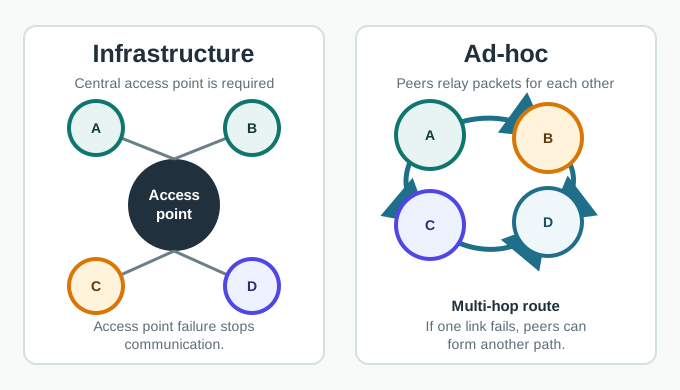
Compare the fixed access point with the peer relay chain, then trace the multi-hop route.
- The infrastructure network needs a central access point.The figure’s first network has a fixed access point that organises communication instead of passing packets along a peer chain.
- The ad-hoc network can forward packets through nearby peers.The other side extends communication beyond one radio hop by making intermediate devices responsible for forwarding.
Major section
Infrastructure-Free Networking (2/2)
- Each intermediate relay is another dependency in the route.The rescue sensor’s apparent reach depends on battery-powered peers remaining available as people move through the field.
- A broken link needs detection and a tested repair response.The route must recover, buffer, retry, or declare failure instead of silently forwarding warnings into stale state.
Major section
Local formation and the gateway exit (1/2)
Local formation and the gateway exit are separate parts of the service.
- Local peers can form a network before an outside connection exists.Discovery and forwarding let field devices exchange data when fixed infrastructure is unavailable during the operating window.
- The gateway exit is a separate handoff to another network.A construction-site reading reaching a nearby relay does not prove delivery through the office gateway to the operator.
Major section
Local formation and the gateway exit (2/2)
- Useful delivery depends on discovery, buffering, forwarding, and repair.A missing path can delay the message beyond its decision window even when local devices still hear one another.
- The application must tolerate delay or loss beyond the mesh.The service claim includes the gateway handoff and degraded-path behaviour rather than ending at the last local relay.
Major section
Traffic and movement shape the routing choice
Write down the operating conditions that make the routing family a reasonable candidate.
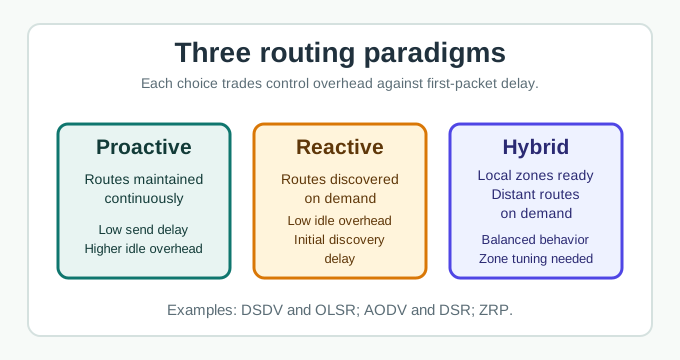
- Frequent traffic in a stable mesh can justify proactive maintenance.Ready routes reduce repeated first-packet discovery when many pairs exchange status messages and links remain stable.
- Sparse mobile traffic makes idle energy and discovery behaviour critical.The wildlife trackers have small batteries and unpredictable movement, so a quiet static route test cannot establish their routing fit.
- Frequent local traffic can justify a hybrid routing zone.Maintaining nearby routes supports local responsiveness while distant flows discover paths when needed, at a real zone-maintenance cost.
- Movement tests reveal relay burden and recovery limits.A route that works once can still fail under weak links, node loss, or traffic bursts in the intended field conditions.
Major section
The first warning’s timing budget
Count route setup before forwarding when judging whether the first warning meets its deadline.
- The trial needs 180 ms to discover the path.The first warning waits for that setup before forwarding begins; the value is a test input, not a protocol constant.
- Three hops at 20 ms each give a 240 ms delivery total.The calculation adds discovery to the measured-style access and forwarding delay for the tested exchange.
- The first warning is 40 ms late against the illustrative deadline.Its 240 ms total exceeds the 200 ms requirement even though the path eventually delivers the message.
- A ready route needs 60 ms under the same forwarding assumptions.Proactive routing can meet this timing example because ongoing route refresh paid the preparation cost before the warning appeared.
Activity 1 · Work it out
✎ Budget the first warning

I want you to spend the deadline on discovery before counting the relay hops.
On paper, add 180 ms of discovery to three hops at 20 ms each. Compare the result with a 200 ms deadline. Repeat with a route already available, then write the continuing cost that keeps a proactive route ready.
3 minutes · Pen and paper · Answer: Activity 1
Major section
Ready routes still need freshness and repair
Keeping routes ready moves the cost earlier; it does not make changing links dependable forever.
- Periodic updates need airtime while the warning application is quiet.Keeping a proactive path ready shifts control work earlier rather than removing its cost from the field network.
- Moving relays can invalidate a route before the next alarm.Ongoing maintenance does not guarantee that the stored next hop remains usable when the warning finally appears.
- A removed relay can reveal detection time and repair traffic.The recovery flood may become the largest load in a quiet network, so the trial counts control transmissions alongside useful data.
- A missed recovery deadline needs a visible unavailable-route state.The rescue team can choose a fallback when delivery failure is reported instead of trusting an unexplained success icon.
Major section
Extra hops and misleading connectivity
Another relay can extend reach while adding delay and another failure dependency.
- A ready four-hop path needs 80 ms in the illustrative trial.The extra hop can bridge a gap while adding a forwarding stage and another relay whose failure affects delivery.
- Stale next-hop state can grow queues while the destination receives nothing.A source may keep placing warnings on a vanished route unless the routing layer detects the break and repairs or exposes failure.
- A neighbour beacon does not establish a returning application reply.Hearing one peer proves neither reverse routing nor acceptance by the receiving service at the end of the warning path.
- Visible delivery failure can help operators select a fallback.The rescue team needs the missing-route state alongside warning cadence, movement, and relay energy when judging the routing choice.
Major section
Summary
Routing families decide when and where the network spends its control effort.
- Proactive maintenance can keep paths ready through recurring control traffic.The illustrative ready route forwards in 60 ms, but movement can still make its stored state stale before an alarm.
- Reactive discovery reduces idle work but adds setup and repair traffic.The trial’s 180 ms discovery makes its first warning late, while a removed relay can trigger a costly repair flood.
- Hybrid zones need enough local traffic to justify maintenance.Nearby routes remain ready while farther destinations use discovery, so the review must count both local upkeep and distant-flow delay.
- Field evidence can connect the routing family to the service requirement.Traffic, mobility, freshness, relay energy, and recovery determine whether the rescue warning arrives usefully rather than merely reaching a relay.
Deck summary
Key takeaways
Judge the route by timely application delivery and visible failure, with relay costs included.
- Multi-hop reach needs shared airtime, energy, and forwarding state.Every additional relay can extend coverage while increasing contention, queues, and the number of devices needed for successful delivery.
- The warning’s delivery budget must include discovery and repair.The first trial needs 240 ms against a 200 ms deadline despite forwarding taking only 60 ms once the route exists.
- Neighbour discovery cannot establish the gateway exit, reply path, or service acceptance.A heard beacon cannot establish reverse routing or confirm that the service received a useful warning.
- Field acceptance includes lost relays, stale routes, movement, and bursts.The rescue network needs tested recovery and visible degradation beyond the conditions of one quiet single-packet demonstration.
Retrieval practice
Recall check 1 of 6
Blueprint Bina says: answer from memory, then check your reasoning.
Q1A small static sensor mesh sends frequent status messages between many pairs of nodes, and some pairs are beyond direct radio reach. Which routing family is the best first candidate?
Show answer
Answer: C Routing family choice starts from traffic and topology evidence, not from protocol popularity.
Retrieval practice
Recall check 2 of 6
Blueprint Bina says: answer from memory, then check your reasoning.
Q2A wildlife tracking network sends rare event packets, nodes move unpredictably, and batteries are small. What should the routing review prioritize?
Show answer
Answer: D Operational routing evidence includes route formation, route repair, relay burden, and field conditions.
Retrieval practice
Recall check 3 of 6
Blueprint Bina says: answer from memory, then check your reasoning.
Q3Why can a routing protocol that looks efficient in a quiet demo fail a real ad-hoc deployment?
Show answer
Answer: D Routing evidence must include the control plane and repair behavior, not only a successful payload path.
Retrieval practice
Recall check 4 of 6
Blueprint Bina says: answer from memory, then check your reasoning.
Q4A field team says its temporary sensor deployment should use an ad-hoc network. Which statement is the strongest evidence that the label fits?
Show answer
Answer: D An ad-hoc network claim should be proven by local formation and forwarding behavior, not by the mere presence of wireless hardware or a dashboard.
Retrieval practice
Recall check 5 of 6
Blueprint Bina says: answer from memory, then check your reasoning.
Q5A construction site has temporary dust and vibration sensors, moving equipment, and one cellular gateway at the site office. What should the design record capture before a routing protocol is selected?
Show answer
Answer: C A useful design record states the operating pressure first so routing choices can be tested against movement, traffic, relay, gateway, and failure evidence.
Retrieval practice
Recall check 6 of 6
Blueprint Bina says: answer from memory, then check your reasoning.
Q6Why can adding more relay hops fail to improve an ad-hoc IoT design?
Show answer
Answer: B Ad-hoc reach is bought with shared wireless resources and route-maintenance work.
Print reference
Answers 1 of 2
Answer key.
- C · Routing family choice starts from traffic and topology evidence, not from protocol popularity.
- D · Operational routing evidence includes route formation, route repair, relay burden, and field conditions.
- D · Routing evidence must include the control plane and repair behavior, not only a successful payload path.
- D · An ad-hoc network claim should be proven by local formation and forwarding behavior, not by the mere presence of wireless hardware or a dashboard.
Print reference
Answers 2 of 2
Answer key.
- C · A useful design record states the operating pressure first so routing choices can be tested against movement, traffic, relay, gateway, and failure evidence.
- B · Ad-hoc reach is bought with shared wireless resources and route-maintenance work.
Print reference
Activity 1 answer
Model answer.
Work it out: 180 ms + 3 × 20 ms = 240 ms, so the first warning is 40 ms late. A ready route needs 60 ms under the same hop assumptions. Proactive routing pays ongoing control traffic to refresh routes; movement still requires freshness and repair checks.