Emerging Paradigms · Study deck

Ad-Hoc Network Applications

Imagine a rescue team entering a valley after the fixed network has failed.

Blueprint Bina is your guide for this deck.

adhocfund
Blueprint Bina, the module guide, in a scene from this chapter.
iotclass.org

After studying this chapter

Learning objectives

You will be able to:

  • Explain: For this ad-hoc network application, a flood cuts power to roadside access points while rescue teams still need to exchange bridge and shelter reports.
  • Explain: In the flood network, a medic’s “bridge closed” alert should favour rapid multi-hop delivery, even if it costs more radio energy.
  • Explain: Under this routing protocol, a sensor archive that can wait until a vehicle passes may use store-carry-forward instead.
  • Explain: The useful job is not "build an ad-hoc network." It is "keep this field action working without fixed support.".
iotclass.org

Major section

Start Simple

Their radios must share location and warning messages through nearby team members.

  • The useful job is not "build an ad-hoc network." It is "keep this field action working without fixed support.".
  • An ad-hoc path can work without fixed equipment, but it is not always connected.
  • The app is the judge of route success.

Key terms

protocol
protocol is a shared set of rules for sending and receiving data.
iotclass.org

Major section

Start Simple (continued)

More relays can add reach while also adding delay, traffic, and battery cost.

  • Under the Hood tests application fit against the actual failure model.
  • A protocol is a shared set of rules for sending and receiving data.
  • Recheck when group size, land shape, radio setting, or message need changes.
iotclass.org

Major section

Choose an Ad-Hoc Path After a Flood

For this ad-hoc network application, a flood cuts power to roadside access points while rescue teams still need to exchange bridge and shelter reports.

  • In the flood network, a medic’s “bridge closed” alert should favour rapid multi-hop delivery, even if it costs more radio energy.
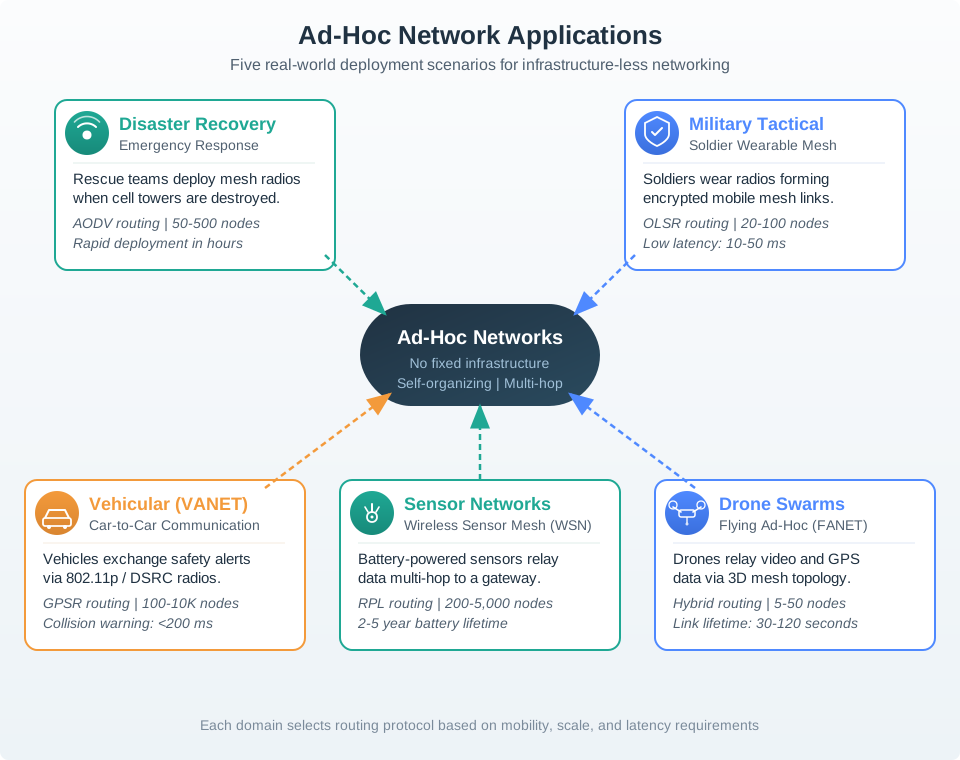
Ad-hoc network application domains including disaster recovery, tactical systems, vehicular networks, sensor networks, and drone swarms.
iotclass.org

Major section

Choose an Ad-Hoc Path After a Flood (continued)

Under this routing protocol, a sensor archive that can wait until a vehicle passes may use store-carry-forward instead.

  • For this ad-hoc network application, the flood map also changes as teams move.
  • An ad-hoc route that worked beside the bridge may vanish behind a hill.
  • The application should mark message age so an old “road open” report cannot look current after delayed delivery.
iotclass.org

Deck summary

Key takeaways

Their radios must share location and warning messages through nearby team members.

  • More relays can add reach while also adding delay, traffic, and battery cost.
  • For this ad-hoc network application, a flood cuts power to roadside access points while rescue teams still need to exchange bridge and shelter reports.
  • Under this routing protocol, a sensor archive that can wait until a vehicle passes may use store-carry-forward instead.
iotclass.org

Retrieval practice

Recall check 1 of 3

Blueprint Bina says: answer from memory, then check your reasoning.

Q1Which deployment is the strongest ad-hoc network candidate?

AA disaster response team that must relay local status messages after normal infrastructure is unavailable.
BA static office building already covered by reliable Ethernet drops and centrally managed Wi-Fi access points.
CA cloud analytics job that processes the previous day's stored sensor data in one batch run every night.
DA single wired sensor installed beside its gateway, with no mobility requirement and no coverage gap to bridge.
Show answer

Answer: A Ad-hoc networks fit applications where local communication must continue without fixed infrastructure.

iotclass.org

Retrieval practice

Recall check 2 of 3

Blueprint Bina says: answer from memory, then check your reasoning.

Q2A farm sensor mesh sends compact readings and must preserve battery life across remote nodes. What should the routing selection record emphasize first?

ASparse reporting, sleep windows, gateway receipt, relay burden, current traces, and behavior when a relay fails.
BContinuous full-table updates from every node, regardless of traffic pattern.
CA vehicle-style safety broadcast plan because all ad-hoc networks are mobile in the same way.
DOnly the diagram label, because protocol behavior does not need field evidence.
Show answer

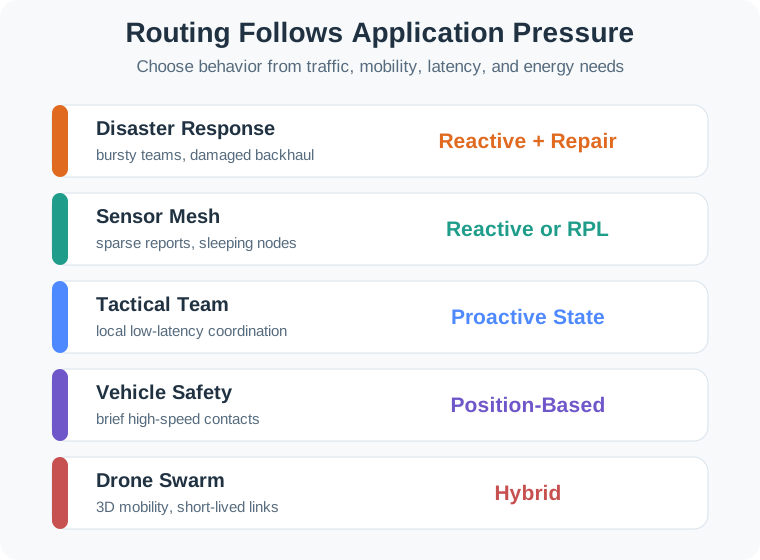
Answer: A Ad-hoc routing selection should follow the application pressure and the evidence the deployment can actually collect.

iotclass.org

Retrieval practice

Recall check 3 of 3

Blueprint Bina says: answer from memory, then check your reasoning.

Q3Why is a degraded-path test important before approving an ad-hoc application design?

AIt proves how the application behaves when relays move, queues fill, partitions occur, or messages arrive stale.
BIt is mainly needed for wired networks, since ad-hoc systems already adapt to failures by rerouting around them automatically.
CPassing it removes the need to define degraded-mode owners and retest triggers before the field pilot.
DOne passing run proves that all future node densities and traffic patterns will behave the same way in the field.
Show answer

Answer: A Ad-hoc applications need proof for expected failure modes, not just a happy-path message transfer.

iotclass.org

Print reference

Answers

Answer key.

  1. A · Ad-hoc networks fit applications where local communication must continue without fixed infrastructure.
  2. A · Ad-hoc routing selection should follow the application pressure and the evidence the deployment can actually collect.
  3. A · Ad-hoc applications need proof for expected failure modes, not just a happy-path message transfer.
iotclass.org