Emerging Paradigms · Study deck

DTN Applications: Missions and Deployment Patterns

This first route compares real disrupted-network missions and decides when delayed delivery is useful rather than a failure.

Blueprint Bina is your guide for this deck.

adhoc
Blueprint Bina, the module guide, in a scene from this chapter.
iotclass.org

After studying this chapter

Learning objectives

You will be able to:

  • Classify DTN Use Cases: Distinguish scenarios where DTN provides unique value over traditional networking
  • Design Rural Connectivity: Apply DTN architectures for developing region connectivity solutions
  • Configure Wildlife Tracking: Implement opportunistic forwarding for animal monitoring deployments
  • Plan Hybrid Architectures: Combine infrastructure and DTN for robust fault-tolerant systems
iotclass.org

Major section

Start Simple

A location record can wait, while a snare alarm may need the first trusted contact.

  • The field lead must decide how long each message may live and how many copies the network may carry.
  • A delayed path is useful only when its limits match the job.
  • This opening does not predict every contact or prove a field schedule.
iotclass.org

Major section

Message in a Bottle Network

"Imagine you live on an island with no phone service," Temperature Terry said, sitting on a beach. "How would you send a message to another island?".

  • Someone on a passing boat might pick it up and carry it closer to your friend's island!".
  • It might take days, but the data eventually reaches the scientists!".
  • the LED lit up green. "And in rural India, buses carry internet messages between villages that have no phone towers.
  • The bus is like the bottle floating between islands -- slow, but it works when nothing else can!".
iotclass.org

Major section

Applications of DTN Routing

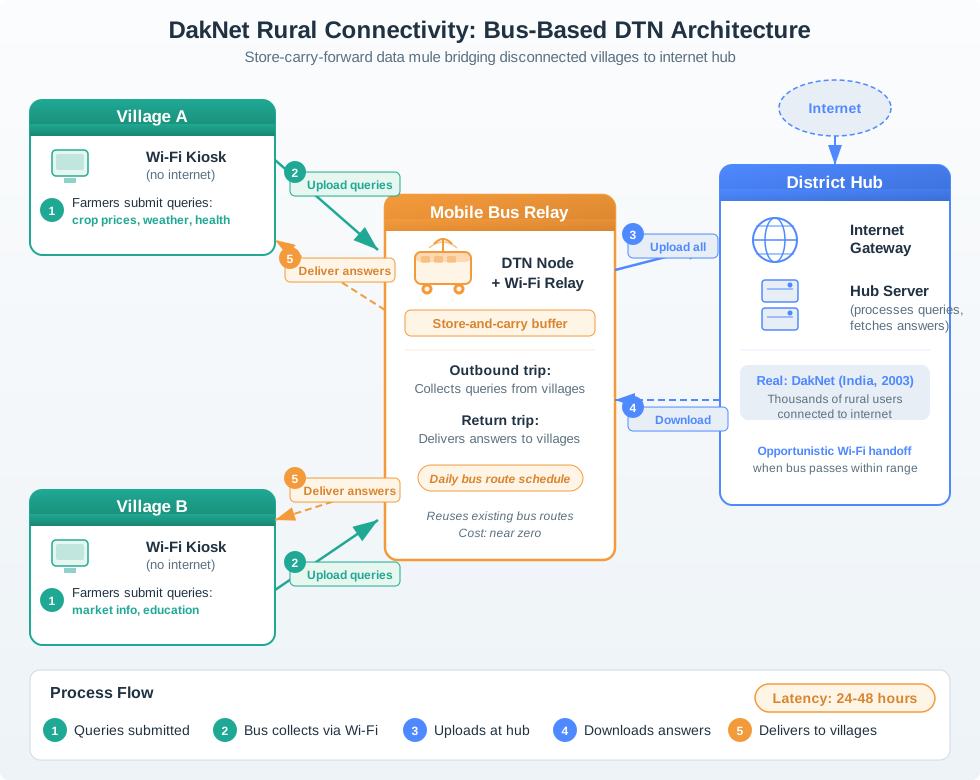
The important feature is that request and response travel in different contact windows; there is never a continuous village-to-internet session.

  • Mobile summary:: A village kiosk stores farmer queries, a scheduled bus collects them over Wi-Fi, the bus syncs at the district hub, and answers return on a later village pass.
  • Soldiers carry handheld DTN nodes.

Key terms

Encounters
Encounters are created by animal movement rather than by a network operator, so a collar cannot assume which peer will next reach a sink.

Why it matters

DTN earns its keep here because waiting is part of the sampling mission.

Rural connectivity DTN architecture showing villages with Wi-Fi kiosks, mobile bus carrier, and hub station with internet gateway.
iotclass.org

Major section

Applications of DTN Routing (continued)
The latency is hours to a day, but the service works without continuous backhaul.

  • The bus then becomes the custodian while physically moving toward the hub.
  • Internet processing happens only after the hub sync, and the reply waits for another bus pass.
  • Villages have Wi-Fi kiosks but no internet.
  • Bus delivers responses on return route.
iotclass.org

Major section

Applications of DTN Routing (continued)

This makes the 24–48 hour service target an application property tied to the timetable, not a packet-level latency claim.

  • Cost: Extremely low (reuses existing bus routes).
  • UAVs provide aerial data mules.
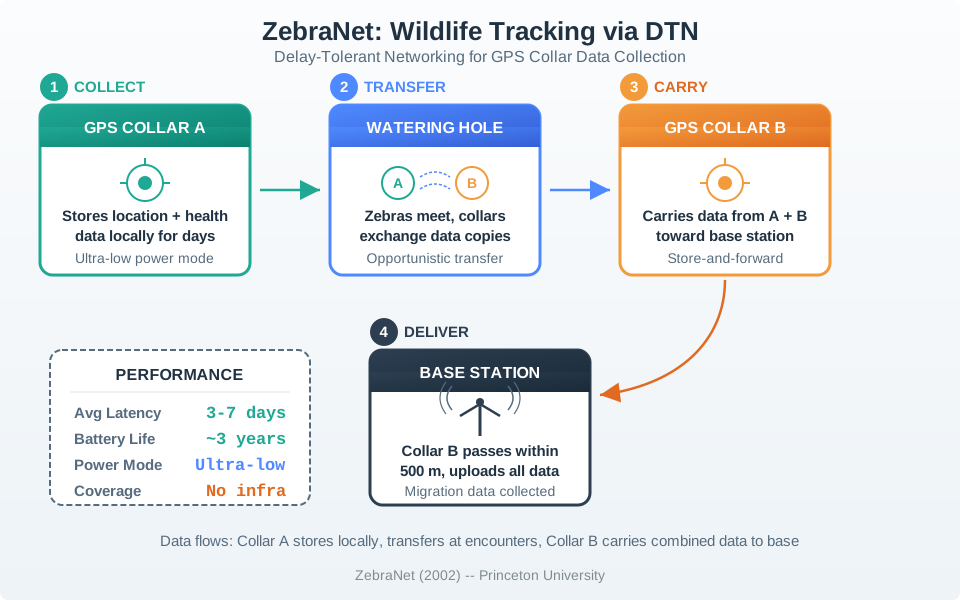
  • Wildlife Tracking Example:: The wildlife figure shows a path assembled from animal encounters.
  • No need to track every animal continuously.
iotclass.org

Major section

Applications of DTN Routing (continued)

Mobile summary:: Each collar stores its own readings, exchanges copies during animal encounters, and uploads the combined backlog when any carrier reaches a base station.

  • The first contact does not deliver the record; it changes which animal can carry it toward a sink.
  • Data eventually reaches base station.
  • The routing lesson is broader than the zebra example.
iotclass.org

Major section

Applications of DTN Routing (continued)

Replication can raise delivery probability, but every extra copy consumes flash, airtime, and battery.

  • Replication improves the chance that some carrier reaches the sink, while copy limits and expiry prevent old observations from consuming every collar's flash and radio budget.
  • Vehicles can be both data sources and mobile carriers.
  • Graceful degradation (DTN fallback if infrastructure fails).
iotclass.org

Major section

Applications of DTN Routing (continued)

The useful routing evidence is route regularity, direction of travel, destination progress, contact duration, and buffer pressure—not simply that two vehicles are close now.

  • Encounters are created by animal movement rather than by a network operator, so a collar cannot assume which peer will next reach a sink.
  • Responders carry DTN nodes.
  • Drones provide aerial relay.
iotclass.org

Major section

Applications of DTN Routing (continued)

The central carrier is not a slower router on a continuous path; it is persistent storage in motion.

  • A field design therefore measures encounter traces, caps replicas, expires stale observations, and gives compact health or location summaries priority over bulky payloads.
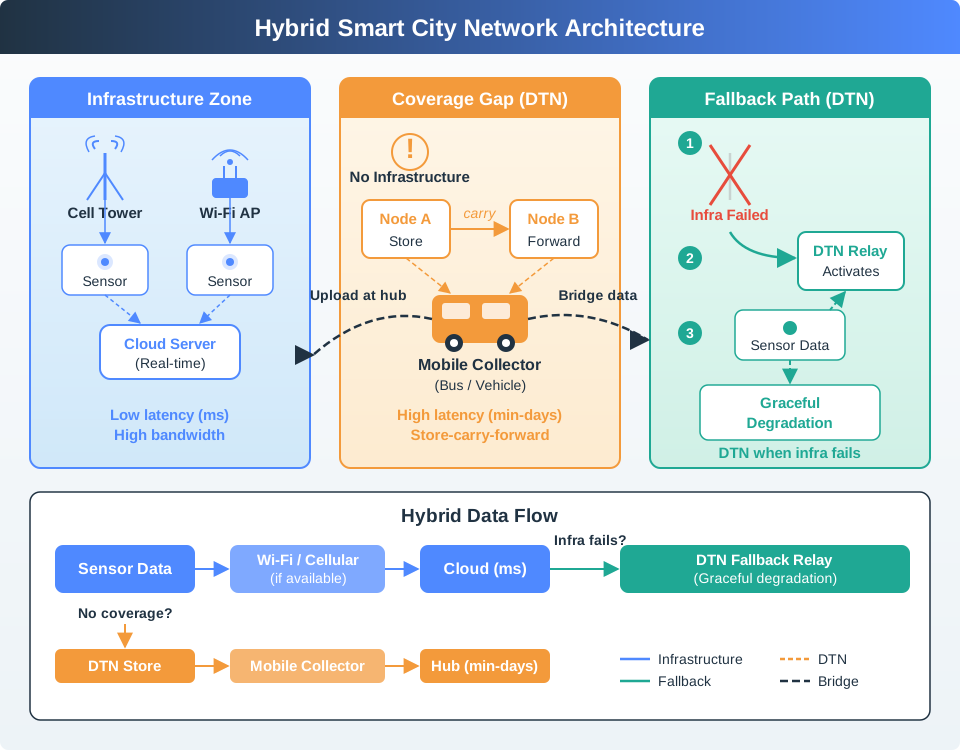
  • Smart City Hybrid:: The hybrid figure separates three operating states.
  • Messages eventually reach command center.
iotclass.org

Major section

Applications of DTN Routing (continued)

The fallback arrow likewise represents a deliberate service downgrade, not instant failover with unchanged latency.

  • Acoustic links propagate slowly, offer limited throughput, and vary with range and water conditions; surfacing or close-range optical and radio contacts provide faster but brief transfer opportunities.
  • A DTN node can keep timestamped observations in persistent storage until an AUV visits, the instrument surfaces, or a gateway contact becomes usable.
  • Light-speed delays: Mars is 4-24 minutes away.
iotclass.org

Major section

Applications of DTN Routing (continued)

Situation reports, shelter inventories, photographs, and family-welfare messages may tolerate delayed carriage by responders or UAVs.

  • A temperature or salinity time series may remain valuable after hours or days, while a closed-loop safety command may not.
  • Space DTN differs from most terrestrial opportunistic networks because many contacts are predicted.
  • The application boundary must be explicit.
iotclass.org

Major section

Applications of DTN Routing (continued)

Routing must distinguish scheduled AUV tours from uncertain drift encounters, reserve storage for the longest credible collection gap, and move small status summaries before raw sonar or imagery when a contact window closes early.

  • Underwater DTN is therefore a data-retrieval architecture, not a promise that an intermittent acoustic link can support real-time control.
  • Buses, service fleets, delivery vehicles, and roadside units meet along partly predictable routes, allowing traffic observations, road-condition reports, map updates, or remote-site telemetry to move between otherwise disconnected islands.
  • Mayday traffic, evacuation commands, and live medical coordination cannot inherit the same assumptions.
iotclass.org

Major section

Applications of DTN Routing (continued)

A bundle may travel in a vehicle for part of a route, transfer during a short roadside contact, and reach a fixed gateway through a later vehicle encounter.

  • Epidemic copying can overwhelm crowded urban fleets; single-copy forwarding can strand a bundle on a vehicle leaving the useful corridor.
  • Bounded-copy or context-aware forwarding is often the practical middle ground, while collision warnings and coordinated driving remain outside the DTN delay budget and require a direct low-latency path.
  • The same payload may change forwarding mode at a zone boundary, so policy must preserve its identity, priority, lifetime, and security across both stacks.
iotclass.org

Major section

Applications of DTN Routing (continued)

Mobile summary:: A hybrid deployment uses Wi-Fi or cellular where coverage exists, DTN mobile collectors where it does not, and fallback DTN paths when the primary infrastructure fails.

  • A sound hybrid design tells the application when it has entered delayed mode and keeps commands that cannot wait off that path.
  • Orbiter passes, ground-station visibility, occultation, and link-rate changes can be represented as a contact plan, so routing can select a path that exists over time rather than flooding copies in hope of an encounter.
  • DTN earns its keep here because waiting is part of the sampling mission.
iotclass.org

Deck summary

Key takeaways

A location record can wait, while a snare alarm may need the first trusted contact.

  • "Imagine you live on an island with no phone service," Temperature Terry said, sitting on a beach. "How would you send a message to another island?".
  • The important feature is that request and response travel in different contact windows; there is never a continuous village-to-internet session.
  • The latency is hours to a day, but the service works without continuous backhaul.
  • This makes the 24–48 hour service target an application property tied to the timetable, not a packet-level latency claim.
iotclass.org

Retrieval practice

Recall check 1 of 3

Blueprint Bina says: answer from memory, then check your reasoning.

Q1In a wildlife tracking DTN, collar A encounters collar B (contact duration 45s). Collar A has 3 messages (each 50 KB) to forward. At 500 Kbps, can all messages be transferred?

AYes
BNo — insufficient contact duration
COnly 2 messages — bandwidth too limited
DYes but requires compression to fit in 45s
Show answer

Answer: A Data size: 3 × 50 KB = 150 KB = 1,200 Kb.

iotclass.org

Retrieval practice

Recall check 2 of 3

Blueprint Bina says: answer from memory, then check your reasoning.

Q2A rural health clinic needs to deliver non-urgent medical test results to village patients. The only transport is a bus that visits twice daily. What is the expected average delivery latency?

AUnder 1 hour -- bus arrives frequently enough
B4-8 hours -- average wait for bus plus travel time
C24-48 hours -- must wait for full round trip
D1 week -- DTN always has very long delays
EWildlife migration tracking with GPS collars
FReal-time video surveillance for security
Show answer

Answer: B

iotclass.org

Retrieval practice

Recall check 3 of 3

Blueprint Bina says: answer from memory, then check your reasoning.

Q3Which of the following applications is LEAST suitable for DTN?

AWildlife migration tracking with GPS collars
BReal-time video surveillance for security
CEnvironmental sensor data collection in remote forests
DDelivering educational content to rural schools
ETo replace all cellular infrastructure for cost savings
FTo provide faster data delivery than Wi-Fi
Show answer

Answer: B

Q4In a hybrid DTN/infrastructure architecture for a smart city, what is the primary purpose of DTN components?

ATo replace all cellular infrastructure for cost savings
BTo provide faster data delivery than Wi-Fi
CTo cover connectivity gaps and provide fallback when infrastructure fails
DTo encrypt data more securely than traditional networks
Show answer

Answer: C

iotclass.org

Print reference

Answers

Answer key.

  1. A · Data size: 3 × 50 KB = 150 KB = 1,200 Kb.
  2. B
  3. B
  4. C
iotclass.org