Emerging Paradigms · Study deck
DTN Applications: Buffers, Contacts, and Field Operations
A mission fits delay-tolerant networking, but the device still has finite storage and only brief contact opportunities.
Blueprint Bina is your guide for this deck.

After studying this chapter
Learning objectives
You will be able to:
- size a DTN buffer from message rate and delay
- calculate whether a contact window can clear queued data
- build a tracking deployment record with explicit failure modes
- Explain: A mission fits delay-tolerant networking, but the device still has finite storage and only brief contact opportunities.
Major section
Start With the Situation
A mission fits delay-tolerant networking, but the device still has finite storage and only brief contact opportunities.
- The team must turn message rate, retention time, link speed, and encounter duration into a design that does not silently drop evidence.
Major section
DTN Buffer Sizing for Tracking
A DTN buffer is shared by locally generated bundles and replicas carried for other nodes.
- That makes fleet average occupancy a dangerous planning number: socially central carriers see more contacts, receive more replicas, and can overflow while quiet nodes remain almost empty.
- A historical SocialCast experiment makes the imbalance concrete.
- The durable lesson is the shape.

Major section
DTN Buffer Sizing for Tracking (continued)
where Qj(t) is its queued bundle set and sm is each stored bundle's size.
- If an experiment reports only binned percentages, form the empirical tail by summing bins above a threshold.
- In the approximate SocialCast bars, roughly one fifth of nodes lie above 15 units, while the no-prediction tail above 15 is only a few percent.
- That difference tells the designer where to inject overload and eviction tests.
Major section
DTN Buffer Sizing for Tracking (continued)
The weights are product policy, not routing truth, so record them and test sensitivity.
- If the 99th percentile rises while the median stays flat, the routing policy is concentrating pressure.
- A fleet mean can look safe while a few social carriers run out of storage. Figure: Per-node DTN buffer occupancy distribution compares social and puts the median, P90, P99, and an 80% overflow gate on the same occupancy scale.
- The median pair in Figure: Per-node DTN buffer occupancy distribution compares social and is modest at 34 and 29, yet the: P99 social-routing bar reaches 96 and crosses the 80% limit.
Major section
ZebraNet GPS Collar Design
Each collar records GPS position, accelerometer activity, and ambient temperature every 5 minutes.
- Each collar may carry data from multiple elephants.
- Total: ~1.75 MB, which fits comfortably in a small flash part.
- Raw-airtime floor: 250 kB × 8 / 250 kbps = 8 seconds; allow setup, frame overhead and retries within the 30-second window.
Major section
Putting Numbers to It
DTN contact windows limit data transfer during brief encounters.
- Raw radio ceiling: elephants meet for 30 seconds and the radio runs at 250 kbps, so 250,000 x 30 / 8 = 937.5 KB before radio framing.
- Margin: a 30-second contact leaves about 22 seconds for setup, handshakes, and retries.
- Payload needed: 5 days of own data is 10 KB/day x 5 = 50 KB, plus about 200 KB of relay data, for 250 kB total.
Major section
Application Selection Guide
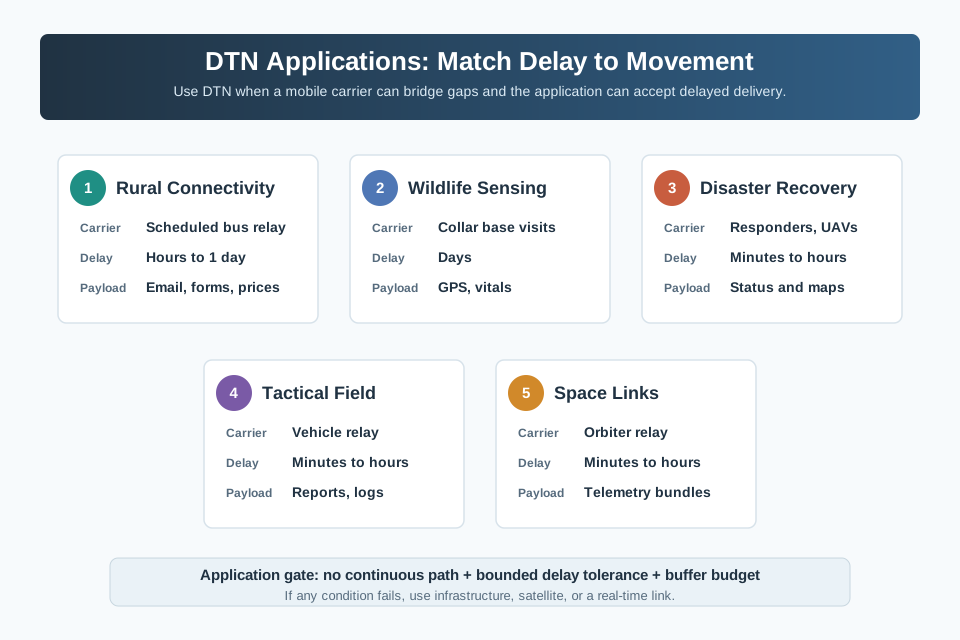
Decision Framework: Delay alone does not select a routing algorithm.
- The deployment must choose against measured contacts, buffer capacity, energy, delivery deadline, and the cost of duplicate traffic.
- Epidemic routing buys reachability with copies; spray-and-wait places a hard replication budget on that trade; predictive and social schemes spend encounter history or context to choose better carriers; contact-plan routing uses known future links.
Major section
Concept Relationships
Rural connectivity uses scheduled buses or other vehicles as data mules to provide village internet access without continuous backhaul.
- Wildlife tracking uses animal encounters and base-station visits for opportunistic data collection.
- Latency tolerance determines whether minutes-to-days delivery delay is acceptable.
- Vehicular carriers use repeated routes and roadside contacts to create paths over time, but cannot safely carry latency-critical driving messages.
Major section
2. Assuming DTN Delivery Is Guaranteed
DTN's store-carry-forward provides best-effort delivery, not guaranteed delivery.
- In extreme partition scenarios with rare contacts, messages may expire before delivery.
- Applications must define maximum tolerable delay (time-to-live) and design for graceful degradation when messages expire undelivered.
Major section
3. Using DTN for Time-Sensitive Alerts
DTN is inherently high-latency.
- Disaster alerts, medical emergencies, or any time-critical information should not rely on DTN's potentially multi-hour delivery delay.
- DTN is appropriate for non-time-sensitive data collection, not real-time alerting.
Major section
4. Ignoring Security in DTN Applications
DTN's store-carry-forward model means messages traverse many intermediate nodes.
- Without end-to-end encryption and authentication, intermediate nodes can read or modify messages.
Major section
Summary
DTN routing is useful when a path can exist over time even though it does not exist end to end at one instant.
- Space DTN uses predicted relay and ground-station contacts, persistent storage, and contact-plan routing across long propagation delays and planned outages.
- The routing family is a resource ladder rather than a delay lookup.
- Rural and remote DTN uses buses, ferries, patrols, or service vehicles to carry non-urgent records between kiosks and connected hubs.
Major section
Summary (continued)
Wildlife tracking uses animal encounters and sink visits to return low-rate science data while tightly budgeting replicas, flash, and battery.
- Disaster response uses responders, vehicles, and UAVs to move reports through damaged infrastructure, while urgent command and safety traffic stays on a separate path.
- Underwater sensing stores observations across weak acoustic links and drains them during AUV visits, surfacing events, or other brief high-capacity contacts.
- Vehicular opportunistic networking exploits repeated routes and roadside encounters for telemetry and content that can wait, not for collision avoidance or coordinated control.
Major section
Key Takeaway
DTN applications should be designed around delayed delivery, local storage, custody decisions, and priority.
- If the mission can tolerate delay, intermittent connectivity becomes a design condition instead of a failure.
Deck summary
Key takeaways
A mission fits delay-tolerant networking, but the device still has finite storage and only brief contact opportunities.
- A DTN buffer is shared by locally generated bundles and replicas carried for other nodes.
- where Qj(t) is its queued bundle set and sm is each stored bundle's size.
- The weights are product policy, not routing truth, so record them and test sensitivity.
- Each collar records GPS position, accelerometer activity, and ambient temperature every 5 minutes.
Retrieval practice
Recall check 1 of 3

Blueprint Bina says: answer from memory, then check your reasoning.
Q1A carrier has 300 kB queued. Its usable link sends 80 kb/s for 20 s. Can this contact clear the queue?
Show answer
Answer: A The usable contact carries only part of the queued data.
Retrieval practice
Recall check 2 of 3
Blueprint Bina says: answer from memory, then check your reasoning.
Q2A collar creates 40 KB of bundles each day and may wait 5 days for upload. Ignoring relay copies and reserve, how much storage does its own backlog need?
Show answer
Answer: A At least 200 KB.
Q3What connected base accepts, deduplicates and acknowledges delivered DTN bundles?
Show answer
Answer: B The connected base accepts, deduplicates, and acknowledges delivered bundles.
Q4Complete the DTN fit check:
Show answer
Answer: A A DTN application must check whether the backlog k fits inside the contact window.
Retrieval practice
Recall check 3 of 3
Blueprint Bina says: answer from memory, then check your reasoning.
Q5A rural clinic wants to use bus-carried DTN for appointment reminders, lab results, and emergency alerts. Which deployment record keeps the design bounded?
Show answer
Answer: C DTN can support delayed clinic data, but emergency traffic needs a direct or higher-priority channel and explicit boundaries.
Print reference
Answers
Answer key.
- A · The usable contact carries only part of the queued data.
- A · At least 200 KB.
- B · The connected base accepts, deduplicates, and acknowledges delivered bundles.
- A · A DTN application must check whether the backlog k fits inside the contact window.
- C · DTN can support delayed clinic data, but emergency traffic needs a direct or higher-priority channel and explicit boundaries.