Emerging Paradigms · Study deck

DSDV Route Updates and Convergence

Picture a relay disappearing while neighboring devices still hold different views of the path.

Blueprint Bina is your guide for this deck.

adhocdsdvoperation
Blueprint Bina, the module guide, in a scene from this chapter.
iotclass.org

After studying this chapter

Learning objectives

You will be able to:

  • Explain: In DSDV Route Updates and Convergence, the first question is not the protocol name; it is which neighbors, routes, failure signals, and degraded behaviors you would trust in the field.
  • Explain: In other words, DSDV operation is a loop of maintaining tables, comparing freshness, invalidating broken state, and measuring whether the update stream stays affordable for the IoT workload.
  • Explain: The update review should therefore name the fields that decide whether a route is installed, ignored, or invalidated, and retain the before-and-after rows as convergence evidence.
  • trace broken-route invalidation and alternate route acceptance
iotclass.org

Major section

Start Simple

Forwarding is safe only after stale information loses to a newer valid route.

  • A protocol means an agreed set of rules for exchanging information.
  • This test covers one small network and change, not every mobile pattern.
  • In DSDV Route Updates and Convergence, the first question is not the protocol name; it is which neighbors, routes, failure signals, and degraded behaviors you would trust in the field.
iotclass.org

Major section

DSDV Updates Before Demand
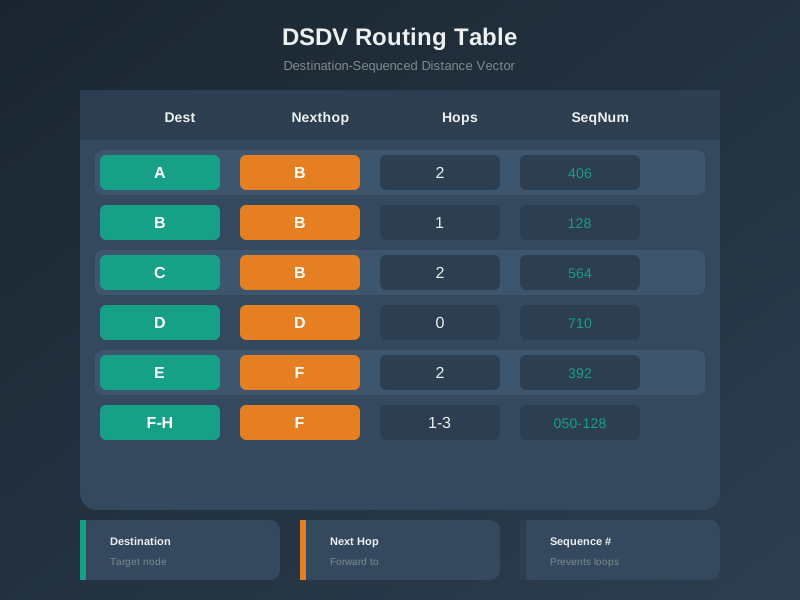
Destination-Sequenced Distance Vector routing keeps a table of next-hop routes at every node.

  • Nodes advertise table entries to neighbors, and neighbors decide whether the advertised route is fresher or better than the route they already hold.
  • Route updates are not a side task.
  • That contract has two rhythms.
  • The route choice itself is staged.

Why it matters

The route is available without an on-demand discovery pause because updates have already distributed reachability and freshness.

DSDV routing concept showing proactive table maintenance across an ad hoc network.
iotclass.org

Major section

DSDV Updates Before Demand (continued)
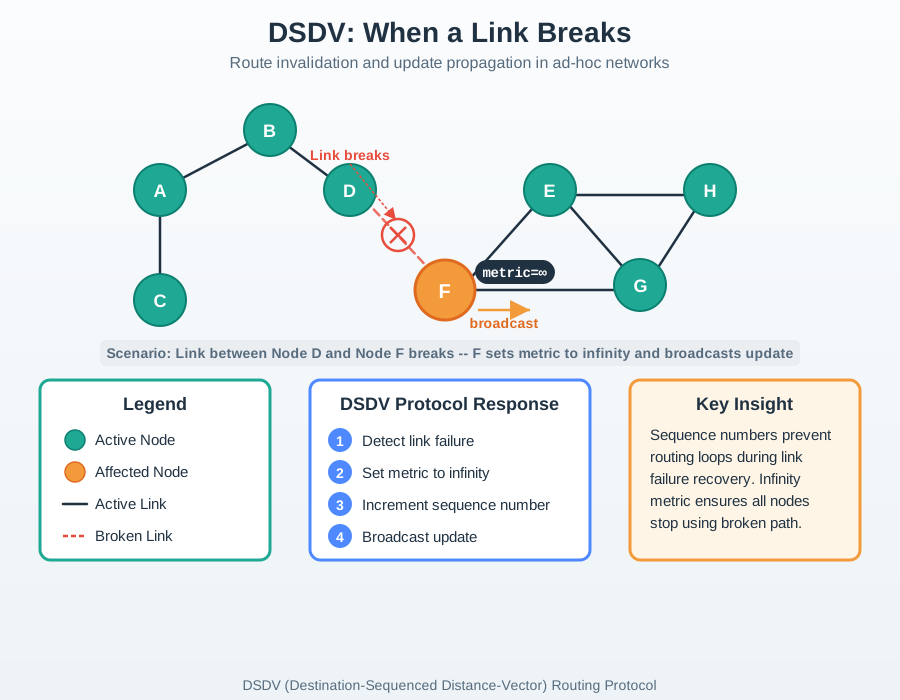
The important operational idea is simple: DSDV pays continuous control overhead so a node can forward immediately when an application packet arrives.

  • Periodic updates give neighbors a regular view of the table, even if no obvious topology change has happened.
  • Triggered updates carry urgent news sooner, such as a broken next hop, a newly learned route, or an invalidation that should displace stale good news.
  • If sequence numbers match, the route with the lower metric wins.
iotclass.org

Major section

DSDV Updates Before Demand (continued)

When a link fails, the affected routes must be advertised as unreachable with newer freshness so neighbors stop forwarding toward the dead next hop.

  • In other words, DSDV operation is a loop of maintaining tables, comparing freshness, invalidating broken state, and measuring whether the update stream stays affordable for the IoT workload.
  • A strong operator trace therefore shows one quiet interval, one triggered change, and the table row before and after each decision.
  • Carry that benefit forward with its cost: the deployment record must show update traffic during both quiet and changing intervals.
iotclass.org

Major section

DSDV Updates Before Demand (continued)

Nodes send routing information on a schedule so neighbors can refresh table state even when no topology event was observed.

  • Important changes, such as a broken next hop or a new fresher route, can be advertised without waiting for the next scheduled update.
  • A detected broken route is advertised with an unreachable metric and a newer sequence value so stale good news is displaced.
  • The route is available without an on-demand discovery pause because updates have already distributed reachability and freshness.
iotclass.org

Major section

Practitioner: Trace the Update Decision

Each step prevents a neighbour from continuing to prefer the dead path.

  • The update review should therefore name the fields that decide whether a route is installed, ignored, or invalidated, and retain the before-and-after rows as convergence evidence.
When a new link appears, DSDV propagates the route outward: node K joins near node A, K advertises itself at metric 0, and each hop away increases the metric by one while the destination sequence number stays fixed.
iotclass.org

Major section

Convergence as State Audit

Under the hood, DSDV convergence is not just the moment one node changes a table row.

  • Wireless loss, hidden terminals, neighbor timeout policy, table size, update suppression, and rapid mobility can all make the observed convergence differ from a simple hop-count story.

Why it matters

Triggered updates can reduce delay, but they do not remove the need to measure propagation.

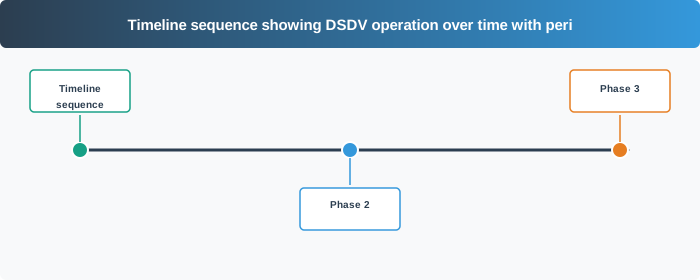
DSDV timing variant showing route advertisement, invalidation, alternate route, and convergence evidence stages.
iotclass.org

Major section

Summary

DSDV maintains route tables proactively so forwarding can use a ready next hop.

  • Periodic updates refresh state, while triggered updates propagate important route changes sooner.
  • Route selection uses destination sequence freshness first, then metric when freshness ties.
  • Broken routes should be invalidated with an unreachable metric and newer freshness so stale routes are displaced.
iotclass.org

Deck summary

Key takeaways

Forwarding is safe only after stale information loses to a newer valid route.

  • Destination-Sequenced Distance Vector routing keeps a table of next-hop routes at every node.
  • The important operational idea is simple: DSDV pays continuous control overhead so a node can forward immediately when an application packet arrives.
  • When a link fails, the affected routes must be advertised as unreachable with newer freshness so neighbors stop forwarding toward the dead next hop.
  • Nodes send routing information on a schedule so neighbors can refresh table state even when no topology event was observed.
iotclass.org

Retrieval practice

Recall check 1 of 3

Blueprint Bina says: answer from memory, then check your reasoning.

Q1What is the core operational trade-off in DSDV?

AIt spends continuous control traffic maintaining route tables so forwarding can use a ready next hop.
BIt avoids route updates until a source packet needs a route.
CIt lets every packet discover its path independently without stored routing state.
DIt removes the need to detect link failures because sequence numbers solve every problem automatically.
Show answer

Answer: A DSDV trades continuous routing-update overhead for immediate table-based forwarding.

iotclass.org

Retrieval practice

Recall check 2 of 3

Blueprint Bina says: answer from memory, then check your reasoning.

Q2A node receives two DSDV advertisements for the same destination. One has an older sequence number but a lower hop count. Which decision is most defensible?

APrefer the newer sequence number first; use hop count only when sequence numbers are equal.
BAlways choose the lower hop count because shorter paths are always safer.
CAlways choose the first advertisement that arrives.
DInstall both routes and forward packets to both neighbors at the same time.
Show answer

Answer: A A DSDV practitioner should prove freshness comparison first and metric comparison second.

iotclass.org

Retrieval practice

Recall check 3 of 3

Blueprint Bina says: answer from memory, then check your reasoning.

Q3Which evidence best supports a claim that DSDV link-break recovery is ready for an IoT field pilot?

AA trace showing neighbor-loss detection, unreachable-route advertisement with newer freshness, stale table removal, alternate-route selection, convergence timing, and control overhead.
BA static topology diagram showing that every node has at least two connected neighbors, proving an alternate forwarding path exists on paper for any single link break in the pilot deployment.
CA forwarding log showing one successful end-to-end delivery, captured shortly after the network had already reconverged from the induced link break.
DThe configured periodic and triggered update settings for the deployment, confirming the intervals are short enough that any break must heal within one cycle.
Show answer

Answer: A Under-the-hood DSDV review treats convergence as an evidence trail across detection, invalidation, alternate selection, and overhead.

iotclass.org

Print reference

Answers

Answer key.

  1. A · DSDV trades continuous routing-update overhead for immediate table-based forwarding.
  2. A · A DSDV practitioner should prove freshness comparison first and metric comparison second.
  3. A · Under-the-hood DSDV review treats convergence as an evidence trail across detection, invalidation, alternate selection, and overhead.
iotclass.org