Emerging Paradigms · Study deck
DSDV Proactive Routing
Picture a rescue node that forwards immediately but uses yesterday's next hop after the team moves.
Blueprint Bina is your guide for this deck.

After studying this chapter
Learning objectives
You will be able to:
- Explain: If a two-hop route has an older destination sequence number than a three-hop route, the two-hop path may simply be a stale story about a topology that no longer exists.
- Explain: The destination normally advances its own sequence number for valid routes, and broken routes are advertised with a newer sequence number and an infinite metric so neighbors stop using the old path.
- Explain: The comparison 42>40 shows why a newer advertisement wins even when an older path might look shorter; hop count breaks ties only within the same freshness generation.
Major section
Start With a Route Table That Is Ready Before Demand
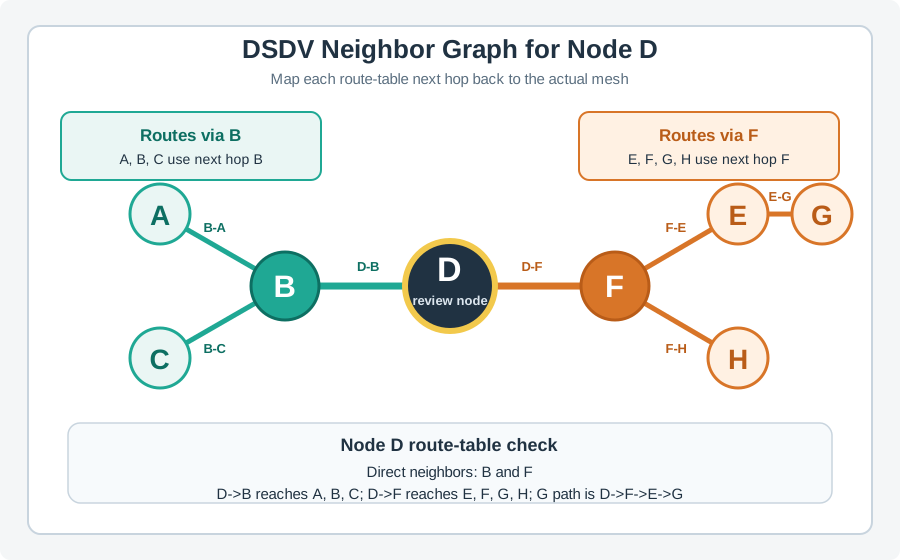
DSDV tells the network to keep routes ready before a packet asks for them.
- Each node maintains destination entries, sequence numbers, and next hops so forwarding can happen quickly when data arrives.
- That promise is useful only when the cost of constant upkeep fits the IoT deployment.
- The sequence-number story is the heart of DSDV.
Major section
In 60 Seconds
Destination-Sequenced Distance Vector (DSDV) is a proactive ad-hoc routing protocol.
- It keeps route tables ready before traffic arrives, so forwarding can begin with a table lookup instead of an on-demand route discovery flood.
- The benefit is low first-packet delay.
- The cost is ongoing table maintenance, route advertisements, receive time, memory, and convergence work after topology changes.
Major section
DSDV Updates for Ready Routes
When an application has a packet to send, the node can forward immediately from the table instead of first flooding a route discovery request.
- That ready-route behavior is useful only when the network can afford the maintenance cost.
- The practical question is whether the saved route-discovery delay is visible to the service.
- A sleepy star-like telemetry estate usually does not.
Major section
DSDV Updates for Ready Routes (continued)
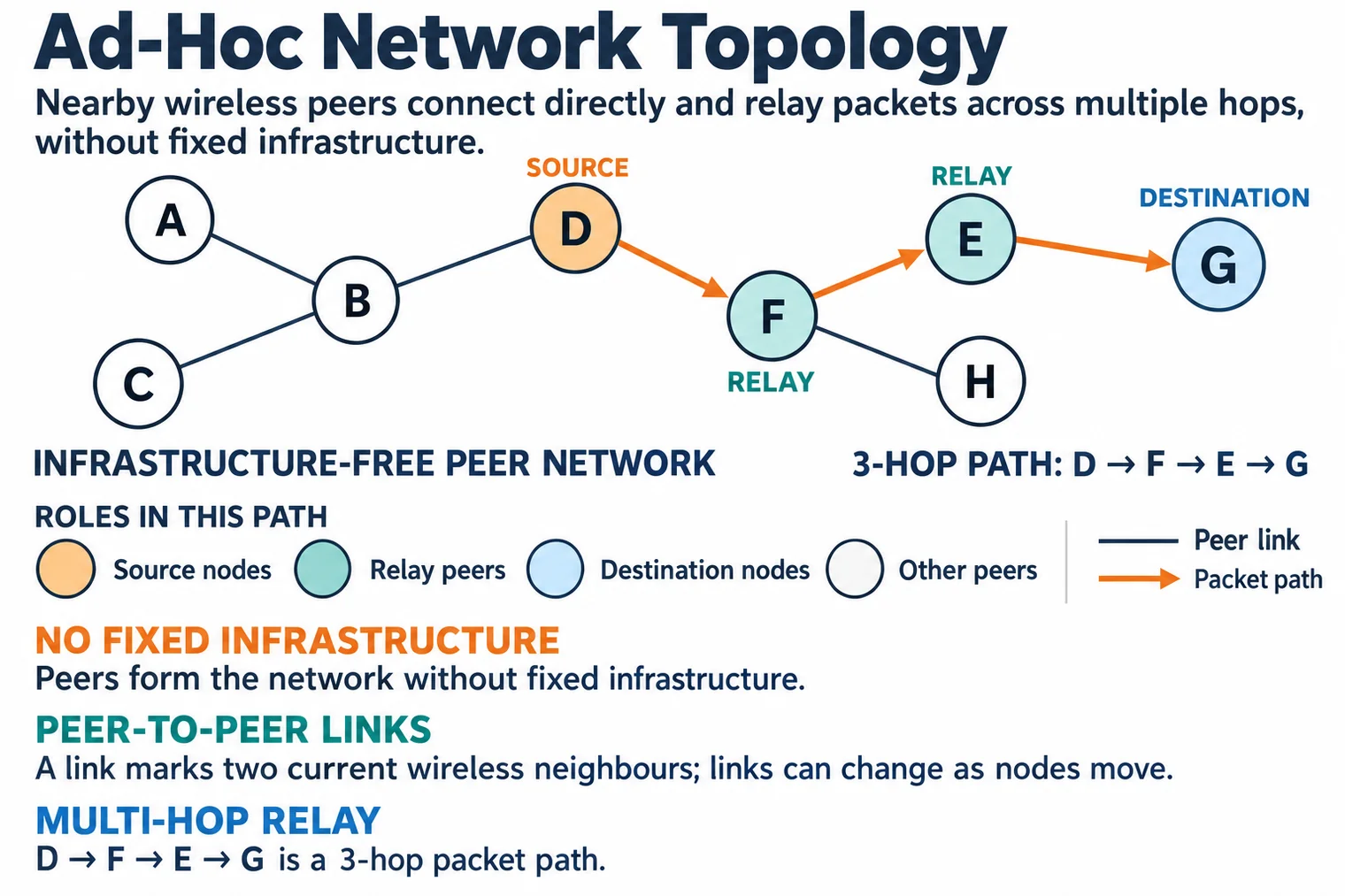
DSDV assumes an infrastructure-free mesh where neighbors can relay for each other.
- DSDV is easiest to defend in relatively stable ad-hoc IoT networks where many nodes communicate often enough that low route-lookup delay matters.
- Forwarding starts with a table lookup.
- Higher destination sequence numbers win before hop count is considered.
Major section
DSDV Updates for Ready Routes (continued)
Nodes exchange route information even when the application is quiet, so control traffic competes with useful data and listening time.
- A mobile robot team exchanging coordination messages, a temporary field mesh with awake relays, or a warehouse cart network may benefit from immediate forwarding.
- This reduces first-packet delay compared with protocols that discover a path on demand.
- A fresh longer path is safer than a stale shorter path.
Major section
DSDV Route-Freshness Contract
A DSDV design review should not stop at "the table has a path." The review has to prove that each node can maintain fresh enough route state for the service.
- This makes the review concrete enough to compare against DSR, AODV-style discovery, a static route set, or a gateway tree.
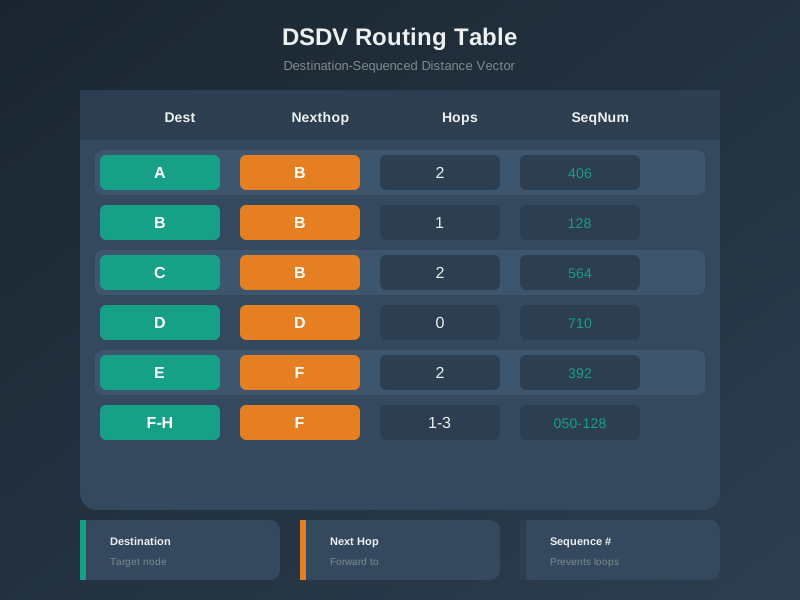
- A route review should map table entries back to the actual neighbor graph, not just to protocol labels.
- Hop count estimates distance, but the destination sequence number records freshness.
Major section
DSDV Route-Freshness Contract (continued)
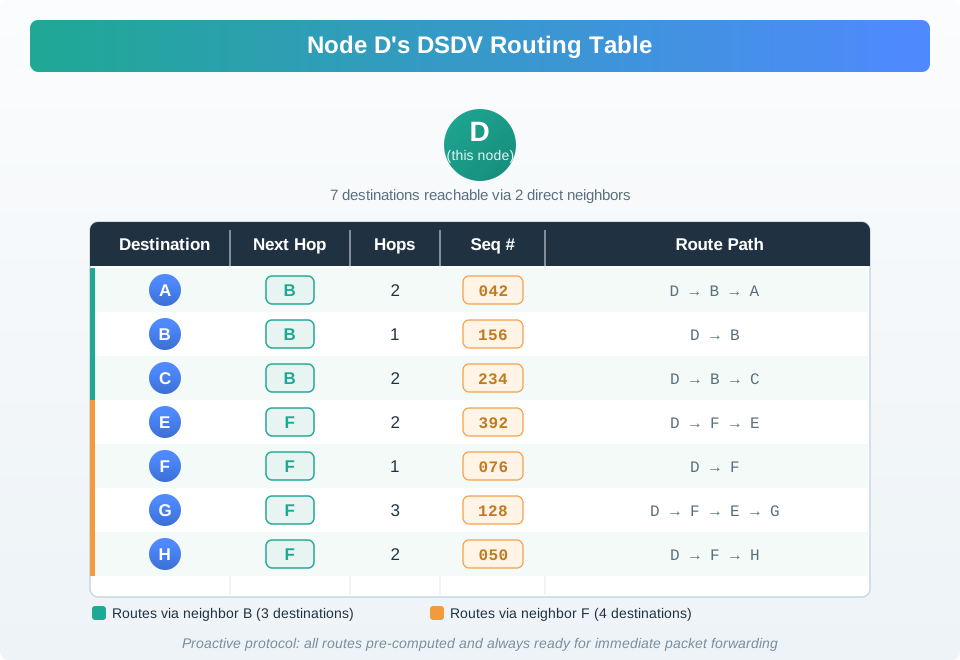
Destinations A and B forward through B, while E and G use F, so the table turns a multi-hop topology into one immediate action per destination.
- The comparison 42>40 shows why a newer advertisement wins even when an older path might look shorter; hop count breaks ties only within the same freshness generation.
- This ordering prevents a stale route from displacing current knowledge after movement.
- The table therefore supports DSDV's operating bargain: forwarding is immediately available, provided periodic updates keep sequence state current and invalid routes are withdrawn.
Major section
DSDV Sequence Numbers
Classic distance-vector routing can form loops when neighbors advertise outdated reachability after a link fails.
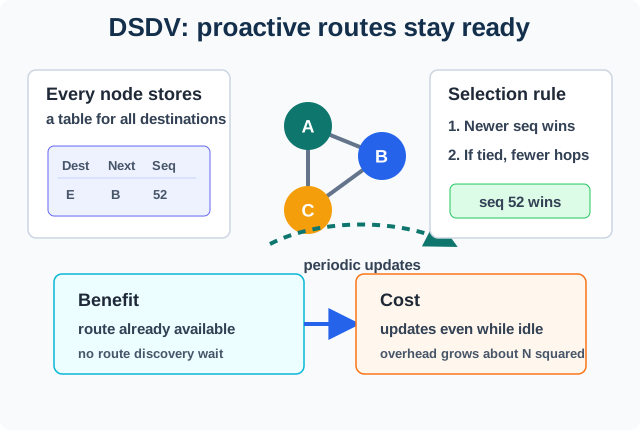
- DSDV adds destination sequence numbers so nodes can identify which advertisement is newer.
- The update stream has two parts.
- Periodic updates keep the table synchronized during normal operation.
- Triggered updates spread important changes faster when a link fails or a route becomes unavailable.
Major section
DSDV Sequence Numbers (continued)
The destination normally advances its own sequence number for valid routes, and broken routes are advertised with a newer sequence number and an infinite metric so neighbors stop using the old path.
- Some implementations also damp updates so brief instability does not create repeated oscillation.
- These mechanisms improve correctness, but they do not remove the basic cost: every node stores and advertises route state for many destinations.
- The subtle point is that freshness and distance are separate decisions.
Major section
DSDV Sequence Numbers (continued)
A lower hop count is attractive only after the sequence number says the route information belongs to the same freshness generation.
- If a two-hop route has an older destination sequence number than a three-hop route, the two-hop path may simply be a stale story about a topology that no longer exists.
- The cost of that safety is propagation discipline.
- Failure recovery depends on how quickly newer route information replaces stale entries.
Major section
DSDV Sequence Numbers (continued)
A failure has to be detected, converted into an unreachable metric with newer freshness information, and carried far enough that neighbors stop preferring old good news.
- If a two-hop route has an older destination sequence number than a three-hop route, the two-hop path may simply be a stale story about a topology that no longer exists.
- Under-the-hood testing therefore watches sequence numbers, invalidation messages, and selected next hops over time, not just the final path after the network has settled.
- This explains why data forwarding is simple after convergence while the control plane must keep paying to refresh and invalidate route state.
Major section
Summary
The trade-off is continuous maintenance.
- DSDV is a proactive distance-vector protocol for ad-hoc networks.
- It keeps route tables ready at each node, so forwarding can begin with a lookup instead of on-demand discovery.
- Periodic and triggered updates consume airtime, energy, memory, and attention from relay nodes.
Deck summary
Key takeaways
DSDV tells the network to keep routes ready before a packet asks for them.
- Destination-Sequenced Distance Vector (DSDV) is a proactive ad-hoc routing protocol.
- When an application has a packet to send, the node can forward immediately from the table instead of first flooding a route discovery request.
- DSDV assumes an infrastructure-free mesh where neighbors can relay for each other.
- Nodes exchange route information even when the application is quiet, so control traffic competes with useful data and listening time.
Retrieval practice
Recall check 1 of 3

Blueprint Bina says: answer from memory, then check your reasoning.
Q1Which deployment is the strongest first candidate for DSDV?
Show answer
Answer: A DSDV fits best when ready routes are valuable and the network can afford ongoing route maintenance.
Retrieval practice
Recall check 2 of 3
Blueprint Bina says: answer from memory, then check your reasoning.
Q2Node A has two DSDV routes to destination D: route 1 has sequence 42 and 3 hops, while route 2 has sequence 40 and 2 hops. Which route should be installed?
Show answer
Answer: B DSDV's route-selection rule is freshness first, hop count second.
Retrieval practice
Recall check 3 of 3
Blueprint Bina says: answer from memory, then check your reasoning.
Q3During a DSDV fault drill, a node loses the next hop for several destinations. What evidence best shows that the protocol handled the failure correctly?
Show answer
Answer: A DSDV recovery evidence should show newer failure information, stale-route suppression, and acceptable convergence to an alternative when the topology allows one.
Print reference
Answers
Answer key.
- A · DSDV fits best when ready routes are valuable and the network can afford ongoing route maintenance.
- B · DSDV's route-selection rule is freshness first, hop count second.
- A · DSDV recovery evidence should show newer failure information, stale-route suppression, and acceptable convergence to an alternative when the topology allows one.