Emerging Paradigms · Study deck
DSDV Cost and Scalability
A protocol is a set of rules for exchanging data.
Blueprint Bina is your guide for this deck.

After studying this chapter
Learning objectives
You will be able to:
- Explain: The pass condition is that stale forwarding stops before the application violates its latency, loss, safety, or energy budget, and that the control plane returns to a stable update rate after the disturbance.
- Explain: A defensible DSDV fit statement names the traffic pattern, node wake behavior, expected movement or link instability, and the alternative that would be tried if control traffic dominates payload traffic.
- Explain: Incremental updates reduce the size of each advertisement, but nodes still need enough state to decide which entries changed and enough receive time to hear neighbors' changes.
- Explain: Several costs grow together.
Major section
Start Simple
Ready paths can reduce delay, but every robot must spend radio time and energy keeping those paths fresh.
- Pay for Ready Routes Only When They Are Used: A protocol is a set of rules for exchanging data.
- A payload is the useful data carried inside a message.
- One route table cannot prove the whole network will scale.
Major section
Minimum Viable Understanding
Ready routes have recurring cost: periodic, incremental, and triggered updates consume resources even when payload traffic is quiet.
- Good fit means used routes: proactive tables are easiest to justify when many devices communicate often enough to use the maintained state.
- Poor fit means wasted upkeep: sleepy sensors and sparse gateway reports often pay for entries they rarely need.
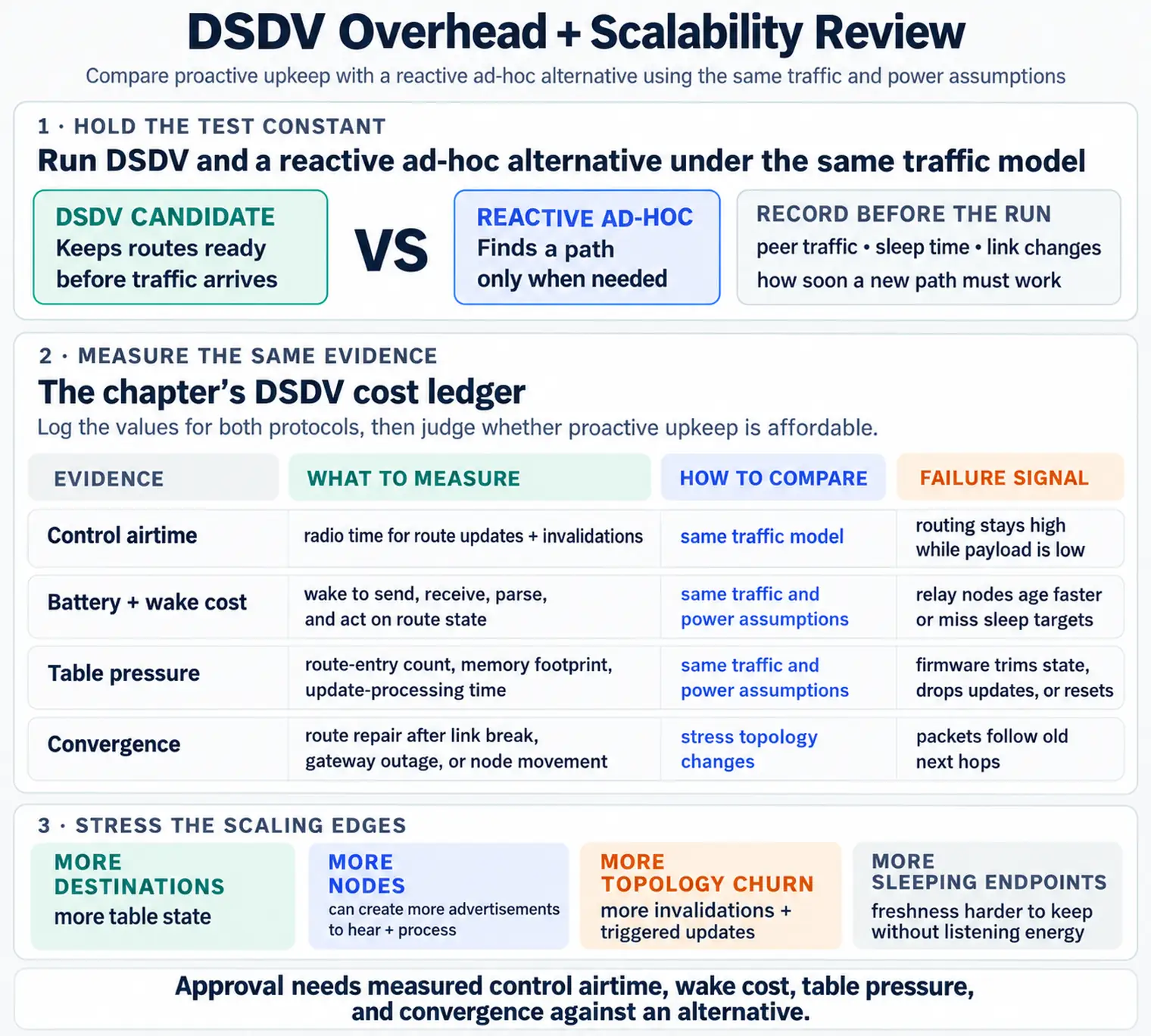
- Approval needs evidence: control airtime, battery wake cost, table pressure, and convergence behavior must be measured against an alternative.
Major section
Fast DSDV, Constant Upkeep
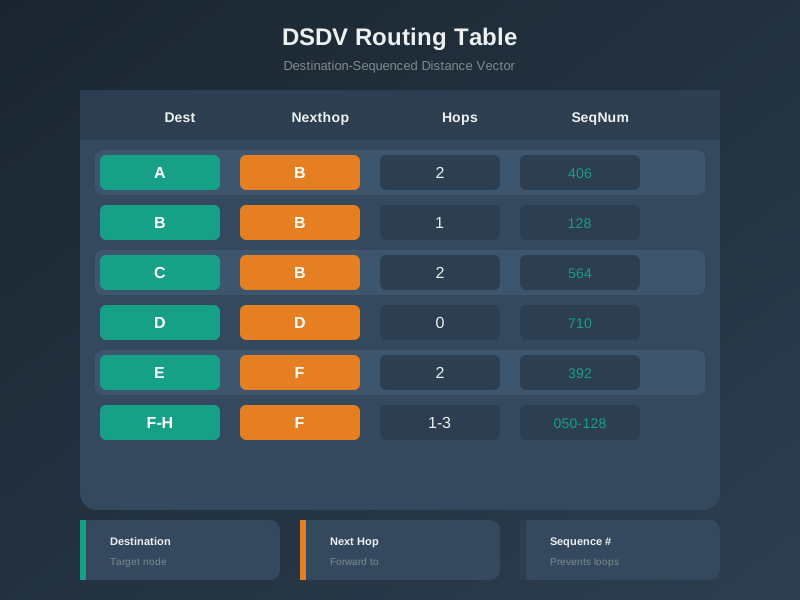
Destination-Sequenced Distance Vector (DSDV) is proactive routing.
- Each node keeps routes ready before an application packet arrives.
- The cost is continuous maintenance.
- Nodes advertise route knowledge, receive neighbor updates, compare sequence numbers, and keep table entries for destinations that may not be used soon.
- A useful evaluation starts by separating the application benefit from the routing upkeep.
Major section
Fast DSDV, Constant Upkeep (continued)
In an IoT ad-hoc network, that maintenance consumes airtime, memory, processing, and battery budget even when application traffic is quiet.
- If the application is a mobile robot team, a warehouse cart mesh, or a field gateway cluster where peers exchange state frequently, immediate next-hop lookup can remove a visible delay from each transaction.
- If the application is a sleepy environmental monitor that reports to one gateway every few minutes, most route entries are maintained for flows that rarely happen.
- DSDV also has more than one kind of upkeep: scheduled table refreshes, smaller incremental changes, and triggered updates after a route becomes invalid.
Major section
Fast DSDV, Constant Upkeep (continued)
Each one has to fit the same radio duty-cycle and energy envelope as the sensing workload.
- The first-pass decision is therefore not "proactive or reactive" in the abstract.
- A defensible DSDV fit statement names the traffic pattern, node wake behavior, expected movement or link instability, and the alternative that would be tried if control traffic dominates payload traffic.
- If the application is a mobile robot team, a warehouse cart mesh, or a field gateway cluster where peers exchange state frequently, immediate next-hop lookup can remove a visible delay from each transaction.
Major section
Practitioner: Build a DSDV Cost Review
A DSDV review should not stop at "routes are ready." It should prove that the deployed network can afford the upkeep.
- A practical DSDV review treats table size and update churn as deployment costs, not just protocol details.
Major section
Scaling Fails Through Coupled Costs
DSDV scalability is not a single number.
- Several costs grow together.
- More destinations increase table state.
- More nodes can create more advertisements to hear and process.
- More sleeping endpoints make route freshness harder to maintain without spending energy on listening windows.
Major section
Scaling Fails Through Coupled Costs (continued)
Sequence numbers are the safety mechanism that keeps stale routes from winning.
- Longer update intervals save airtime and battery, but they leave more time for a broken next hop to remain attractive.
- The pass condition is that stale forwarding stops before the application violates its latency, loss, safety, or energy budget, and that the control plane returns to a stable update rate after the disturbance.
- The pass condition is not instant convergence.
Major section
Scaling Fails Through Coupled Costs (continued)
Triggered updates help after important changes, yet a noisy link can turn them into repeated repair traffic.
- Incremental updates reduce the size of each advertisement, but nodes still need enough state to decide which entries changed and enough receive time to hear neighbors' changes.
- That coupling is why a DSDV evaluation should include a churn test, not just a steady-state table dump.
- The pass condition is that stale forwarding stops before the application violates its latency, loss, safety, or energy budget, and that the control plane returns to a stable update rate after the disturbance.
Deck summary
Key takeaways
Ready paths can reduce delay, but every robot must spend radio time and energy keeping those paths fresh.
- Ready routes have recurring cost: periodic, incremental, and triggered updates consume resources even when payload traffic is quiet.
- Destination-Sequenced Distance Vector (DSDV) is proactive routing.
- In an IoT ad-hoc network, that maintenance consumes airtime, memory, processing, and battery budget even when application traffic is quiet.
- Each one has to fit the same radio duty-cycle and energy envelope as the sensing workload.
Retrieval practice
Recall check 1 of 4

Blueprint Bina says: answer from memory, then check your reasoning.
Q1A route update occupies the shared radio for 20 ms and is sent every 2 s. What share of radio time does that one stream consume?
Show answer
Answer: C One percent of radio time.
Retrieval practice
Recall check 2 of 4
Blueprint Bina says: answer from memory, then check your reasoning.
Q2Which deployment is the strongest first-pass fit for DSDV?
Show answer
Answer: B DSDV trades continuous control overhead for route availability.
Retrieval practice
Recall check 3 of 4
Blueprint Bina says: answer from memory, then check your reasoning.
Q3A team proposes DSDV because route discovery delay is undesirable. What evidence should the reviewer request before approval?
Show answer
Answer: B A DSDV cost review should prove the upkeep budget and compare it with the traffic pattern.
Retrieval practice
Recall check 4 of 4
Blueprint Bina says: answer from memory, then check your reasoning.
Q4Why can a shorter DSDV route be rejected in favor of a longer route?
Show answer
Answer: A DSDV sequence numbers are the core loop-avoidance and freshness mechanism.
Print reference
Answers
Answer key.
- C · One percent of radio time.
- B · DSDV trades continuous control overhead for route availability.
- B · A DSDV cost review should prove the upkeep budget and compare it with the traffic pattern.
- A · DSDV sequence numbers are the core loop-avoidance and freshness mechanism.