Actuators & Control · Study deck
Stepper Motors: Precision and Reliability
The motor follows a planned move on the bench, but open-loop motion can still lose position under load.
Motor Max is your guide for this deck.

After studying this chapter
Learning objectives
You will be able to:
- measure stepper precision and missed steps
- evaluate torque and resolution margins
- record reliability and recovery evidence
- Explain: Energize its coils in the right sequence and the rotor snaps to the next aligned position; do it repeatedly and the shaft advances one precise increment per pulse.
Major section
Deep Dive: Step Counts, Torque Margin, and Missed Steps
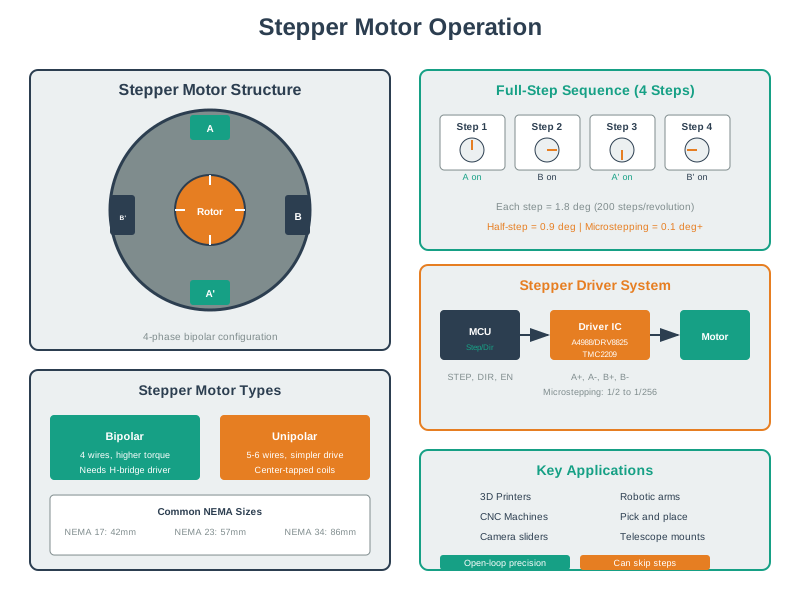
Energize its coils in the right sequence and the rotor snaps to the next aligned position; do it repeatedly and the shaft advances one precise increment per pulse.
- A common motor has a 1.8-degree step angle, which is exactly 200 steps per revolution.
- Microstepping makes the command grid finer.
Major section
Deep Dive: Step Counts, Torque Margin, and Missed Steps (continued)
Acceleration and deceleration add time, so a real profile may be closer to 5 s.
- Counted commands estimate angular motion only while current, acceleration, and load leave enough torque for every alignment step to occur.
- That counted motion is why steppers are useful for open-loop positioning.
- Sizing starts from travel.
Major section
Deep Dive: Step Counts, Torque Margin, and Missed Steps (continued)
If a controller commands 400 steps on a 200-step motor, the shaft should move 400 / 200 = 2 revolutions.
- On a 2 mm-pitch lead screw, that becomes 2 rev x 2 mm/rev = 4 mm of carriage travel.
- The calculation is simple, but it is only true while the motor has enough torque margin to follow every commanded step.
- The screw needs 18 / 1.5 = 12 revolutions.
Major section
Deep Dive: Step Counts, Torque Margin, and Missed Steps (continued)
Detent torque is the small residual holding you feel when the motor is unpowered, from the permanent-magnet rotor.
- At 1/16 microstepping, a 200-step motor has 200 x 16 = 3200 commanded microsteps per revolution.
- On the same 2 mm lead screw, one microstep is 2 mm / 3200 = 0.000625 mm, or 0.625 micrometers.
- Torque drops as speed rises, which is why steppers need acceleration ramps.
Major section
Deep Dive: Step Counts, Torque Margin, and Missed Steps (continued)
With a 200-step motor at 1/8 microstepping, each revolution is 200 x 8 = 1600 microsteps, so the move is 12 x 1600 = 19200 step pulses.
- If an axis is told to move 10,000 microsteps and it misses 80 during a fast acceleration, the controller still believes the target was reached.
- Holding torque is how hard an energized stepper resists being turned off its commanded position; it clamps the load in place with no motion, which a basic DC motor cannot do by itself.
- Because there is no built-in position measurement, every assumption depends on torque margin.
Major section
Deep Dive: Step Counts, Torque Margin, and Missed Steps (continued)
Microstepping gives smooth, fine motion, but the incremental torque per microstep is small, so microsteps improve smoothness and command resolution far more than they improve absolute positioning accuracy.
- If the controller can issue 4800 pulses/s after ramp-up, the constant-speed portion alone takes about 19200 / 4800 = 4 s.
- If the phase current limit is 1.2 A and the winding resistance is 2.4 ohm, copper heating in one energized phase is I^2R = 1.2^2 x 2.4 = 3.46 W.
- At 200 steps/s, one step interval is 5 ms, or 2.5 time constants.
Major section
Deep Dive: Step Counts, Torque Margin, and Missed Steps (continued)
With two phases active, the motor can dissipate roughly twice that, so thermal rise is a design constraint even while the shaft is stationary.
- Reducing hold current after a move can save heat, but only if the load cannot back-drive the axis.
- A phase winding is inductive, so at higher step rates there is less time for current to reach the requested value.
- If a phase has L = 4 mH and R = 2 ohm, its electrical time constant is L / R = 0.004 / 2 = 0.002 s, or 2 ms.
Major section
For Kids: Meet the Actuator Crew!
"It's like running," the battery added. "You can't sprint from a standstill -- you have to accelerate gradually.
- "Why do you move in little ticks instead of spinning smoothly like DC Danny?" asked the LED.
- "But I have a weakness," Stella admitted. "If something pushes against me too hard while I'm stepping, I can miss a step.
- My count will be off from then on.".
Major section
Try It Yourself: Stepper Speed vs. Torque Trade-Off
At high speed, the rotor can't keep up with the magnetic field switching -- missed steps occur.
- No acceleration means trying to go from 0 to full speed instantly -- rotor has too much inertia.
- Gradual acceleration lets the rotor keep pace with the field.
- Hint:: For maximum torque, keep speeds under 300 RPM for 28BYJ-48.
- For faster rotation, use NEMA 17 with higher current capacity.
Deck summary
Key takeaways
Energize its coils in the right sequence and the rotor snaps to the next aligned position; do it repeatedly and the shaft advances one precise increment per pulse.
- Acceleration and deceleration add time, so a real profile may be closer to 5 s.
- If a controller commands 400 steps on a 200-step motor, the shaft should move 400 / 200 = 2 revolutions.
- Detent torque is the small residual holding you feel when the motor is unpowered, from the permanent-magnet rotor.
- With a 200-step motor at 1/8 microstepping, each revolution is 200 x 8 = 1600 microsteps, so the move is 12 x 1600 = 19200 step pulses.
Retrieval practice
Recall check 1 of 4

Motor Max says: answer from memory, then check your reasoning.
Q1Why must stepper motors use acceleration profiles rather than starting at full speed?
Show answer
Answer: B Answer: B) The rotor can miss steps and lose position.
Q2What does 1/16 microstepping achieve on a NEMA 17 stepper with 200 full steps per revolution?
Show answer
Answer: B Answer: B) 3200 microsteps per revolution.
Retrieval practice
Recall check 2 of 4

Motor Max says: answer from memory, then check your reasoning.
Q3A 3D printer uses a stepper motor with 200 steps per revolution (1.8 degrees per step) for the Z-axis. During a print, the nozzle occasionally shifts by exactly one layer height. A technician suspects "missed steps." What is the most likely cause?
Show answer
Answer: D Stepper motors are open-loop actuators with no position feedback.
Retrieval practice
Recall check 3 of 4

Motor Max says: answer from memory, then check your reasoning.
Q4A 3D printer using open-loop steppers prints fine slowly but shifts layers when run fast. What is happening, and what is the correct remedy?
Show answer
Answer: A Stepper torque falls with speed because winding inductance limits current build-up per step; overload then causes undetected skipped steps in open loop.
Retrieval practice
Recall check 4 of 4

Motor Max says: answer from memory, then check your reasoning.
Q5Place each stepper responsibility where it lives so you can predict motion and find where commanded steps become lost physical position.
Show answer
Answer: A predict motion and find where commanded steps become lost physical position.
Q6Complete the stepper motor control sequence:
Show answer
Answer: A Stepper motors use a 4-phase sequence where each coil is energized in turn.
Print reference
Answers
Answer key.
- B · Answer: B) The rotor can miss steps and lose position.
- B · Answer: B) 3200 microsteps per revolution.
- D · Stepper motors are open-loop actuators with no position feedback.
- A · Stepper torque falls with speed because winding inductance limits current build-up per step; overload then causes undetected skipped steps in open loop.
- A · predict motion and find where commanded steps become lost physical position.
- A · Stepper motors use a 4-phase sequence where each coil is energized in turn.