Actuators & Control · Study deck
How Actuators Work
Start with a room that is too hot.
Motor Max is your guide for this deck.

After studying this chapter
Learning objectives
You will be able to:
- Explain: The control decision is only useful if the valve driver can energize the coil, the flyback path protects the electronics, and a flow, pressure, current, or timeout rule catches a stuck valve.
- Explain: The software may set a PWM duty cycle, relay output, or step command, but the actual result depends on supply voltage, driver rating, wiring, load, friction, heating, timing, and physical limits.
- Explain: The running electrical load is 12 x 0.5 = 6 W, but the startup current may be several times higher, so the fan cannot be treated as a GPIO accessory.
Major section
Start With the Story
A sensor reports the temperature, and software decides to cool the room.
- An actuator is a device that makes a physical change.
- A fan, moving vent, relay, or valve can be the actuator in this example.
- A later measurement provides feedback and shows whether the room changed.
Major section
Overview: Actuators Close The Sense-Decide-Act Loop
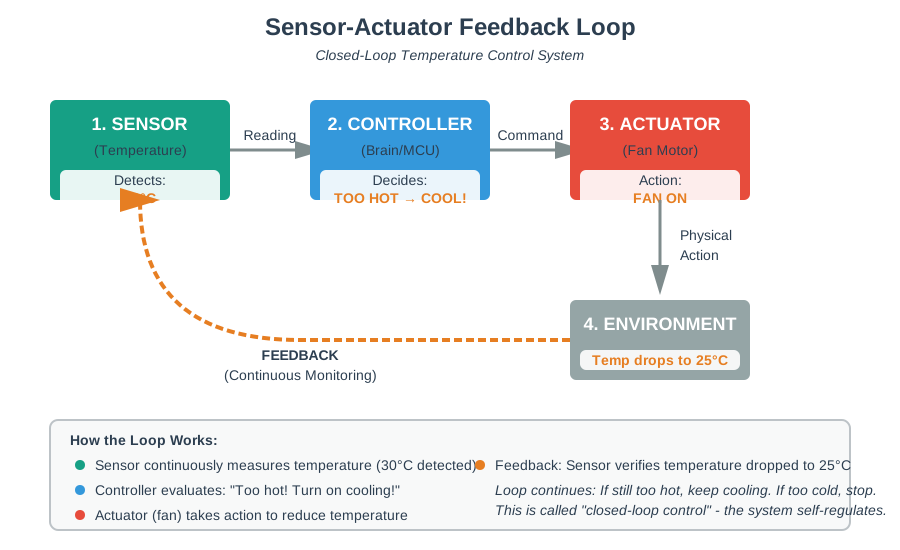
An IoT system becomes useful when it connects sensing to action.
- A temperature sensor can report a hot room.
- A solenoid uses a coil to create movement.
- These devices differ in motion, power, precision, response time, and risk.
- “Sensing decides; actuating commits — and a commit to the physical world needs a safe stop.”.
Major section
Overview: Actuators Close The Sense-Decide-Act Loop (continued)
The actuator design must include the driver, supply margin, wiring, protection, and a way to see that temperature or airflow actually changed.
- In a greenhouse, the sensor may report 35 C, the controller may target 28 C, and the actuator path may run a 12 V, 0.5 A fan.
- An irrigation valve shows the same pattern with a different output.
- The key beginner move is to name the boundary.
Major section
Overview: Actuators Close The Sense-Decide-Act Loop (continued)
The running electrical load is 12 x 0.5 = 6 W, but the startup current may be several times higher, so the fan cannot be treated as a GPIO accessory.
- A short watering pulse may be fine, but holding it open indefinitely changes the heat and battery budget.
- The control decision is only useful if the valve driver can energize the coil, the flyback path protects the electronics, and a flow, pressure, current, or timeout rule catches a stuck valve.
- Limits: a short watering pulse is fine; holding it open indefinitely changes the heat and battery budget.
Major section
Overview: Actuators Close The Sense-Decide-Act Loop (continued)
Safe stop: the flyback path protects the electronics; a flow, pressure, current, or timeout rule catches a stuck valve.
- Confusing those roles is how simple IoT projects end up with reset loops, overheated coils, jammed motors, or dashboards that claim success while nothing moved.
- If you only need the intuition, remember this: sensors notice, controllers decide, actuators act, and feedback proves whether the action worked.
- Process Change:: Heaters, fans, coolers, pumps, and valves change temperature, airflow, fluid flow, pressure, or another process state.
- A safety monitor detects a fault and commands a buzzer, warning LED, relay cutoff, or all three.
Major section
Practitioner: Put A Driver Between Logic And Load
The first practical actuator design step is to separate the logic signal from the load current.
- GPIO pins are designed for small digital signals.
- Motors, relays, solenoids, heaters, lamps, and pumps often need more current, different voltage, inductive-load protection, or isolation.
- A driver boundary lets the microcontroller command a power stage safely.
Major section
Under The Hood: Action Needs Feedback And Safe Failure
The software may set a PWM duty cycle, relay output, or step command, but the actual result depends on supply voltage, driver rating, wiring, load, friction, heating, timing, and physical limits.
- Each boundary has a failure mode that can be tested.
- That voltage drop may be enough to reset a marginal controller supply.
Major section
Under The Hood: Action Needs Feedback And Safe Failure (continued)
On the mechanical side, a motor may spin freely on the bench but stall once connected to a sticky linkage.
- Limits: 2 x 0.3 = 0.6 V lost before the driver even sees the load — enough to reset a marginal controller supply.
- Safe stop: a motor can spin freely on the bench and still stall once connected to a sticky linkage — bench success is not proof.
- On the process side, a pump may rotate while a blocked tube prevents flow.
Deck summary
Key takeaways
A sensor reports the temperature, and software decides to cool the room.
- An IoT system becomes useful when it connects sensing to action.
- The actuator design must include the driver, supply margin, wiring, protection, and a way to see that temperature or airflow actually changed.
- The running electrical load is 12 x 0.5 = 6 W, but the startup current may be several times higher, so the fan cannot be treated as a GPIO accessory.
- Safe stop: the flyback path protects the electronics; a flow, pressure, current, or timeout rule catches a stuck valve.
Retrieval practice
Recall check 1 of 3

Motor Max says: answer from memory, then check your reasoning.
Q1In a smart greenhouse, the temperature sensor reports 35 C and the controller decides to cool the space. Which part performs the physical cooling action?
Show answer
Answer: A Actuators are the physical-output stage of the sense-decide-act loop.
Retrieval practice
Recall check 2 of 3

Motor Max says: answer from memory, then check your reasoning.
Q2Why should a motor, relay coil, or solenoid usually not be connected directly to a microcontroller GPIO pin?
Show answer
Answer: A GPIO pins are command signals; actuator loads need appropriately rated driver and protection circuits.
Retrieval practice
Recall check 3 of 3

Motor Max says: answer from memory, then check your reasoning.
Q3A controller logs that it opened a solenoid valve, but no water flowed because the valve was jammed. What does this show?
Show answer
Answer: A Actuator commands need feedback or fault handling when physical action must be proven.
Print reference
Answers
Answer key.
- A · Actuators are the physical-output stage of the sense-decide-act loop.
- A · GPIO pins are command signals; actuator loads need appropriately rated driver and protection circuits.
- A · Actuator commands need feedback or fault handling when physical action must be proven.