Actuators & Control · Study deck
DC Motors
Picture a fan that spins freely on the bench but stops when dust blocks the duct.
Motor Max is your guide for this deck.

After studying this chapter
Learning objectives
You will be able to:
- Explain: If you only need the intuition, use this rule: use PWM for speed, a transistor or H-bridge for current, protection for inductive kick, and feedback when speed or position must be proven.
- Explain: PWM changes average electrical drive, current produces torque, load changes speed, speed changes back-EMF, and the useful physical process responds through airflow, pressure, wheel motion, or mechanism position.
- Explain: A startup spike of 2.0 A for 80 ms may be normal for a loaded motor, while 2.0 A for 2 s may mean a jam.
Major section
Start With the Story
The command is unchanged, yet current and heat rise while airflow disappears.
- An actuator means a part that causes a physical action.
- Modulation means changing a signal pattern.
- Pulse width modulation, or PWM, controls average drive by switching power on and off quickly.
- A driver carries the motor current that a control pin cannot safely supply.
Major section
Overview: DC Motors Are Continuous-Motion Loads
The rotor must accelerate mechanically while current builds electrically, so startup and blocked-shaft behavior differ from free running.
- A small 6 V gearmotor might draw 180 mA with no load, 600 mA while pushing a real mechanism, and 1.8 A when stalled.
- PWM is a control method, not a proof of motion.

Major section
Overview: DC Motors Are Continuous-Motion Loads (continued)
The controller pin is only a logic signal; it cannot be the motor supply.
- The driver, wires, connector, battery, and voltage regulator must tolerate the worst case long enough for the fault strategy to work.
- If a fan only needs approximate airflow, open-loop PWM plus a temperature response may be enough.
- If a conveyor must move parts reliably, the design needs current, encoder, limit-switch, or process evidence.
Major section
Overview: DC Motors Are Continuous-Motion Loads (continued)
Torque by current: Higher load usually means more current.
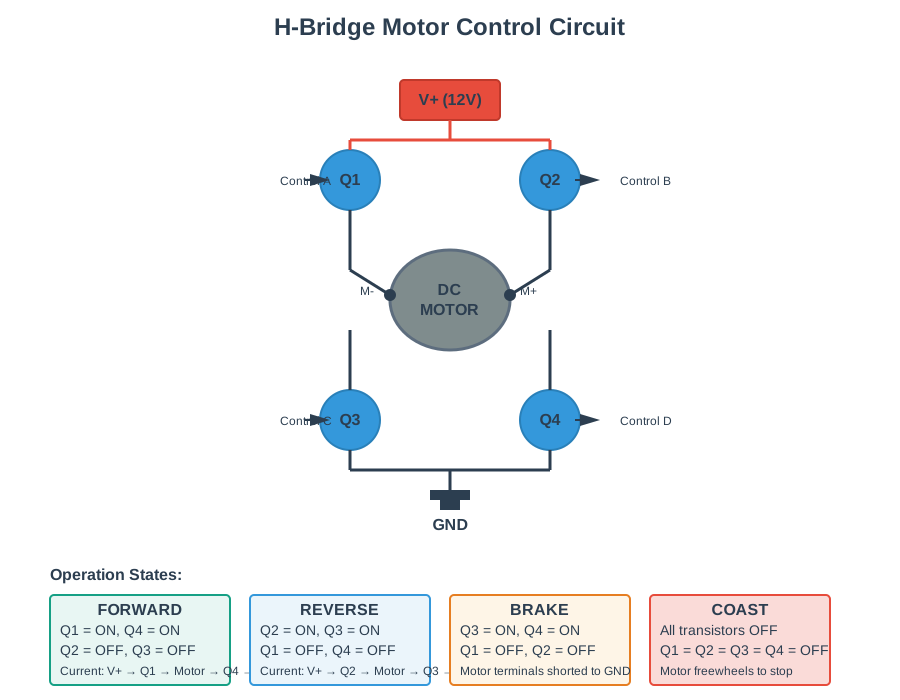
- A one-direction fan can use a low-side MOSFET or motor-driver channel with flyback handling, while a reversible load needs the full bridge.
- Those four states connect a firmware command to distinct electrical and mechanical outcomes; feedback is still required when the outcome must be proven.
- A wheeled robot needs an H-bridge because it must reverse.
Major section
Overview: DC Motors Are Continuous-Motion Loads (continued)
If you only need the intuition, use this rule: use PWM for speed, a transistor or H-bridge for current, protection for inductive kick, and feedback when speed or position must be proven.
- The duty cycle changes the average delivered power, so the motor tends to run faster or slower under its current load.
- Direction by current path: An H-bridge changes the direction of current through the motor so the shaft can rotate forward or reverse.
- Evidence by feedback: An encoder, limit switch, current measurement, airflow, pressure, or process sensor can prove more than command acknowledgement alone.
Major section
Practitioner: Size The Driver Around The Real Load
Retest after change: Reopen the record when the motor, gearbox, load, supply, PWM settings, driver, enclosure, or failure mode changes.
- A practical DC motor design starts with the load, not with a driver module.
- The difference is not only motor size.
- A dashboard fan can tolerate approximate speed.
Major section
Practitioner: Size The Driver Around The Real Load (continued)
A pump used for dosing needs stronger evidence: expected current, runtime limit, flow or pressure confirmation, dry-run behavior, and safe shutdown on fault.
- The record should state supply voltage, running current, startup or stall current, direction need, braking need, PWM behavior, thermal margin, protection, and the evidence used to confirm motion.
- Closed-loop control is needed when the system must hold a target speed, track movement under changing load, or prove that a mechanism reached a useful state.
- A dosing pump or moving mechanism may require closed-loop confirmation and a conservative failure path.
Major section
Under The Hood: Motion Evidence Comes From The Whole Loop
The design is trustworthy only when the loop has enough evidence at the right boundary.
- Under the hood, a DC motor is part of an electromechanical loop.
- When the motor slows under load, that opposing voltage falls and current can rise.
- Current evidence should be interpreted over time.
Major section
Under The Hood: Motion Evidence Comes From The Whole Loop (continued)
PWM changes average electrical drive, current produces torque, load changes speed, speed changes back-EMF, and the useful physical process responds through airflow, pressure, wheel motion, or mechanism position.
- When the driver switches current off, stored inductive energy needs a safe recirculation path.
- These effects are why driver and protection choices cannot be left as afterthoughts.
- The unloaded output speed is about 6000 / 30 = 200 rpm before losses.
Major section
Under The Hood: Motion Evidence Comes From The Whole Loop (continued)
If a wheel radius is 30 mm, its circumference is about 2 x 3.14 x 0.03 = 0.188 m.
- At 120 rpm under load, the wheel turns twice per second, so the ideal ground speed is about 2 x 0.188 = 0.376 m/s before slip.
- That calculation links PWM experiments to a physical result students can measure.
- The protection path also depends on the driver mode.
Major section
Under The Hood: Motion Evidence Comes From The Whole Loop (continued)
A startup spike of 2.0 A for 80 ms may be normal for a loaded motor, while 2.0 A for 2 s may mean a jam.
- A simple current limit that trips instantly can make the product unreliable; a timeout that ignores current can burn the driver.
- A more useful rule records normal startup duration, expected running current, blocked-load current, and the delay before firmware declares a fault.
- In a low-side switch, inductive current needs a flyback or clamp path when the switch opens.
Major section
Under The Hood: Motion Evidence Comes From The Whole Loop (continued)
Startup surge: initial current causes supply sag, reset, or driver thermal stress.
- In an H-bridge, current may recirculate through driver devices or diodes depending on whether firmware commands coast, brake, or reverse.
- PWM Dynamics: Duty cycle, frequency, driver switching behavior, audible noise, thermal loss, and mechanical response should match the load and product context.
- Stall or jam: blocked rotation draws high current while software still reports commanded speed.
Major section
Under The Hood: Motion Evidence Comes From The Whole Loop (continued)
Closed Loop: Encoder or process feedback lets the controller compare target and actual behavior instead of assuming PWM equals speed.
- Fault Handling: Timeouts, current limits, stall detection, jam recovery, brake/coast behavior, and manual override define safe operation after failure.
- Feedback mismatch: encoder speed looks normal while the driven process, such as airflow or fluid movement, is blocked.
- The safety review should name that path explicitly, because back-EMF does not disappear just because the command changed.
Major section
Summary
DC motors are useful for continuous rotation, fans, pumps, wheels, conveyors, and geared mechanisms where speed and direction matter more than exact position.
- PWM controls average drive, while an H-bridge is needed when the motor must reverse or use explicit brake/coast behavior.
- Driver sizing must account for real load, startup current, blocked-load current, thermal path, wiring, and safe reset behavior.
- Feedback or process evidence is needed when software must prove more than "command sent.".
Deck summary
Key takeaways
The command is unchanged, yet current and heat rise while airflow disappears.
- The rotor must accelerate mechanically while current builds electrically, so startup and blocked-shaft behavior differ from free running.
- The controller pin is only a logic signal; it cannot be the motor supply.
- Torque by current: Higher load usually means more current.
- If you only need the intuition, use this rule: use PWM for speed, a transistor or H-bridge for current, protection for inductive kick, and feedback when speed or position must be proven.
Retrieval practice
Recall check 1 of 3

Motor Max says: answer from memory, then check your reasoning.
Q1What makes a DC motor different from a simple low-current indicator output in an IoT design?
Show answer
Answer: D A DC motor crosses electrical and mechanical boundaries that a simple indicator output does not.
Retrieval practice
Recall check 2 of 3
Motor Max says: answer from memory, then check your reasoning.
Q2A DC motor works during bench testing with no load, but in the installed device it causes controller resets during startup. What should the review investigate first?
Show answer
Answer: B Bench no-load behavior does not prove the motor power path under startup or real mechanical load.
Retrieval practice
Recall check 3 of 3
Motor Max says: answer from memory, then check your reasoning.
Q3A controller sends a 60 percent PWM command to a DC motor, but the attached pump is jammed and no fluid moves. Why is the PWM command not enough evidence of success?
Show answer
Answer: C Motor commands must be connected to physical evidence when failure matters.
Print reference
Answers
Answer key.
- D · A DC motor crosses electrical and mechanical boundaries that a simple indicator output does not.
- B · Bench no-load behavior does not prove the motor power path under startup or real mechanical load.
- C · Motor commands must be connected to physical evidence when failure matters.