Actuators & Control · Study deck
Choosing the Right Actuator
An actuator is a part that turns a control signal into a physical change.
Motor Max is your guide for this deck.

After studying this chapter
Learning objectives
You will be able to:
- Explain: In the first, the valve and manifold blocks show where control meets the hydraulic cylinder; in the second, compliant fabric fingers show why a soft actuator can handle a fragile load without a rigid pinch point.
- Explain: If it pulses for 10 s every 60 s, the simple duty fraction is 10 / 60 = 0.167, so the average coil heat from the pulse pattern is roughly 1 W before enclosure effects.
- Explain: Limits: startup pulls 2.1 A — three times the running draw — so the driver and supply must be sized for that, not just normal running.
Major section
Start With the Story
The final mechanism, mounting, driver, duty, and environment can change the result.
- Those actions differ in motion, force, speed, position, power, feedback, and harm if the part sticks.
- A sent command is not proof of movement; use an independent sign of the physical result where harm matters.
- The story starts by naming the physical output before comparing parts.
Major section
Overview: Classify Actuators By The Job They Must Do
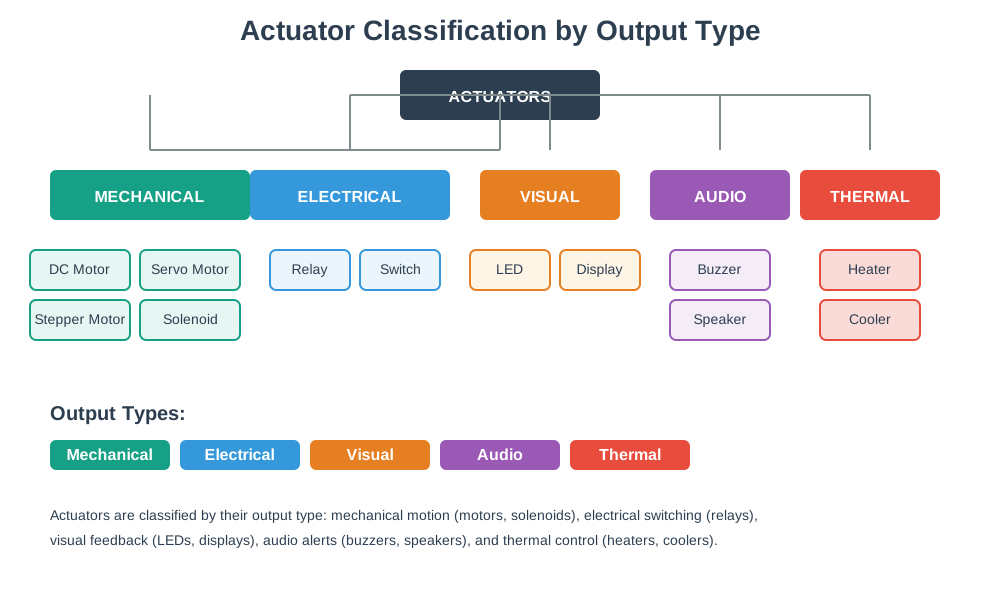
Actuator selection starts with the physical job, not with a favorite part.
- An IoT design may need continuous rotation, a fixed angle, step-by-step positioning, linear push or pull, high-power switching, light, sound, heat, or process movement.
- Each output type carries different power, driver, protection, and verification needs.
Major section
Overview: Classify Actuators By The Job They Must Do (continued)
That points toward a servo, geared motor with limit switches, or stepper with homing, depending on duty and accuracy.
- “Sensing decides; actuating commits — and a commit to the physical world needs a safe stop.”.
- A pump or fan starts from a different classification.
- The real assemblies below make those two families tangible.
Major section
Overview: Classify Actuators By The Job They Must Do (continued)
The map connects classification to the chapter's running Motion Check: name the commitment, bound its limits, and define the stop before selecting hardware.
- For example, a greenhouse vent that must rotate about 60 degrees and hold against wind load is a positioned-motion problem, not a generic "small motor" problem.
- If the linkage needs 1.2 N of push at a 35 mm arm, the load torque is 1.2 x 0.035 = 0.042 N m.
- A relay may switch the load, but it does not make a fan positional.
Major section
Overview: Classify Actuators By The Job They Must Do (continued)
With a 2.5x margin, the actuator target is about 0.105 N m, plus enough travel range and a way to confirm the vent is actually open or closed.
- The output is continuous rotation and flow, so the key evidence is not final angle; it is speed, current, pressure, flow, or temperature change.
- A 12 V fan that runs at 0.7 A but starts at 2.1 A needs a driver and supply sized for startup, not just for normal running.
- A lock, latch, alarm buzzer, or warning lamp is different again.
Major section
Overview: Classify Actuators By The Job They Must Do (continued)
Limits: startup pulls 2.1 A — three times the running draw — so the driver and supply must be sized for that, not just normal running.
- Safe stop: a relay can switch the load, but it does not make a fan positional — pick the family for the job.
- A solenoid lock might need a short release pulse and a safe default state; a buzzer needs audibility and user recognition; a lamp needs visibility and current limiting.
- Continuous motion:: DC motors and fans are useful when the task is ongoing rotation, airflow, pumping, or wheel movement rather than a precise final position.
Major section
Overview: Classify Actuators By The Job They Must Do (continued)
Classification turns the design from "choose a part" into "choose the output family, driver boundary, evidence path, and safe state that match the physical job.".
- If you only need the intuition, this layer is enough: choose by output role, motion shape, positioning need, load behavior, driver boundary, and evidence required after the command.
- Positioned motion:: Servo motors, stepper motors, and geared mechanisms fit tasks where angle, step count, or repeatable position matters.
- Binary action:: Relays, solenoids, valves, and locks fit on/off, open/closed, latch/release, and switch-isolated power tasks.
Major section
Overview: Classify Actuators By The Job They Must Do (continued)
Fluid-power motion:: Hydraulic cylinders or fluid motors use pressurized liquid for high force, while pneumatic cylinders, pumps, and rack-and-pinion actuators use compressed air for fast linear or rotary motion.
- Their evidence includes pressure source, valve behavior, leaks, reserve capacity, and safe venting or default state.
- Material-response motion:: Thermal, magnetic, shape-memory alloy, shape-memory polymer, and soft actuators can bend, contract, or deform when heated, magnetized, illuminated, or exposed to chemical or moisture changes.
- Their evidence includes stimulus range, response time, fatigue, recovery behavior, and whether the motion stays gentle enough for fragile objects.
Major section
Overview: Classify Actuators By The Job They Must Do (continued)
Their evidence includes backlash, friction, travel limits, load margin, and jamming behavior.
- A smart vent, a warning buzzer, and a pump are all actuators, but they should not be selected from the same checklist.
- The vent needs movement and end-state evidence, the buzzer needs a clear human signal, and the pump needs power switching, protection, and flow or process evidence.
- In the first, the valve and manifold blocks show where control meets the hydraulic cylinder; in the second, compliant fabric fingers show why a soft actuator can handle a fragile load without a rigid pinch point.
Major section
Practitioner: Compare Types With A Selection Record
A useful actuator comparison record is a small design argument.
- It states the required output, lists realistic candidate types, rejects poor fits with reasons, and records the driver, protection, feedback, and failure behavior that must be tested.
- A remote irrigation valve could use a solenoid valve, motorized ball valve, or relay-controlled pump.
Major section
Practitioner: Compare Types With A Selection Record (continued)
The right answer depends on whether the system needs normally-closed behavior, low standby power, partial positioning, serviceability, and direct evidence of flow.
- A selection record makes those tradeoffs explicit before hardware is ordered.
- For mobile robots, the comparison also has to name the controllable degrees of freedom.
- That classification changes the evidence.
Major section
Practitioner: Compare Types With A Selection Record (continued)
A wheel motor command is not proof of a pose update; wheel slip, backlash, floor friction, battery voltage, and sensor delay can all disturb the motion model.
- A differential-drive robot may have planar state (x, y, heading) but only two direct wheel-speed commands, so it is non-holonomic: it cannot move sideways without changing heading over time.
- A holonomic platform has enough independently controlled motion axes to command every relevant degree of freedom directly.
- Shape-memory and magnetic actuators deserve their own line in a selection record because "shape-memory" is not one material.
Major section
Under The Hood: Classification Also Defines Failure Boundaries
A motor may stall, overshoot, or draw more current under load.
- A relay may wear contacts or weld shut.
- A solenoid may heat if energized too long.
- An LED or buzzer may be safe electrically but still fail the human-factor job if it is ambiguous or missed.
- Thermal behavior changes the classification too.
Major section
Under The Hood: Classification Also Defines Failure Boundaries (continued)
The selection is not only about opening a door.
- A software command such as "open" or "turn on" is not enough evidence.
- The physical boundary determines what must be checked: driver state, load current, mechanical movement, final position, thermal behavior, isolation, manual override, and whether the default state is safe when power or communication fails.
- If one row is unclear, the actuator choice is not ready.
Major section
Under The Hood: Classification Also Defines Failure Boundaries (continued)
A relay may only prove that the controller energized a coil; it does not prove the contact did not weld, the strike received power, the door moved, or the door is now secure.
- If the strike draws 1.5 A at 12 V, the relay contact, wiring, fuse, and supply must be rated for that DC load and inrush.
- If the controller also drives an 80 mA relay coil, the coil still needs a transistor driver and flyback path because the microcontroller pin is not the load supply.
- Actuator categories matter because they fail differently.
Major section
Under The Hood: Classification Also Defines Failure Boundaries (continued)
Safe stop: that jump may need a latching mechanism or reduced hold current, not just a bigger coil.
- If it pulses for 10 s every 60 s, the simple duty fraction is 10 / 60 = 0.167, so the average coil heat from the pulse pattern is roughly 1 W before enclosure effects.
- If the same solenoid is held continuously, the heat case is six times larger and may require a latching mechanism, reduced hold current, or a different actuator family.
- A building access controller might compare a relay-driven strike, a solenoid lock, and a motorized latch.
Deck summary
Key takeaways
The final mechanism, mounting, driver, duty, and environment can change the result.
- Actuator selection starts with the physical job, not with a favorite part.
- That points toward a servo, geared motor with limit switches, or stepper with homing, depending on duty and accuracy.
- The map connects classification to the chapter's running Motion Check: name the commitment, bound its limits, and define the stop before selecting hardware.
- With a 2.5x margin, the actuator target is about 0.105 N m, plus enough travel range and a way to confirm the vent is actually open or closed.
Retrieval practice
Recall check 1 of 3

Motor Max says: answer from memory, then check your reasoning.
Q1What is the strongest first question when comparing actuator types for an IoT design?
Show answer
Answer: A Selection starts from the physical job, power boundary, and verification evidence.
Retrieval practice
Recall check 2 of 3

Motor Max says: answer from memory, then check your reasoning.
Q2A stepper motor is commanded to move a vent, but wind load can cause missed steps. What should the selection record add before release?
Show answer
Answer: A Open-loop steps are not enough when load can make the mechanism miss movement.
Retrieval practice
Recall check 3 of 3

Motor Max says: answer from memory, then check your reasoning.
Q3Why is command acknowledgement not the same as actuator success?
Show answer
Answer: A IoT actuation needs evidence across the electrical, mechanical, and state-confirmation boundaries.
Print reference
Answers
Answer key.
- A · Selection starts from the physical job, power boundary, and verification evidence.
- A · Open-loop steps are not enough when load can make the mechanism miss movement.
- A · IoT actuation needs evidence across the electrical, mechanical, and state-confirmation boundaries.