Actuators & Control · Study deck
Actuator Assessment and Reference
Picture a greenhouse fan that should start when the air grows too hot.
Motor Max is your guide for this deck.
After studying this chapter
Learning objectives
You will be able to:
- Evaluate your actuator knowledge through interactive self-assessment quizzes
- Interpret quick reference cards to identify correct specifications for common actuators and motor drivers
- Diagnose actuator problems using systematic troubleshooting frameworks
- Recommend the appropriate actuator type (DC, servo, or stepper motor) for real-world IoT scenarios
Major section
Start With the Story
A correct quiz answer is useful only if the chosen parts can drive the real fan and fail in a visible way.
- The first review question is what physical result proves the choice worked.
- An actuator means a part that turns a command into a physical action.
- GPIO means general-purpose input/output, a pin used for a direct digital control line.
- This runway does not prove that one driver suits every motor or safety class.
Major section
Start With the Story (continued)
PWM means pulse-width modulation: rapid on-off pulses vary the share of time that power is applied.
- Disconnect the load, hold the fan safely, repeat the command, and restart the controller while the hot condition remains.
- The deeper questions and reference cards cover load types, driver limits, protection, power, motion, warning outputs, and troubleshooting evidence.
- A correct answer should not only name a motor, relay, PWM value, or flyback diode; it should explain the physical action, the driver boundary, the protection, and the evidence that the actuator result is believable.
Major section
Putting Numbers to It
Actuator control decisions are often power-budget decisions.
- where D is duty cycle (0 to 1).
- Running 2 hours/day consumes 2.4×2=4.8 Wh/day.
- At 100% duty cycle it would be 12 Wh/day, so duty-cycle control cuts daily energy by 60% while still delivering usable actuation.
Major section
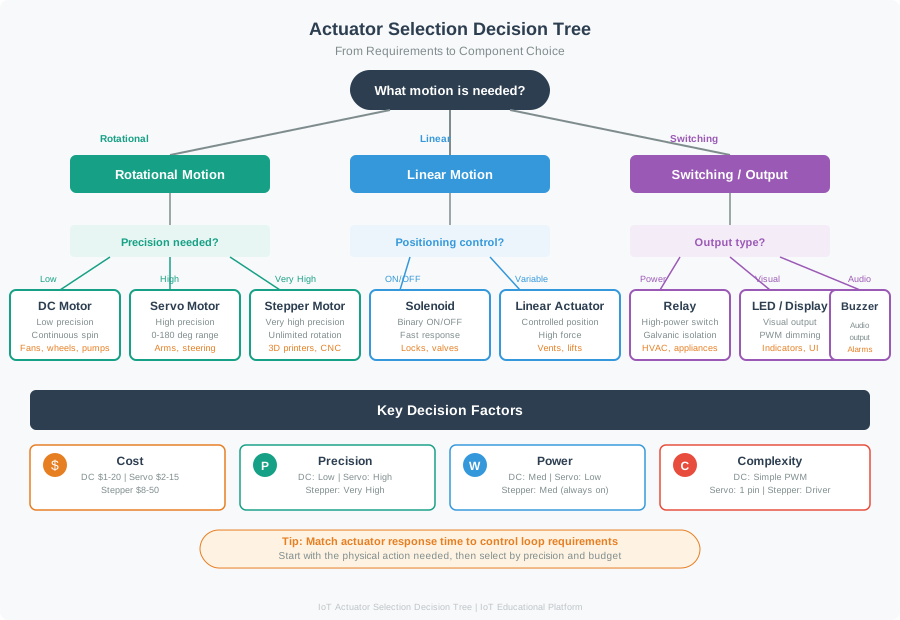
DC vs Servo vs Stepper Choice
When your IoT project needs rotational motion, choosing the right motor type is critical for performance, cost, and power efficiency.
- NO → Use: DC motor (simplest, cheapest, most efficient for continuous rotation).
- Limited range (0-180° or 0-270°) → Use: Servo motor (easiest position control, built-in feedback).
- Need: Variable speed forward/backward, turns via differential steering.
Major section
DC vs Servo vs Stepper Choice (continued)
NO (position relative, occasional reset OK) → Use: Servo motor with continuous rotation modification.
- YES (absolute position critical, no position loss allowed) → Use: Stepper motor.
- Need: Rotate to specific angles (0° = open, 180° = closed) and hold position.
- Need: Rotate deadbolt 90° to lock/unlock, must hold position against force.
- Speed control is sufficient (no position required).
Major section
DC vs Servo vs Stepper Choice (continued)
Problem: No feedback means no way to know if motor reached target position (could stall, slip, or overshoot).
- Impact: Blinds system that randomly stops at wrong positions; requires manual reset.
- Problem: Steppers lose torque at high step rates (>1000 steps/sec) and consume 500mA-1.5A continuously.
- Cost is constrained (<$5 per motor).
Major section
DC vs Servo vs Stepper Choice (continued)
Impact: 300 RPM fan application uses stepper drawing 800mA when DC motor drawing 150mA would work better.
- You need continuous rotation (fans, wheels, conveyor belts).
- You need angular positioning (0-180° typical).
- Holding torque is required (robotic arms, locks).
- You need precise step-by-step positioning (3D printers, CNC).
Major section
For Kids: Meet the Actuator Crew!
"Pop quiz time!" announced Max the Microcontroller, wearing a tiny graduation cap. "Who can tell me -- if I need to move a robot arm to exactly 90 degrees, which actuator friend should I call?".
- Bella the Battery chimed in, "And don't forget -- always use a motor driver between Max and the motors.
- Max can only provide a tiny bit of power.
- "Great teamwork!" said Max. "Remember: servos for angles, DC motors for spinning, steppers for precise steps, and ALWAYS use the right driver circuit!".
Major section
Deep Dive: Selection Evidence, Sizing, and Gearing
The recurring trap is confusing peak and continuous ratings.
- Each branch narrows the candidate, but the path only becomes defensible when its load, speed, duty-cycle, and worst-case-current assumptions are recorded and tested.
- With a 2x margin, the target becomes about 0.09 N m.
- Direct drive fails on torque.
Major section
Deep Dive: Selection Evidence, Sizing, and Gearing (continued)
Speed must satisfy the application at the same time as torque.
- If the vent only needs to sweep 90 degrees and hold position, a positional servo may fit.
- If it must rotate continuously, a DC gearmotor is a better starting point.
- A candidate motor can provide 0.06 N m continuously near 300 rpm.
Major section
Deep Dive: Selection Evidence, Sizing, and Gearing (continued)
If it must index repeatably through many turns without a position sensor, a stepper may be justified.
- A motor can deliver stall torque briefly, but only its lower continuous torque without overheating.
- If the chosen actuator can draw 900 mA at stall, the driver and supply must tolerate that worst case.
- A small valve actuator runs from 12 V, draws 0.4 A while moving, and is driven at 60% PWM during normal travel.
Major section
Deep Dive: Selection Evidence, Sizing, and Gearing (continued)
If a gearbox produces enough torque but only reaches 5 rpm, it is safe but too slow.
- If the load is inductive, include a flyback or clamp path; if a stall would overheat the actuator, include a timeout, current limit, or firmware fault state.
- If the valve moves for 20 s every 120 s, the time duty is 20 / 120 = 0.167, so the average heat load from movement is much lower than the instantaneous moving power.
- If an ungeared motor reaches 300 rpm but lacks torque, it is fast but unusable.
Major section
Deep Dive: Selection Evidence, Sizing, and Gearing (continued)
If a valve must close in 1 s and the mechanism needs 90 degrees of output travel, the output speed target is one quarter turn per second, or 15 rpm.
- Every motor has a torque-speed curve running from stall torque to no-load speed.
- It also divides the reflected load inertia the motor feels by N squared, which is why gearing helps a motor accelerate a heavy load.
- A 4:1 reduction with an assumed 80% efficient gearbox gives output torque near 0.06 x 4 x 0.80 = 0.192 N m and output speed near 300 / 4 = 75 rpm.
Deck summary
Key takeaways
A correct quiz answer is useful only if the chosen parts can drive the real fan and fail in a visible way.
- PWM means pulse-width modulation: rapid on-off pulses vary the share of time that power is applied.
- Actuator control decisions are often power-budget decisions.
- When your IoT project needs rotational motion, choosing the right motor type is critical for performance, cost, and power efficiency.
- NO (position relative, occasional reset OK) → Use: Servo motor with continuous rotation modification.
Retrieval practice
Recall check 1 of 5
Motor Max says: answer from memory, then check your reasoning.
Q1A small camera platform must move within a 0-180-degree range to 90 degrees and hold there with built-in position feedback and simple control. Which actuator type is most appropriate?
Show answer
Answer: C A suitable positional servo provides built-in feedback and simple angle control within its rated travel and torque.
Retrieval practice
Recall check 2 of 5
Motor Max says: answer from memory, then check your reasoning.
Q2A student connects a DC motor directly to an ESP32 GPIO pin. The motor does not spin, and the ESP32 restarts repeatedly. What is the most likely cause?
Show answer
Answer: B A GPIO is a control signal, not a motor power stage.
Retrieval practice
Recall check 3 of 5
Motor Max says: answer from memory, then check your reasoning.
Q3A motor has enough peak torque for a load but stalls when asked to run it continuously and struggles to accelerate it. Which sizing reasoning fixes this?
Show answer
Answer: B Sustained loads must be sized to the continuous (thermal) torque, not peak; a gear reduction N multiplies torque, divides speed by N, and divides reflected inertia by N-squared, placing the operating point safely under the torque-speed curve.
Retrieval practice
Recall check 4 of 5
Motor Max says: answer from memory, then check your reasoning.
Q4A servo jitters when a load is attached. What should a first troubleshooting check test?
Show answer
Answer: C A weak supply can cause servo jitter, so measure it during the fault.
Retrieval practice
Recall check 5 of 5
Motor Max says: answer from memory, then check your reasoning.
Q5Place each actuator-assessment task where it lives so you can connect the required motion to a drive circuit and prove the application fails safely.
Show answer
Answer: A Identify the motion and load, match the electrical drive and control method, then challenge safety and application fit so you can justify the actuator choice.
Retrieval practice
Recall check 5 of 5
Motor Max says: answer from memory, then check your reasoning.
Q6Complete the multi-actuator control system:
Show answer
Answer: A A dictionary organizes multiple actuators by name.
Print reference
Answers 1 of 2
Answer key.
- C · A suitable positional servo provides built-in feedback and simple angle control within its rated travel and torque.
- B · A GPIO is a control signal, not a motor power stage.
- B · Sustained loads must be sized to the continuous (thermal) torque, not peak; a gear reduction N multiplies torque, divides speed by N, and divides reflected inertia by N-squared, placing the operating point safely under the torque-speed curve.
Print reference
Answers 2 of 2
Answer key.
- C · A weak supply can cause servo jitter, so measure it during the fault.
- A · Identify the motion and load, match the electrical drive and control method, then challenge safety and application fit so you can justify the actuator choice.
- A · A dictionary organizes multiple actuators by name.