Actuators & Control · Study deck
Actuator Safety: Watchdogs and Interlocks
A watchdog that trips too soon stops sound work; one set too late lets harm grow.
Motor Max is your guide for this deck.

After studying this chapter
Learning objectives
You will be able to:
- Explain: A conveyor moving at 0.5 m/s travels the same 0.10 m in only 200 ms, so a cloud timeout or app command is too slow for personnel protection.
- Explain: A practical design uses driver current limiting near the allowed peak, a fuse for wiring faults, and firmware that cuts drive if high current persists beyond the expected acceleration window.
- Explain: But if the actuator can cause damage after 150 ms of uncontrolled motion, the software architecture must change; slow logging or network work belongs in a background task.
Major section
Pull-Downs on Relay Boot
The mistake: A smart irrigation controller uses GPIO pins to control 8 solenoid valves via relays.
- Floating pins can be pulled HIGH by electromagnetic coupling or internal leakage currents, randomly energizing relays.
- Weak enough that firmware can override by driving pin HIGH.
- Bench testing often uses short power cycles where floating pins stay LOW by chance.
Major section
Deep Dive: Failure Energy, Interlocks, and Stall Protection
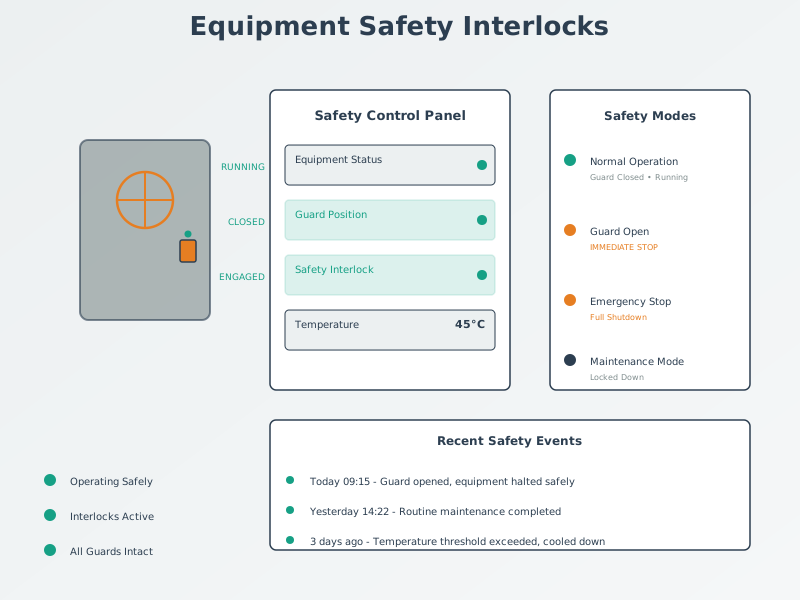
A heater usually fails safe by turning off.
- A greenhouse vent may fail safe by opening.
- A fire-exit lock may fail safe by unlocking.
- A laboratory exhaust damper may fail safe by opening, even though a security door may fail safe by locking.
- Two design choices carry much of the fail-safe weight.
Major section
Deep Dive: Failure Energy, Interlocks, and Stall Protection (continued)
Each unsafe condition forces a bounded local response; that hierarchy connects the safe-state choice to the energy and travel calculations below.
- If the controller must keep that coil energized to hold the safe state, a power loss removes the energy needed for safety.
- Hardware defaults come first, local controls second, and network supervision last.
- A relay board driven from a 3.3 V GPIO should not float while the controller boots.
Major section
Deep Dive: Failure Energy, Interlocks, and Stall Protection (continued)
A conveyor moving at 0.5 m/s travels the same 0.10 m in only 200 ms, so a cloud timeout or app command is too slow for personnel protection.
- If a 12 V door actuator normally draws 1.5 A, its running power is 12 V x 1.5 A = 18 W.
- If the mechanism jams and stall current reaches 6 A, the wiring, driver, and fuse must account for a 12 V x 6 A = 72 W fault.
- Stall current can therefore be many times the running current, all of it turning into heat in the windings.
Major section
Deep Dive: Failure Energy, Interlocks, and Stall Protection (continued)
A practical design uses driver current limiting near the allowed peak, a fuse for wiring faults, and firmware that cuts drive if high current persists beyond the expected acceleration window.
- A 10 kOhm pull-down draws only 3.3 V / 10000 ohm = 0.33 mA, but it defines the input while firmware is not yet running.
- Across eight relay outputs, that is 8 x 0.33 mA = 2.64 mA, a tiny standby cost compared with valves or motors energizing during reset.
- Copper heating is I^2R = 1.5^2 x 2 = 4.5 W.
Major section
Deep Dive: Failure Energy, Interlocks, and Stall Protection (continued)
At stall, speed is zero and back-EMF is zero.
- For high-current drivers, apply the same rule to the enable pin: hardware should hold it disabled until firmware explicitly proves it is healthy.
- If the critical loop normally completes in 80 ms and has a measured worst case of 120 ms, a 200 ms watchdog leaves margin.
- A cloud alert or thirty-second timeout cannot protect that motor.
Major section
Deep Dive: Failure Energy, Interlocks, and Stall Protection (continued)
But if the actuator can cause damage after 150 ms of uncontrolled motion, the software architecture must change; slow logging or network work belongs in a background task.
- A watchdog is useful only when its timeout is shorter than the physical hazard time and the reset state actually removes actuator energy.
- A spinning motor generates back-EMF, a voltage opposing the supply that rises with speed, and that back-EMF is what limits its running current.
- When a motor stalls, speed is zero, back-EMF is zero, and the only thing limiting current is the winding's small resistance.
Major section
For Kids: Meet the Actuator Crew!
"Safety meeting!" called the microcontroller, gathering the team. "Before we connect any actuators, we need to talk about protection.".
- "From YOU, Danny!" said Max with a smile. "When you stop spinning, your coils create a nasty voltage spike -- like a tiny lightning bolt.
- Without a flyback diode to catch it, that spike could fry my circuits!".
- We call it fail-safe!".
Deck summary
Key takeaways
The mistake: A smart irrigation controller uses GPIO pins to control 8 solenoid valves via relays.
- A heater usually fails safe by turning off.
- Each unsafe condition forces a bounded local response; that hierarchy connects the safe-state choice to the energy and travel calculations below.
- A conveyor moving at 0.5 m/s travels the same 0.10 m in only 200 ms, so a cloud timeout or app command is too slow for personnel protection.
- A practical design uses driver current limiting near the allowed peak, a fuse for wiring faults, and firmware that cuts drive if high current persists beyond the expected acceleration window.
Retrieval practice
Recall check 1 of 5

Motor Max says: answer from memory, then check your reasoning.
Q1A geared actuator jams against an obstruction. Why does this threaten to overheat or start a fire, and which protections address it correctly?
Show answer
Answer: A Stalling removes the back-EMF that limits current, so locked-rotor current surges and heats the windings; current limiting, thermal cutoffs/PTC, firmware stall detection, and de-energize-to-safe wiring with a hardware E-stop protect against it.
Retrieval practice
Recall check 2 of 5

Motor Max says: answer from memory, then check your reasoning.
Q2A watchdog timer is set to 3 seconds. What happens if the main control loop takes 5 seconds to complete one iteration?
Show answer
Answer: B Answer: B) The watchdog resets the entire system because it was not fed within the 3-second timeout.
Retrieval practice
Recall check 3 of 5

Motor Max says: answer from memory, then check your reasoning.
Q3Why should IoT actuators default to a safe state on power loss rather than maintaining their last commanded state?
Show answer
Answer: B Answer: B) Uncontrolled actuator states can cause physical harm -- a heater stuck ON could cause fire, a valve stuck OPEN could cause flooding.
Retrieval practice
Recall check 4 of 5

Motor Max says: answer from memory, then check your reasoning.
Q4An IoT motor controller drives a conveyor belt in a food processing plant. A maintenance technician needs to clear a jam while the system is powered on. What minimum safety features must the IoT controller implement?
Show answer
Answer: D Industrial actuator maintenance requires a hardware stop path that physically disconnects power, independent of software or network connectivity.
Retrieval practice
Recall check 5 of 5

Motor Max says: answer from memory, then check your reasoning.
Q5Place each actuator safeguard where it lives so you can contain electrical energy, protect people from motion, and drive faults to a safe state.
Show answer
Answer: A Separate electrical protection, physical hazard controls, and stopping behavior so you can build layered actuator safety instead of relying on one software check.
Q6Complete the actuator safety watchdog implementation:
Show answer
Answer: A A hardware Timer acts as a watchdog: after 5000 ms (5 seconds), it fires once (ONE_SHOT mode) and calls emergency_stop to disable the motor.
Print reference
Answers 1 of 2
Answer key.
- A · Stalling removes the back-EMF that limits current, so locked-rotor current surges and heats the windings; current limiting, thermal cutoffs/PTC, firmware stall detection, and de-energize-to-safe wiring with a hardware E-stop protect against it.
- B · Answer: B) The watchdog resets the entire system because it was not fed within the 3-second timeout.
- B · Answer: B) Uncontrolled actuator states can cause physical harm -- a heater stuck ON could cause fire, a valve stuck OPEN could cause flooding.
Print reference
Answers 2 of 2
Answer key.
- D · Industrial actuator maintenance requires a hardware stop path that physically disconnects power, independent of software or network connectivity.
- A · Separate electrical protection, physical hazard controls, and stopping behavior so you can build layered actuator safety instead of relying on one software check.
- A · A hardware Timer acts as a watchdog: after 5000 ms (5 seconds), it fires once (ONE_SHOT mode) and calls emergency_stop to disable the motor.