Design Methodology · Study deck
Accelerometer Datasheets: Selection Evidence
A parcel tag must catch a hard drop but ignore road shake.
Blueprint Bina is your guide for this deck.
After studying this chapter
Learning objectives
You will be able to:
- Extract application-relevant accelerometer specifications from a manufacturer datasheet.
- Translate range, resolution, data rate, power, interface, FIFO, interrupt, package, and environmental rows into design decisions.
- Build a requirement-to-evidence record for an accelerometer selection.
- Identify what the datasheet proves, what firmware must configure, and what bench tests must still verify.
Major section
Start With the Acceleration Claim
None matters until the team links it to the product claim and a setting it can test.
- Bandwidth means the span of changes a sensor path can follow: It is not the same as sample rate.
- A default value is not a reviewed choice.
- A similar part name may have different limits.
Major section
Start With the Acceleration Claim (continued)
Firmware is the built-in software that controls a device: Record the exact range, rate, filter, interrupt, and power settings that firmware writes.
- The tag must preserve the event meaning and show when it cannot.
- The datasheet case study starts by translating that claim into range, resolution, bandwidth, noise, interrupt, interface, power, and calibration evidence.
- One bench set cannot copy every real parcel.
Major section
ADXL345 Datasheet Claim Filter
The ADXL345 datasheet is useful when it is read against one product claim at a time.
- A drop or shock flag cares about range, sampling, saturation, mounting, and what the part can actually observe.
- None of those features is a release claim until the board and firmware prove the chosen configuration.
- For the equipment-tag example, the first pass is not "use every ADXL345 feature." The first pass is to decide which product statements the part must support.
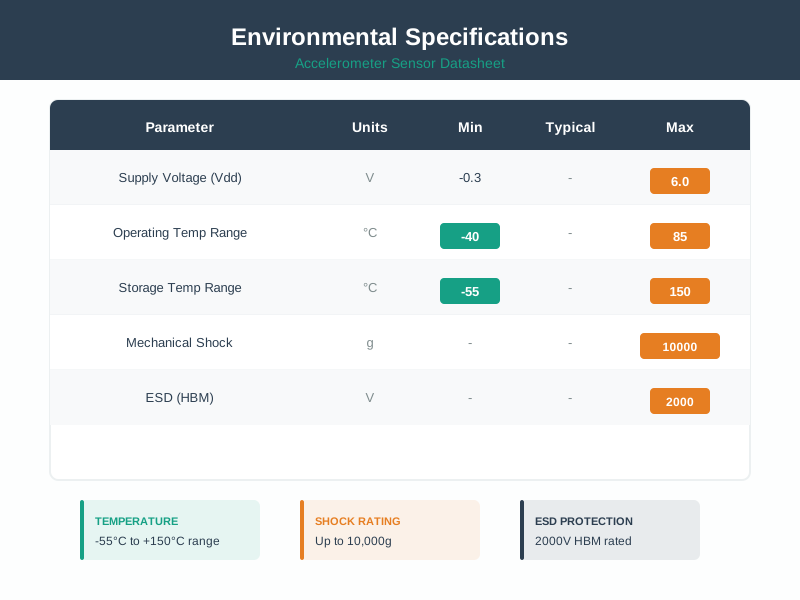
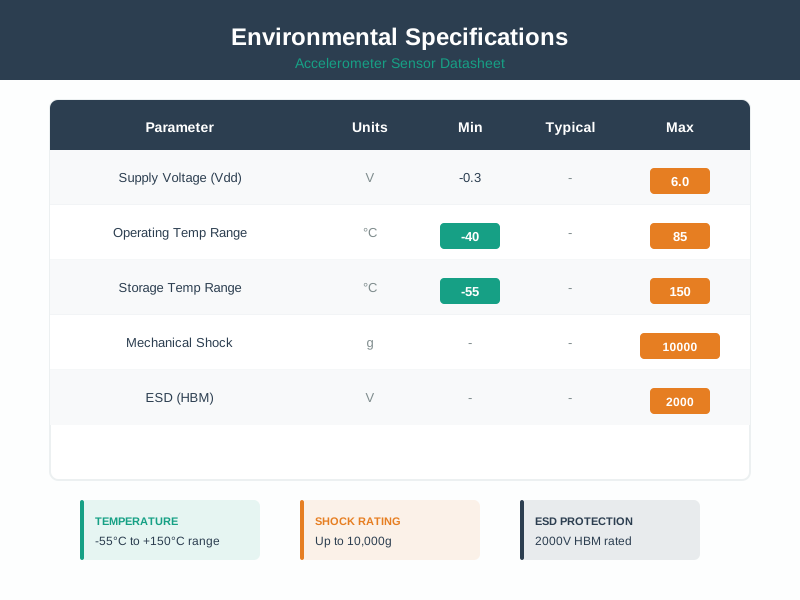
- The rows separate supply, temperature, shock, and ESD limits; each needs a matching application claim and board check.
Major section
ADXL345 Datasheet Claim Filter (continued)
A wake-on-motion tag cares about activity/inactivity thresholds, interrupt mapping, standby and measurement current, host wake behavior, and false wakes.
- For the equipment-tag example, the first pass is not "use every ADXL345 feature." The first pass is to decide which product statements the part must support.
- Orientation detection needs a gravity reference, axis convention, offset tolerance, and calibration plan.
- Motion detection needs a data rate, threshold, duration, interrupt route, host wake sequence, and false-positive test.
- Reading the datasheet through those claims keeps the design from treating an impressive feature list as proof.
Major section
Convert Rows to Behavior
Activity/inactivity may support wake-on-motion.
- Data-ready may support fixed-rate sampling.
- FIFO watermark may let the MCU sleep between bursts.
- Free-fall or tap features may be useful for an interaction or handling claim, but only if thresholds, duration settings, interrupt mapping, and false-positive behavior are reviewed.
Major section
Convert Rows to Behavior (continued)
The firmware settings should be saved beside the bench log, not hidden inside a source file.
- SPI can be attractive when bus traffic, timing, or device addressing makes I2C awkward.
- I2C can save pins when timing and bus sharing are acceptable.
- A narrow range gives more useful low-motion detail but can clip handling shocks.
Major section
Convert Rows to Behavior (continued)
A low-power mode can reduce current but may change noise and timing behavior.
- Either way, the design needs sensor supply, I/O supply, pullups or chip-select behavior, logic levels, bus speed, driver support, and a traceable device-ID read.
- For a battery tag, the practitioner decision is usually a trade between missed events and excess wakeups.
- A high output data rate can catch short events but costs host reads and may fill the FIFO sooner.
Major section
Counts Need Product Meaning
Raw accelerometer counts are affected by range, data format, offset, noise, bandwidth, axis orientation, mounting, temperature, host timing, and filtering.
- A full-resolution setting may preserve scale across ranges, but firmware still needs to parse the data format correctly and prove that the selected range does not clip the real motion.
- Good bench evidence separates those layers.
- A static gravity check can catch axis sign and orientation errors before those errors become application logic.
- That requires board-level traces, current logs, raw-sample captures, threshold sweeps, interrupt waveforms, calibration notes, and field-pilot follow-up when the installation environment is not yet known.
Major section
Counts Need Product Meaning (continued)
The product-level question is usually not "does the chip measure acceleration?" It is whether the assembled product can distinguish useful motion from noise, vibration, transport handling, user interaction, and fault states.
- The under-the-hood risk is that several conversions sit between the MEMS structure and the release decision.
- The sensor produces signed digital samples whose meaning depends on range and resolution settings.
- A mistake at any layer can make gravity look inverted, make short shocks disappear, or make normal vibration look like a handling event.
- A bus trace checks that multi-byte reads do not mix old and new samples.
Major section
What This Chapter Adds
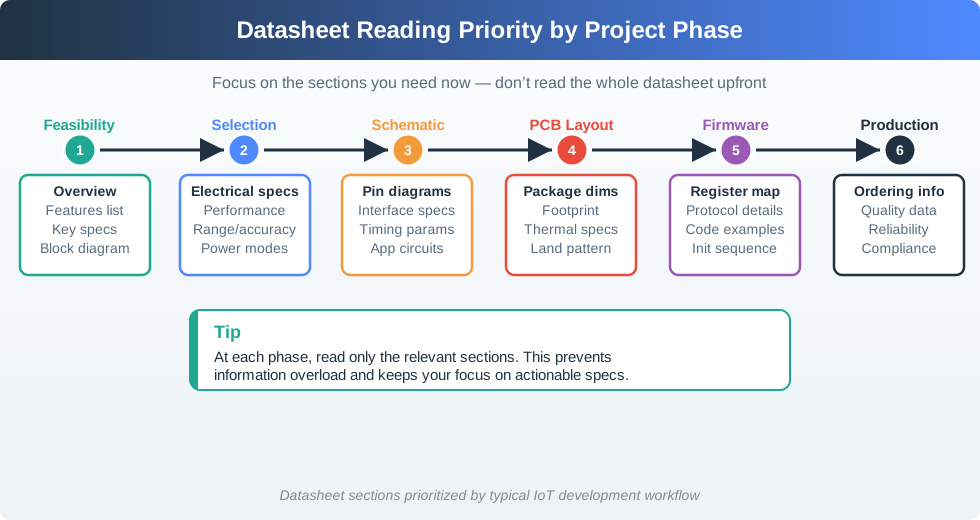
The datasheet reading plan changes as the ADXL345 design moves from choice to build.
- In Figure: Accelerometer evidence should come from the datasheet sections, the feasibility and selection columns point to sensor type, range, and resolution: those rows show whether the part can serve the motion claim.
- The production column adds availability, lifecycle, and test records.
Major section
What This Chapter Adds (continued)
Schematic and PCB work shifts attention to supply, I/O, and package details because the board must support the chosen part.
- Firmware then needs the power, FIFO, and interrupt settings, along with readback evidence.
- The lists change from broad capabilities to electrical details, implementation instructions, and quality evidence.
- Claim Start from use The important rows depend on the application: tilt, step detection, asset motion, shock flag, or low-power wake.
Major section
Case Study, Not Part Advice
ADXL345 is used here because the public documentation is clear and familiar.
- A real product still needs a current availability check, lifecycle review, package review, regulatory context, mechanical fit, firmware support review, and bench qualification.
Major section
Case Study Brief
The device uses a small MCU with a 3.3 V rail and can wake from an interrupt pin.
- The accelerometer can measure gravity on multiple axes with enough resolution for the chosen angle threshold.
- The part can sample at a suitable output data rate and trigger activity or inactivity events.
- The sensor and MCU can spend most time in low-power states and wake only when useful.
- The package, pins, supply, and host logic levels match the PCB and MCU.
Major section
ADXL345 Rows to Selection
The ADXL345 datasheet becomes useful when the team reads it against one product behavior at a time.
- The route below starts with the motion claim, extracts only the relevant rows, turns those rows into board and firmware choices, and then checks the assembled device before release.
Major section
Extract the Critical Rows
For the ADXL345 example, the first extraction pass should produce a small selection table, not a copied datasheet.
- Full-resolution mode supports a scale factor of about 4 mg per LSB across ranges.
- Sensor supply and I/O supply have separate allowed ranges.
- SPI and I2C access are supported.
Deck summary
Key takeaways
None matters until the team links it to the product claim and a setting it can test.
- Firmware is the built-in software that controls a device: Record the exact range, rate, filter, interrupt, and power settings that firmware writes.
- The ADXL345 datasheet is useful when it is read against one product claim at a time.
- The table in Figure: An accelerometer datasheet becomes engineering evidence only after lists part limits; check each row against the board.
- Activity/inactivity may support wake-on-motion.
Retrieval practice
Recall check 1 of 4

Blueprint Bina says: answer from memory, then check your reasoning.
Q1A parcel tag must detect drops but ignore normal road shake. Which datasheet facts should be extracted first?
Show answer
Answer: A The application event sets the relevant specification rows.
Retrieval practice
Recall check 2 of 4
Blueprint Bina says: answer from memory, then check your reasoning.
Q2A parcel tag must detect drops, tilt, and sleep between events in a cold enclosure. Which datasheet review is complete?
Show answer
Answer: D Each specification row must support a distinct application decision.
Retrieval practice
Recall check 3 of 4
Blueprint Bina says: answer from memory, then check your reasoning.
Q3A battery tag selects an accelerometer because it supports motion interrupts. What must still support the release claim?
Show answer
Answer: A The chapter says listed features become evidence only after the chosen configuration is proved.
Retrieval practice
Recall check 4 of 4
Blueprint Bina says: answer from memory, then check your reasoning.
Q4A tag uses a FIFO watermark to let its MCU sleep between bursts. What should its configuration record include?
Show answer
Answer: C The chapter connects the selected source and configuration to bench observations and host actions.
Print reference
Answers
Answer key.
- A · The application event sets the relevant specification rows.
- D · Each specification row must support a distinct application decision.
- A · The chapter says listed features become evidence only after the chosen configuration is proved.
- C · The chapter connects the selected source and configuration to bench observations and host actions.