Wi-Fi & 802.11 · Study deck
IEEE 802.15.4: Roles, Sleep, and Topology
Group tests fail when faults are dense or roles keep changing.
Radio Remi is your guide for this deck.

After studying this chapter
Learning objectives
You will be able to:
- Explain: A hidden coordinator, interference near beacon time, or excessive clock drift can make a scheduled design worse than CAP contention because devices now wait for windows they cannot reliably observe.
- Explain: The worst-case wait until the next scheduled slot is roughly one beacon interval, plus the frame exchange, so the reviewer can compare that bound with the control deadline.
- Explain: In 802.15.4, the MAC backoff period is 20 symbols, so at 2.4 GHz one backoff period is 20 × 16 µs = 320 µs.
- Explain: That limit forces prioritization.
Major section
Device Roles And Sleep Boundaries
A reduced-function device is simpler.
- Advanced 802.15.4 design often fails when device roles are chosen from features rather than power and topology evidence.
- A full-function device can coordinate and may route when an upper-layer stack supplies routing.
- Routing responsibility has energy, memory, and reliability consequences.
Major section
Frame, Security, And Adaptation Overhead
802.15.4 frames are small.
- Advanced design must account for the overhead that remains after addressing, security, adaptation, and application metadata.
- Small frames are a feature for low-power radio links, but they make hidden overhead dangerous.
- If a design claims that a payload fits, verify the actual frame layout and worst-case header combination.
Major section
Scheduling Time to Tame Collisions
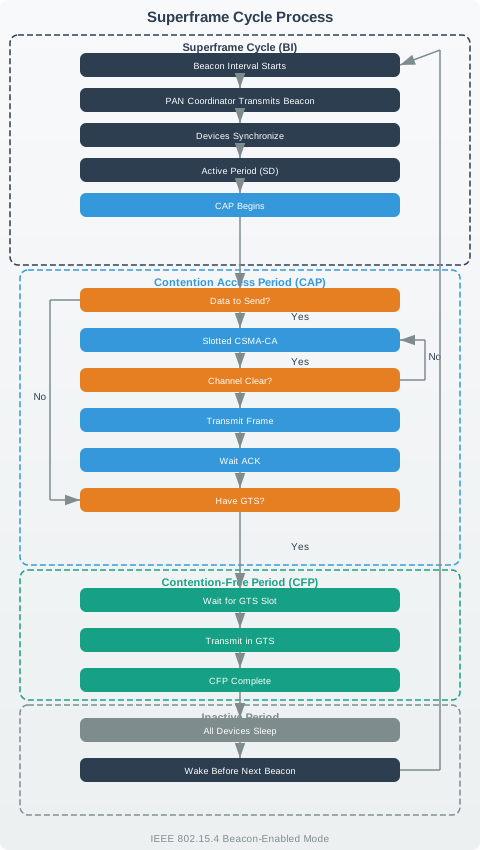
The CAP keeps shared access, while the optional CFP gives GTS windows to named devices.
- In the worked case, 12 sensors: 2 safety sensors = 10 sensors remain in the CAP while the two safety sensors use one GTS each.
- The schedule has not increased capacity; it has protected the traffic class whose lateness would matter most.
- A GTS does not make the radio faster; it replaces a random wait with ownership of a set window.
- If all twelve wake together, the safety frames compete with routine frames and their delay depends on random backoff.
Major section
Scheduling Time to Tame Collisions (continued)
Worked example: Suppose twelve shelf sensors normally report by contention, but two safety sensors must deliver one short status frame within a 100 ms control window.
- If the coordinator uses a beacon schedule and reserves one GTS for each safety sensor, those two frames move out of contention.
- The remaining ten devices can still use the CAP, while the safety sensors wait for their assigned CFP windows.
- The design review should therefore ask two questions before approving GTS.
- A one-frame status update every beacon interval is a better fit than a burst whose size changes wildly.
Major section
Beacon Order, Superframe Order, and Duty Cycle
The active duty cycle is SD / BI = 2^(0−6) = 1/64 = 1.5625%.
- The Beacon Interval (BI) is how often beacons repeat; the Superframe Duration (SD) is how much of that interval is active.
- The active duration is SD = 960 symbols, or 15.36 ms.
- That limit forces prioritization.
Major section
Beacon Order, Superframe Order, and Duty Cycle (continued)
Slot-sizing example: A different deployment might choose BO = 6, SO = 3.
- Both scale from a base of 960 symbols, so a small change in Beacon Order or Superframe Order doubles or halves the timing.
- In the 2.4 GHz PHY, one symbol is 16 µs, so symbol arithmetic turns directly into schedule time.
- Because the active superframe has 16 slots, each slot is 7680 / 16 = 480 symbols, or 7.68 ms.
Major section
Slotted CSMA/CA and the GTS Trade-off
Inside the CAP, beacon-enabled nodes use slotted: CSMA/CA.
- The random backoff is no longer an arbitrary delay; it is counted in beacon-aligned backoff periods.
- This reduces timing ambiguity and lets the coordinator define where contention is allowed.
- Slotted CSMA/CA also uses a contention window.
- A good advanced design uses both.
Major section
Slotted CSMA/CA and the GTS Trade-off (continued)
The exchange must also fit before the CAP ends.
- In 802.15.4, the MAC backoff period is 20 symbols, so at 2.4 GHz one backoff period is 20 × 16 µs = 320 µs.
- A device must see the channel idle for two consecutive clear-channel assessments before it transmits.
- That looks conservative, but it protects the CFP.
Major section
Slotted CSMA/CA and the GTS Trade-off (continued)
GTS removes contention for the owner, but it does not remove every failure mode.
- If either assessment finds the channel busy, the device increases its backoff attempt and tries again later, subject to the configured limits.
- CAP boundary example: In the BO = 6, SO = 3 schedule above, each active slot is 7.68 ms.
- The coordinator must track which devices own which slots and must reclaim or reassign unused reservations.
Major section
Slotted CSMA/CA and the GTS Trade-off (continued)
If the CAP is nearly over and a device still needs random backoff, two clear CCAs, data transmission, turnaround, acknowledgment, and inter-frame spacing, the safe answer may be to wait for the next superframe.
- Without that boundary rule, a late CAP frame could collide with a device that has been promised contention-free airtime.
- The owner must hear beacons, keep time with the coordinator, and have a frame exchange that fits inside the assigned slot count.
- Control-loop example: A machine-guard sensor must report once per cycle before a controller decides whether motion may continue.
Major section
Slotted CSMA/CA and the GTS Trade-off (continued)
A hidden coordinator, interference near beacon time, or excessive clock drift can make a scheduled design worse than CAP contention because devices now wait for windows they cannot reliably observe.
- In unslotted contention, the frame may arrive quickly when the channel is quiet, but the tail latency grows when unrelated devices wake together.
- With one GTS per beacon interval, the guard sensor waits for its reserved CFP window and transmits without backoff.
- The worst-case wait until the next scheduled slot is roughly one beacon interval, plus the frame exchange, so the reviewer can compare that bound with the control deadline.
Deck summary
Key takeaways
A reduced-function device is simpler.
- 802.15.4 frames are small.
- The CAP keeps shared access, while the optional CFP gives GTS windows to named devices.
- Worked example: Suppose twelve shelf sensors normally report by contention, but two safety sensors must deliver one short status frame within a 100 ms control window.
- The active duty cycle is SD / BI = 2^(0−6) = 1/64 = 1.5625%.
Retrieval practice
Recall check 1 of 5

Radio Remi says: answer from memory, then check your reasoning.
Q1A battery endpoint must sleep while powered devices carry traffic. Which role plan fits?
Show answer
Answer: D Routing stays with devices that can remain available.
Retrieval practice
Recall check 2 of 5
Radio Remi says: answer from memory, then check your reasoning.
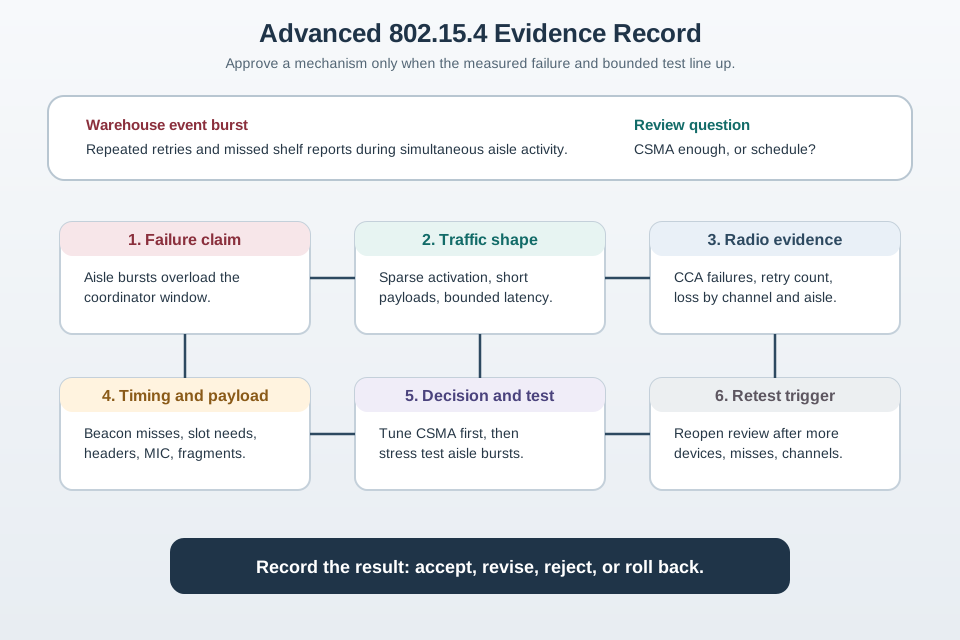
Q2A coordinator sees collisions during short event bursts. Only a small subset of devices is active, but the team has not measured the burst size, retry count, or query latency. What should the reviewer require before approving a group-testing-style collision-identification design?
Show answer
Answer: A Group-testing-style designs need measured sparse activation, query timing, RF reliability, energy impact, and stress-test evidence.
Retrieval practice
Recall check 3 of 5
Radio Remi says: answer from memory, then check your reasoning.
Q3In beacon-enabled 802.15.4, what is a Guaranteed Time Slot (GTS) used for?
Show answer
Answer: A GTS avoid CSMA/CA contention in the contention-free period; the chosen beacon interval and slot must still fit the actual deadline.
Retrieval practice
Recall check 4 of 5
Radio Remi says: answer from memory, then check your reasoning.
Q4With BO = 6 and SO = 0, what active duty cycle does the superframe impose?
Show answer
Answer: A The active superframe is 960 symbols (~15.4 ms) out of a 61440-symbol (~983 ms) interval. Nodes sleep ~98% of each ~983 ms beacon interval.
Retrieval practice
Recall check 5 of 5
Radio Remi says: answer from memory, then check your reasoning.
Q5How does slotted CSMA/CA (beacon-enabled) differ from unslotted CSMA/CA?
Show answer
Answer: B Slotted access is synchronised to the superframe and uses a two-CCA contention window, unlike the single-CCA unslotted scheme.
Print reference
Answers 1 of 2
Answer key.
- D · Routing stays with devices that can remain available.
- A · Group-testing-style designs need measured sparse activation, query timing, RF reliability, energy impact, and stress-test evidence.
- A · GTS avoid CSMA/CA contention in the contention-free period; the chosen beacon interval and slot must still fit the actual deadline.
- A · The active superframe is 960 symbols (~15.4 ms) out of a 61440-symbol (~983 ms) interval. Nodes sleep ~98% of each ~983 ms beacon interval.
Print reference
Answers 2 of 2
Answer key.
- B · Slotted access is synchronised to the superframe and uses a two-CCA contention window, unlike the single-CCA unslotted scheme.