Wi-Fi & 802.11 · Study deck

IEEE 802.15.4 Fundamentals

Picture a greenhouse sensor that wakes once a minute and sends moisture data through a short low-power link.

Radio Remi is your guide for this deck.

ieee-802-15-4fundamentalsframe-budget
Radio Remi, the module guide, in a scene from this chapter.
iotclass.org

After studying this chapter

Learning objectives

You will be able to:

  • explain what IEEE 802.15.4 defines and what it leaves to upper layers
  • separate FFD, RFD, coordinator, router, parent, child, and end-device role language
  • identify why the classic 127-octet PSDU profile shapes payload and protocol overhead decisions
  • compare non-beacon channel access with beacon-enabled scheduling assumptions
iotclass.org

Major section

Start With the Wireless Story

The maker wants years of battery life, yet each send also needs addresses, checks, security data, and perhaps a reply.

  • Nearby traffic can force more waits and tries.
  • A short frame or low quoted rate does not by itself prove long life.
  • This opening does not promise range or choose an upper stack.

Key terms

If any answer
If any answer is no, the years-long claim stays open.
iotclass.org

Major section

Start With the Wireless Story (continued)

The link can report and coordinate, but loss still needs a safe rule at the device or site.

  • Under the Hood examines channel access, timing, frame limits, security cost, coexistence, and how higher layers use the lower service.
  • If any answer is no, the years-long claim stays open.
  • A small clear record lets the next person see why the link passed.
iotclass.org

Major section

Core Boundary

The first review question is not which product name appears on the box, but which layer owns the claim.

  • Range and coexistence claims depend on the implemented PHY, antenna, enclosure, channel plan, and installed observations.
IEEE 802.15.4 defines PHY and MAC services; routing, commissioning, application meaning, and end-to-end interoperability depend on the selected upper stack and product. Payload, reliability, and range claims therefore require profile and field evidence rather than a radio name alone.
iotclass.org

Major section

What 802.15.4 Defines

The PHY layer covers how the radio sends and receives symbols in the selected band and channel.

  • It includes the radio behavior needed to transmit and receive packets, but the exact product performance depends on the radio, antenna, firmware, power settings, enclosure, and environment.
  • These functions make 802.15.4 a useful foundation for constrained wireless systems.
  • They do not by themselves prove routing, application interoperability, user onboarding, cloud connection, or product support behavior.

Numbers to remember

15.4 aThese functions make 802.15.4 a useful foundation for constrained wireless systems.
iotclass.org

Major section

Folded Stack Boundary Evidence

Same radio does not mean same protocol.

  • Two devices may agree on 802.15.4 PHY and MAC behavior while disagreeing on routing, IPv6 adaptation, application data model, commissioning flow, security material, gateway behavior, diagnostics, or firmware-update practice.
IEEE 802.15.4 defines PHY and MAC services; routing, commissioning, application meaning, and end-to-end interoperability depend on the selected upper stack and product. Payload, reliability, and range claims therefore require profile and field evidence rather than a radio name alone.
iotclass.org

Major section

Device Capability And Product Role

802.15.4 uses device capability terms, while upper-layer stacks and products use role terms.

  • An FFD can implement the full function set needed for coordination or routing roles.
  • An RFD is a simpler device that normally communicates through an FFD and avoids forwarding traffic for others.
  • A product role may be coordinator, router, parent, child, sleepy end device, border router, bridge, actuator, sensor, or gateway.

Key terms

Some of those roles
Some of those roles are created by the upper-layer stack, not by the lower-layer standard alone.
iotclass.org

Major section

Frame Budget

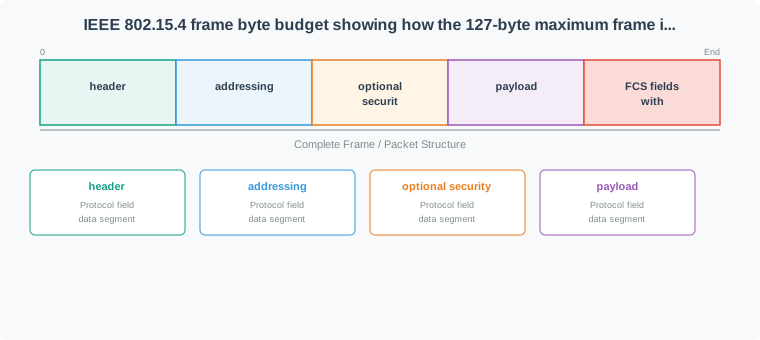
For the classic 127-octet PSDU profile used by common 2.4 GHz IEEE 802.15.4 deployments, the PHY carries a MAC frame of at most 127 octets.

  • Other IEEE 802.15.4 PHYs and amendments can define different frame-length or FCS options, so a review must name the active profile before applying this budget.
In the classic 127-octet profile, the PSDU carries one MAC frame: a variable MAC header, a variable MAC payload, and a two-octet FCS footer. Addressing and security choices change the MAC overhead, while adaptation, routing, transport, and application headers consume the remaining payload room; useful application data is therefore configuration-dependent.
iotclass.org

Major section

The 802.15.4 Physical Layer Sets the Radio Budget
For the common 2.4 GHz O-QPSK profile taught here, one PSDU may carry at most 127 octets.

  • Other IEEE 802.15.4 PHY profiles can differ, so the engineering record must name the active profile.
  • The standard family has several amendment names that appear in product literature.

Numbers to remember

15.4a802.15.4a added alternate PHY work such as UWB support

Why it matters

Fundamentals review prevents that mistake before deployment testing begins.

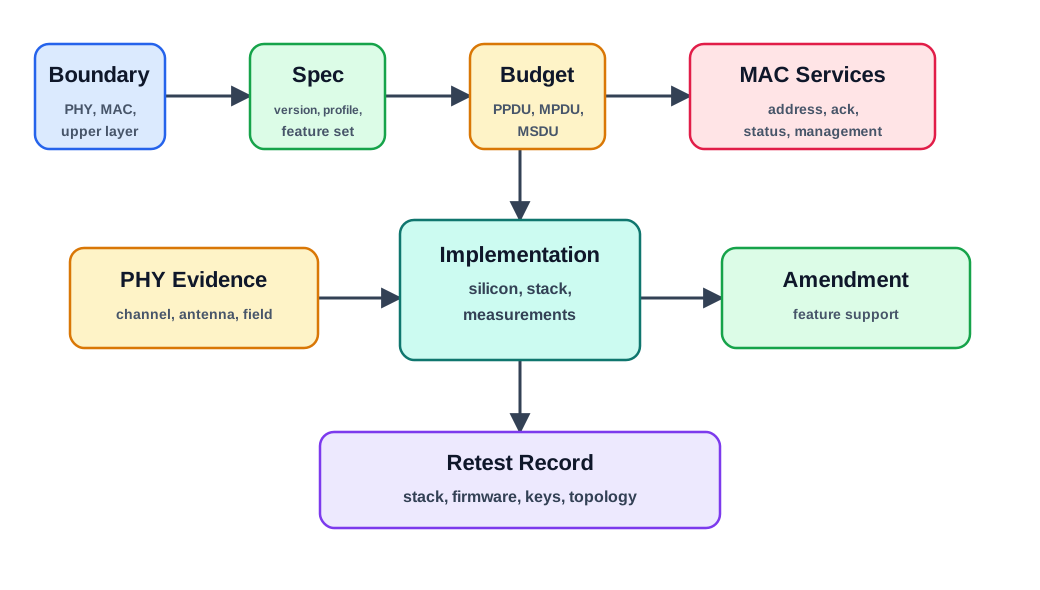
Fundamentals review turns layer facts into evidence gates. Start by separating PHY, MAC, and upper-layer claims, then check the active specification profile, frame budget, MAC services, implementation evidence, installed PHY evidence, amendment support, and the retest trigger.
iotclass.org

Major section

The 802.15.4 Physical Layer Sets the Radio Budget (continued)

Fundamentals review prevents that mistake before deployment testing begins.

  • A review should not treat the number alone as a deployment proof; it should name the actual PHY, channel plan, MAC mode, and upper-layer stack in use.
  • Range claims need the same caution.
  • Teaching summaries often quote ordinary indoor links in the tens of metres, with much longer outdoor line-of-sight results possible under clean radio conditions.
iotclass.org

Major section

Read the Channel Plan and the Real Throughput

So channel 11 sits at 2405 MHz and channel 26 at 2480 MHz.

  • The 250 kbit/s label is not delivered throughput.
  • Every frame also carries a MAC header, addressing, an optional security header, and a 2-byte FCS, and the MAC spends time on inter-frame spacing, CSMA/CA backoff, and the acknowledgment.
  • Worked example.: Send one full 127-byte frame at 2.4 GHz.

Numbers to remember

2405 MHzSo channel 11 sits at 2405 MHz
2.4 GHzWorked example.: Send one full 127-byte frame at 2.4 GHz.
iotclass.org

Major section

O-QPSK, DSSS, and Why 250 kbit/s Is Robust

At 2.4 GHz the PHY groups every 4 data bits into one symbol (16 possible symbols) at a symbol rate of 62.5 ksymbol/s — that is the 250 kbit/s.

  • Each symbol is then mapped to a 32-chip near-orthogonal pseudo-random sequence and transmitted at 2 Mchip/s using offset-QPSK with half-sine pulse shaping (equivalent to MSK).
  • That 32-chips-per-4-bits spreading is what makes the link tough.
  • The DSSS processing gain is 10 log₁₀(2 Mchip/s ÷ 250 kbit/s) = 10 log₁₀(8) ≈ 9 dB.
iotclass.org

Major section

O-QPSK, DSSS, and Why 250 kbit/s Is Robust (continued)

The receiver correlates against the known chip sequences, so it can recover weak symbols and reject some narrowband interference.

  • Worked example.: A node transmitting at 0 dBm into a receiver rated −97 dBm can tolerate about 97 dB of path loss before the link fails — comfortably tens of metres indoors.
  • Processing gain is not a substitute for deployment evidence.
  • The frame budget has the same hidden-layer effect.
iotclass.org

Deck summary

Key takeaways

The maker wants years of battery life, yet each send also needs addresses, checks, security data, and perhaps a reply.

  • The link can report and coordinate, but loss still needs a safe rule at the device or site.
  • The first review question is not which product name appears on the box, but which layer owns the claim.
  • The PHY layer covers how the radio sends and receives symbols in the selected band and channel.
  • Same radio does not mean same protocol.
iotclass.org

Retrieval practice

Recall check 1 of 5

Radio Remi says: answer from memory, then check your reasoning.

Q1A design document states, 'Our 802.15.4 devices form a reliable mesh automatically.' What is the best first review response?

AAsk which stack routes and which devices forward
BAccept it, since 802.15.4 includes complete mesh routing
CReject it, since 802.15.4 cannot send any frames at all
DAssume the mesh works because the radios are certified
Show answer

Answer: A 802.15.4 defines PHY/MAC; a reliable mesh needs an upper-layer routing stack and configured forwarders.

iotclass.org

Retrieval practice

Recall check 2 of 5

Radio Remi says: answer from memory, then check your reasoning.

Q2A design document says: 'Our 802.15.4 devices form a reliable mesh automatically.' What is the best first review response?

AAccept the claim because 802.15.4 always includes mesh routing
BAsk which stack routes and which devices forward
CCheck only whether the frame size is 127 bytes
DReject the design because 802.15.4 cannot support multi-hop systems
Show answer

Answer: B A mesh claim must name the routing layer and the configured forwarding roles.

iotclass.org

Retrieval practice

Recall check 3 of 5

Radio Remi says: answer from memory, then check your reasoning.

Q3At 2.4 GHz, what raw bit rate and maximum frame size does the IEEE 802.15.4 PHY provide?

A250 kbit/s raw and a 127-byte PSDU.
B54 Mbit/s, with a 1500-byte frame like Ethernet.
C1 Mbit/s, with a 255-byte frame like classic Bluetooth.
D20 kbit/s on all bands, with no frame-size limit.
Show answer

Answer: A The 2.4 GHz O-QPSK PHY runs at 250 kbit/s and the frame is capped at 127 bytes, so headers and security must fit inside that budget.

iotclass.org

Retrieval practice

Recall check 4 of 5

Radio Remi says: answer from memory, then check your reasoning.

Q4Which 2.4 GHz 802.15.4 channel is centred at 2480 MHz?

AChannel 26.
BChannel 11, the lowest channel.
CChannel 6, matching Wi-Fi channel 6.
DChannel 20, the middle channel.
Show answer

Answer: A Channel 26 is the top of the 16-channel plan: Fc = 2405 + 5 x (26 - 11) = 2480 MHz.

iotclass.org

Retrieval practice

Recall check 5 of 5

Radio Remi says: answer from memory, then check your reasoning.

Q5Why can an 802.15.4 radio hear signals near or below the noise floor even though it transmits only 1 mW?

ADSSS spreading gives processing gain recovered by correlation.
BBecause O-QPSK uses 4096-QAM to pack more bits per symbol.
CBecause the 2.4 GHz band has no interference.
DBecause it transmits at 20 dBm, overpowering noise.
Show answer

Answer: A The 2 Mchip/s spreading over a 250 kbit/s data rate yields about 9 dB of gain, enabling the receiver sensitivity expected by the PHY.

iotclass.org

Print reference

Answers 1 of 2

Answer key.

  1. A · 802.15.4 defines PHY/MAC; a reliable mesh needs an upper-layer routing stack and configured forwarders.
  2. B · A mesh claim must name the routing layer and the configured forwarding roles.
  3. A · The 2.4 GHz O-QPSK PHY runs at 250 kbit/s and the frame is capped at 127 bytes, so headers and security must fit inside that budget.
  4. A · Channel 26 is the top of the 16-channel plan: Fc = 2405 + 5 x (26 - 11) = 2480 MHz.
iotclass.org

Print reference

Answers 2 of 2

Answer key.

  1. A · The 2 Mchip/s spreading over a 250 kbit/s data rate yields about 9 dB of gain, enabling the receiver sensitivity expected by the PHY.
iotclass.org