Wi-Fi & 802.11 · Study deck

802.15.4 MAC Operation

Institute of Electrical and Electronics Engineers (IEEE) 802.15.4 is a set of radio and link rules for small, low-power devices.

Radio Remi is your guide for this deck.

ieee-802-15-4operationcsma-ca
Radio Remi, the module guide, in a scene from this chapter.
iotclass.org

After studying this chapter

Learning objectives

You will be able to:

  • Explain: If 18 devices wake in the same few seconds, more CCAs find the channel busy, some nodes increase their backoff exponent, and a few events may be delayed until a retry or application queue releases them.
  • Explain: Wi-Fi's DCF is also CSMA/CA, but it counts down a backoff timer slot by slot only while the medium is idle, freezing the counter whenever another station transmits, then resuming.
  • Explain: If the frame does transmit but no acknowledgment arrives, the MAC retransmits up to 3 times — a distinct failure path from channel-access failure.
iotclass.org

Major section

Start With the Wireless Story

Institute of Electrical and Electronics Engineers (IEEE) 802.15.4 is a set of radio and link rules for small, low-power devices.

  • Keeping its radio awake may give a fast reply but shorten battery life.
  • Sleeping saves energy but can delay a command.
  • A design must choose which events deserve awake time.

Key terms

802.15.4 operation
802.15.4 operation is a schedule for when a sleepy radio may speak.
iotclass.org

Major section

Start With the Wireless Story (continued)

The difference shows where the budget goes and whether the user promise still holds.

  • One good exchange does not prove a network will scale or survive interference.
  • The deeper sections explain frames, channel access, beacons, polling, retries, and the evidence needed when traffic or timing changes.
  • 802.15.4 operation is a schedule for when a sleepy radio may speak.
iotclass.org

Major section

Operation State Flow
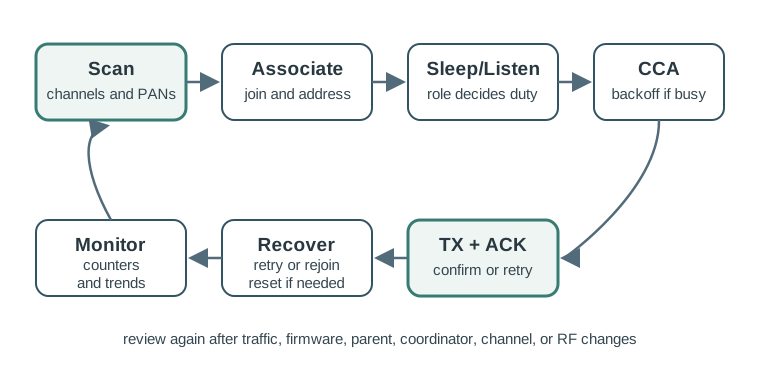
The state path connects MAC rules to timing and battery cost.

  • A device is not simply "connected." It cycles through discovery, association, channel access, data exchange, sleep or listen states, and recovery paths.
IEEE 802.15.4 operation state flow from scan and associate through sleep or listen, CCA and backoff, transmit and ACK, retry, rejoin, and monitoring.
iotclass.org

Major section

Non-Beacon CSMA/CA Operation

In non-beacon operation, devices use contention access.

  • If the channel is busy, the device waits for a random backoff and tries again according to MAC and stack limits.
  • If an acknowledgment was requested and no ACK arrives, the frame can be retried or reported as failed.
  • CSMA/CA is not a delivery guarantee.
iotclass.org

Major section

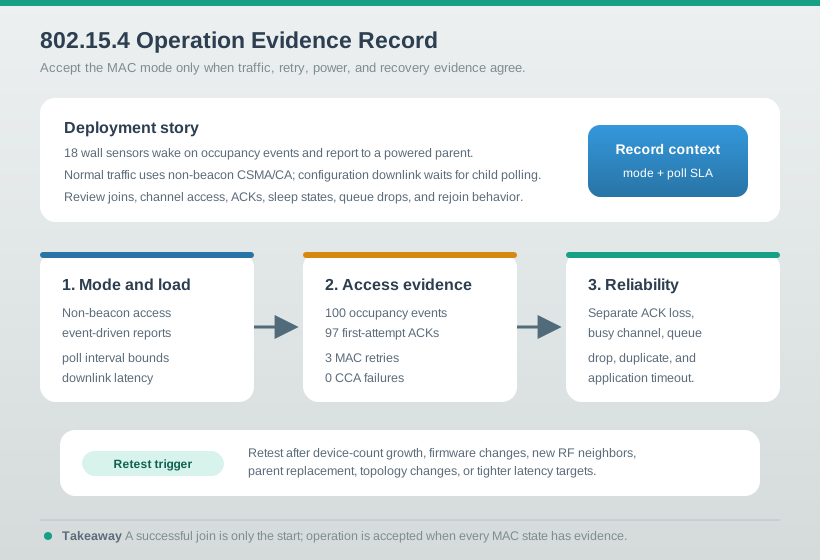
Operation Evidence Record

The record connects MAC settings to what the application actually received.

  • The record should show the mode, traffic pattern, metrics, failure handling, and retest trigger.
802.15.4 operation evidence record for 18 wall sensors showing non-beacon traffic, poll-limited downlink, 100 events, 97 first-attempt ACKs, three MAC retries, zero CCA failures, separated failure counters, and retest triggers.
iotclass.org

Major section

Worked Review Examples

Some command traffic is needed for configuration, but ordinary control does not require immediate downlink.

  • The key review question is whether the sleep behavior matches both reporting and configuration needs.
  • A set of meters reports during a collection window.
  • The traffic is predictable and many devices may transmit near the same time.
iotclass.org

Major section

The MAC Decides When a Radio May Talk
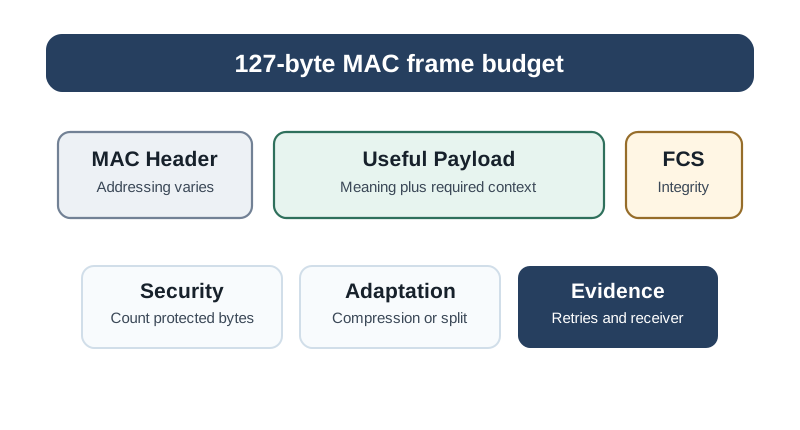
In the common non-beacon (unslotted) mode, every node uses CSMA/CA — carrier-sense multiple access with collision avoidance.

  • When two nodes both have data, the random backoff makes it unlikely they transmit at the same instant.
  • The ledger connects reliability settings to capacity, latency, and energy rather than treating them as free.
MAC operation consumes both airtime and frame budget. A review should connect CSMA/CA access, ACK and retry evidence, security overhead, adaptation overhead, and receiver behavior instead of treating raw PHY rate as usable application capacity.
iotclass.org

Major section

The MAC Decides When a Radio May Talk (continued)

During quiet periods, a sensor wakes, waits its random backoff, performs CCA, transmits, receives an ACK, and returns to sleep.

  • The evidence record for that case might show 100 events, 97 first-attempt successes, three MAC retries, no channel-access failures, and command latency bounded by the child poll interval.
  • The same design behaves differently when every room reports at the start of a meeting.
  • If 18 devices wake in the same few seconds, more CCAs find the channel busy, some nodes increase their backoff exponent, and a few events may be delayed until a retry or application queue releases them.
iotclass.org

Major section

The Backoff Parameters and Retry Budget

Unslotted CSMA/CA is driven by three MAC attributes with standard defaults.

  • The backoff time unit is aUnitBackoffPeriod = 20 symbols = 320 µs at 2.4 GHz (20 × 16 µs per symbol).
  • If busy, increment the backoff count and set BE = min(BE+1, macMaxBE); after macMaxCSMABackoffs busy results, report a channel-access failure.
  • A channel-access failure says the transmitter repeatedly sensed a busy channel before it could send.
iotclass.org

Major section

The Backoff Parameters and Retry Budget (continued)

Worked example.: First attempt uses BE = 3, so the node waits a random 0–7 backoff periods = 0–2240 µs (mean ~1.1 ms) before its first CCA.

  • If the channel is busy, BE becomes 4, widening the window to 0–15 periods (0–4800 µs); a third busy result widens it to BE = 5, 0–31 periods.
  • If the frame does transmit but no acknowledgment arrives, the MAC retransmits up to 3 times — a distinct failure path from channel-access failure.
  • A missing ACK says it did transmit, but the receiver did not confirm the frame.
iotclass.org

Major section

Why 802.15.4 Backoff Differs From Wi-Fi's DCF

Wi-Fi's DCF is also CSMA/CA, but it counts down a backoff timer slot by slot only while the medium is idle, freezing the counter whenever another station transmits, then resuming.

  • Unslotted 802.15.4 is simpler: it waits a fresh random backoff, performs a single CCA, and if busy it draws an entirely new random backoff with a larger exponent.
  • The fix is not a bigger radio but application design — stagger reports, add jitter, or use a beacon-enabled superframe for scheduled access.
  • Under load, the important counter is not just packet delivery.
iotclass.org

Deck summary

Key takeaways

Institute of Electrical and Electronics Engineers (IEEE) 802.15.4 is a set of radio and link rules for small, low-power devices.

  • The difference shows where the budget goes and whether the user promise still holds.
  • The state path connects MAC rules to timing and battery cost.
  • In non-beacon operation, devices use contention access.
  • The record connects MAC settings to what the application actually received.
iotclass.org

Retrieval practice

Recall check 1 of 5

Radio Remi says: answer from memory, then check your reasoning.

Q1A sleepy 802.15.4 sensor reports events reliably, but configuration commands from the coordinator sometimes arrive late. What should the reviewer check first?

APoll timing and parent buffering versus command latency
BThe uplink reporting rate, since event reports already work
CThe coordinator's power-supply voltage level
DThe color-coding of the dashboard alert banners
Show answer

Answer: A Late downlink commands to a sleepy sensor point to its poll/wake schedule and parent buffering versus the latency requirement.

iotclass.org

Retrieval practice

Recall check 2 of 5

Radio Remi says: answer from memory, then check your reasoning.

Q2A sleepy 802.15.4 sensor reports events reliably, but configuration commands sent from the coordinator sometimes arrive late. What should the reviewer check first?

AWhether command airtime dominates the downlink delay.
BWhether the device's downlink behavior, parent buffering.
CWhether the device could use a router role.
DWhether RSSI is strong enough, ignoring poll timing and parent state.
Show answer

Answer: B Operation review connects MAC behavior, parent buffering, polling, latency, and power state evidence.

iotclass.org

Retrieval practice

Recall check 3 of 5

Radio Remi says: answer from memory, then check your reasoning.

Q3In unslotted 802.15.4, what must a node do immediately before transmitting a data frame?

AWait a random backoff, then perform a clear channel assessment
BDetect the collision mid-transmission and abort, like wired Ethernet's CSMA/CD.
CRequest a fixed time slot from the PAN coordinator for every frame.
DTransmit immediately; the receiver sorts out any overlap.
Show answer

Answer: A Random backoff plus listen-before-talk is the heart of CSMA/CA collision avoidance; the node transmits only if CCA finds the channel idle.

iotclass.org

Retrieval practice

Recall check 4 of 5

Radio Remi says: answer from memory, then check your reasoning.

Q4On its first CSMA/CA attempt with default parameters, over what range does an unslotted 802.15.4 node pick its random backoff?

A0 to 31 backoff periods (BE = macMaxBE = 5, using the configured upper limit).
BExactly 320 us, a fixed wait with no randomness.
C0 to 7 backoff periods (BE = macMinBE = 3, so 2^3 - 1 = 7).
D0 to 1023 periods, matching Wi-Fi's contention window.
Show answer

Answer: C BE starts at 3, giving a random 0-7 periods, i.e. 0-2240 us before the first CCA. (Also: each period 320 us.).

iotclass.org

Retrieval practice

Recall check 5 of 5

Radio Remi says: answer from memory, then check your reasoning.

Q5How does unslotted 802.15.4 backoff differ from Wi-Fi's DCF backoff?

A802.15.4 uses collision detection (CSMA/CD) while Wi-Fi uses collision avoidance.
BWi-Fi never senses the channel; it relies only on acknowledgments.
CThey are identical; both freeze and resume a slotted countdown.
D802.15.4 draws a fresh random backoff and does one CCA.
Show answer

Answer: D

iotclass.org

Print reference

Answers 1 of 2

Answer key.

  1. A · Late downlink commands to a sleepy sensor point to its poll/wake schedule and parent buffering versus the latency requirement.
  2. B · Operation review connects MAC behavior, parent buffering, polling, latency, and power state evidence.
  3. A · Random backoff plus listen-before-talk is the heart of CSMA/CA collision avoidance; the node transmits only if CCA finds the channel idle.
iotclass.org

Print reference

Answers 2 of 2

Answer key.

  1. C · BE starts at 3, giving a random 0-7 periods, i.e. 0-2240 us before the first CCA. (Also: each period 320 us.).
  2. D
iotclass.org