Wi-Fi & 802.11 · Study deck

802.15.4 Deployment Practices

IEEE 802.15.4 is a low-power radio and link standard.

Radio Remi is your guide for this deck.

ieee-802-15-4deploymentsite-survey
Radio Remi, the module guide, in a scene from this chapter.
iotclass.org

After studying this chapter

Learning objectives

You will be able to:

  • Explain: The core relationship is the link budget: received power = transmit power + antenna gains − path loss, and the link margin is how far that received power sits above the receiver's sensitivity.
  • Explain: That retry pattern can make a plausible bench battery estimate wrong after installation, so the deployment record should include the measured retry count used by the power calculation.
  • Explain: Deployment turns the radio's numbers into a real link: how much signal actually reaches the receiver, and how much margin is left before the link drops.
  • plan 802.15.4 deployment evidence loops
iotclass.org

Major section

Begin With One Installed Link

IEEE 802.15.4 is a low-power radio and link standard.

  • Firmware is the code that runs on a device.
  • A range claim from a data sheet is not the field result.
  • More link margin can aid repair, but a louder or busier design may use more power and disturb peers.

Key terms

If a relay
If a relay is part of the claim, remove it once.
iotclass.org

Major section

Begin With One Installed Link (continued)

More relays can add paths, but they add upkeep and air use.

  • One site pass does not prove all seasons or loads.
  • Those routes keep the installed claim tied to measured change.
  • A map of real misses is worth more than one best range.
  • If a relay is part of the claim, remove it once.
iotclass.org

Major section

Deployment Evidence Loop
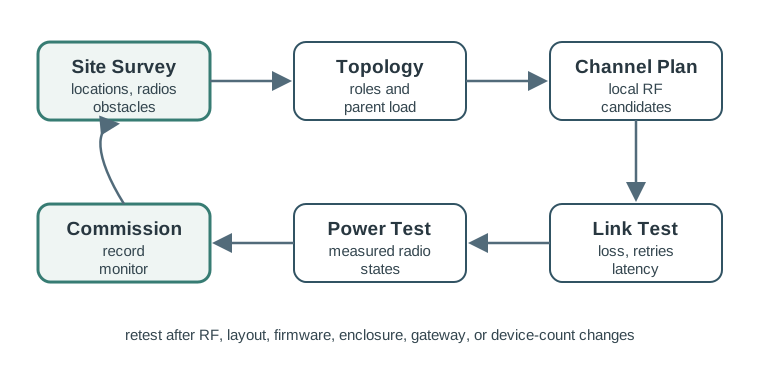
The loop connects planning assumptions to repeatable acceptance evidence.

  • A deployment decision should move from observation to a bounded test, then to commissioning and monitoring.
  • If the site changes, the loop reopens.
Deployment evidence loop from site survey through topology, channel choice, link validation, power measurement, commissioning, monitoring, and retest.
iotclass.org

Major section

Acceptance Record

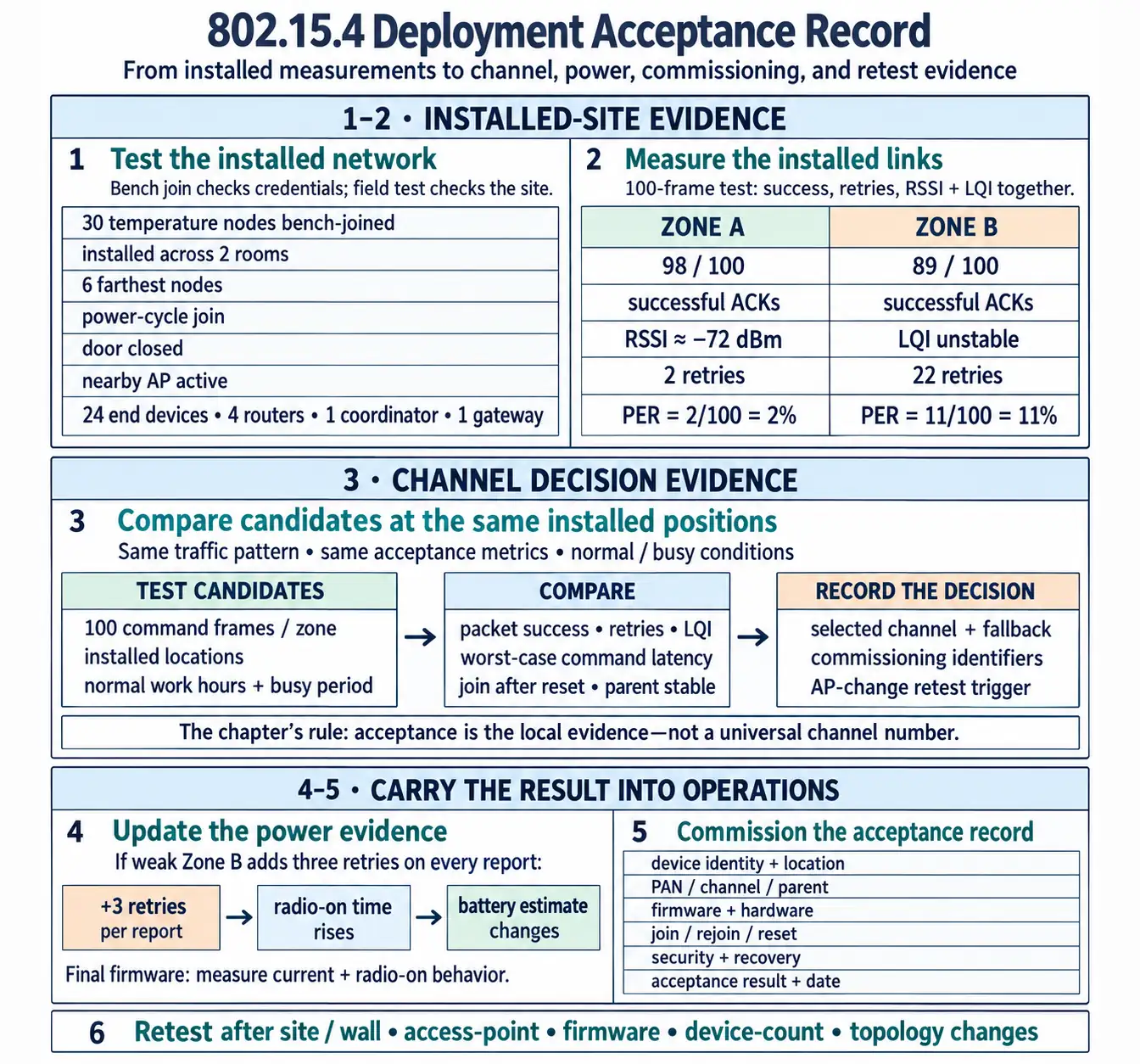
The record joins radio planning to installed measurements, commissioning, and future change control.

  • Finish at the retest trigger: it connects today's acceptance to the conditions under which the deployment must be measured again.
  • The record should make the decision reviewable months later when a wall moves, an access point changes, firmware is updated, or more devices are added.
Deployment acceptance record showing site baseline, role plan, channel evidence, link results, power evidence, commissioning record, and retest trigger.
iotclass.org

Major section

Worked Review Examples

A lighting retrofit adds 802.15.4 wall sensors to an office with existing Wi-Fi.

  • The acceptable answer is not a single channel number.
  • Failures cluster near metal racks and during shift changes.
  • The fix may combine placement, topology, and traffic shaping.
  • A channel change alone may not address the real cause.

Key terms

Temperature sensors
Temperature sensors are installed in cold rooms, freezers, or refrigerated cases.
iotclass.org

Major section

Deployment Is a Link-Budget Question

An 802.15.4 device may pass every bench test and still fail once it is bolted to a wall.

  • Deployment turns the radio's numbers into a real link: how much signal actually reaches the receiver, and how much margin is left before the link drops.
  • The same loop should connect RF, power, and maintenance.

Key terms

link margin
link margin is how far that received power sits above the receiver's sensitivity.
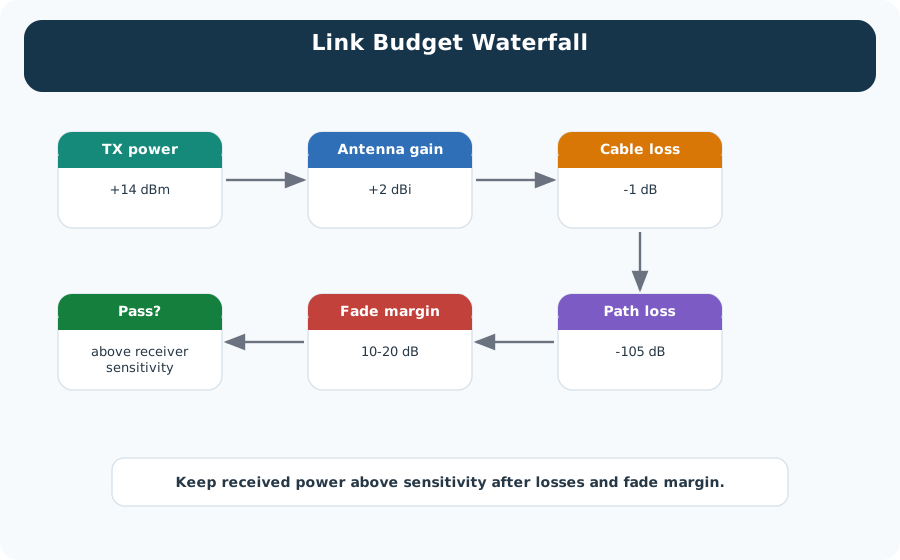
A link budget is a waterfall: add gains, subtract losses, and confirm the received power stays above receiver sensitivity after a reserved fade margin.
iotclass.org

Major section

Deployment Is a Link-Budget Question (continued)

The core relationship is the link budget: received power = transmit power + antenna gains − path loss, and the link margin is how far that received power sits above the receiver's sensitivity.

  • This connects calculation to placement, fading, and the deployment acceptance record.
  • A frame can arrive with strong RSSI but poor LQI if interference is corrupting chips — so both matter.
  • That difference tells the reviewer where to move a router, change channel, rotate an antenna, or reject the location before sign-off.
iotclass.org

Major section

Work a Real Link Budget

Free-space path loss at 10 m and 2.44 GHz is about 60 dB ( FSPL = 20 log₁₀d + 20 log₁₀f − 27.55 ).

  • If Parent B also reports steadier LQI and fewer retries, it is the better commissioning parent even if Parent A is physically closer.
  • If a marginal link causes three retries per report, the radio is awake for more attempts, channel access, acknowledgments, and backoff time.
  • That retry pattern can make a plausible bench battery estimate wrong after installation, so the deployment record should include the measured retry count used by the power calculation.
iotclass.org

Major section

Fade Margin, Multipath, and LQI-Driven Routing

The hidden failure is that every layer can look acceptable in isolation.

  • 2.4 GHz waves are ~12 cm long, so they reflect off metal shelving and reinforced walls and arrive via multiple paths that can add or cancel.
  • A device that reads a healthy −70 dBm today may drop 15 dB when a metal cart parks in the Fresnel zone.
  • RSSI can be above sensitivity, but interference can still lower LQI.

Numbers to remember

2.4 GHz2.4 GHz waves are ~12 cm long
~12 cm2.4 GHz waves are ~12 cm long
iotclass.org

Major section

Fade Margin, Multipath, and LQI-Driven Routing (continued)

That variability is why deployers budget a fade margin — commonly 10–20 dB of headroom — rather than installing at the edge of sensitivity.

  • A poor-LQI neighbour that happens to be one hop away can be a worse parent than a slightly farther neighbour with a clean link.
  • Worked example.: A warehouse sensor installs against a steel column and shows −88 dBm / low LQI with occasional retries.
  • No firmware or power change was needed — only respecting the link budget and the physics of the band.
iotclass.org

Major section

Fade Margin, Multipath, and LQI-Driven Routing (continued)

LQI can look acceptable during a quiet test, but a burst of application traffic can expose collisions and backoff delay.

  • Packet success can look fine near the coordinator, but the same device may churn between parents when a powered router is unplugged for maintenance.
  • A better fix may be a small placement change that gives one parent clear dominance, not a blanket transmit-power increase.
  • A candidate channel that improves the average RSSI is not automatically better if its LQI is unstable near a neighboring transmitter.
iotclass.org

Deck summary

Key takeaways

IEEE 802.15.4 is a low-power radio and link standard.

  • More relays can add paths, but they add upkeep and air use.
  • The loop connects planning assumptions to repeatable acceptance evidence.
  • The record joins radio planning to installed measurements, commissioning, and future change control.
  • A lighting retrofit adds 802.15.4 wall sensors to an office with existing Wi-Fi.
iotclass.org

Retrieval practice

Recall check 1 of 5

Radio Remi says: answer from memory, then check your reasoning.

Q1Every device joined during a short bench test. What evidence is still needed before signing off an 802.15.4 deployment?

ANothing further, because a successful bench join proves readiness
BOnly a louder status buzzer on the coordinator
CInstalled-location link, channel, and power-state evidence.
DOnly confirmation that firmware is the newest version
Show answer

Answer: C An 802.15.4 deployment needs installed-location link, channel, power-state, and retest evidence, not just a bench join.

iotclass.org

Retrieval practice

Recall check 2 of 5

Radio Remi says: answer from memory, then check your reasoning.

Q2A team wants to approve an 802.15.4 sensor deployment because every device joined during a short bench test. What evidence is still needed before deployment sign-off?

AOnly the raw PHY data rate, because successful joining proves the network is ready.
BA statement that all devices are full-function devices.
CA generic channel recommendation copied from another installation.
DInstalled-location link results, local channel evidence, role and topology review.
Show answer

Answer: D Deployment review connects installed-site evidence to topology, channel, power, commissioning, monitoring, and retest decisions.

iotclass.org

Retrieval practice

Recall check 3 of 5

Radio Remi says: answer from memory, then check your reasoning.

Q3What is the 'link margin' for an 802.15.4 deployment?

ASignal headroom above receiver sensitivity, measured in dB.
BThe number of hops between a device and the coordinator.
CThe percentage of the 127-byte frame used by payload.
DThe difference between 2.4 GHz and 868 MHz data rates.
Show answer

Answer: A Margin = received power - sensitivity; it is the headroom before fading drops the link.

iotclass.org

Retrieval practice

Recall check 4 of 5

Radio Remi says: answer from memory, then check your reasoning.

Q4A node reads RSSI = -84 dBm with sensitivity -95 dBm. What does the ~11 dB margin tell a deployer?

AIt works now, but fade headroom is thin.
BThe link has failed, since -84 dBm is below -95 dBm.
CMargin is irrelevant because LQI is the only trustworthy metric.
DIt means the data rate has dropped to 20 kbit/s.
Show answer

Answer: A About 11 dB of headroom is vulnerable to moving obstacles or interference, so the deployer should seek a steadier parent, placement, or router position.

iotclass.org

Retrieval practice

Recall check 5 of 5

Radio Remi says: answer from memory, then check your reasoning.

Q5Why do 802.15.4 mesh stacks feed LQI into their routing metric rather than always choosing the physically nearest neighbour?

ANearest may be noisy; a farther parent can have steadier LQI.
BBecause LQI estimates physical distance without requiring node coordinates.
CBecause LQI increases the transmit power on the chosen link.
DBecause the strongest local LQI identifies the route with the fewest hops.
Show answer

Answer: A Link quality, not raw distance, predicts reliable delivery, so LQI-weighted routing can pick the sturdier path.

iotclass.org

Print reference

Answers 1 of 2

Answer key.

  1. C · An 802.15.4 deployment needs installed-location link, channel, power-state, and retest evidence, not just a bench join.
  2. D · Deployment review connects installed-site evidence to topology, channel, power, commissioning, monitoring, and retest decisions.
  3. A · Margin = received power - sensitivity; it is the headroom before fading drops the link.
  4. A · About 11 dB of headroom is vulnerable to moving obstacles or interference, so the deployer should seek a steadier parent, placement, or router position.
iotclass.org

Print reference

Answers 2 of 2

Answer key.

  1. A · Link quality, not raw distance, predicts reliable delivery, so LQI-weighted routing can pick the sturdier path.
iotclass.org