Wi-Fi & 802.11 · Study deck
802.15.4 Coexistence
Picture a building where small battery sensors and Wi-Fi devices use the same part of the air.
Radio Remi is your guide for this deck.

After studying this chapter
Learning objectives
You will be able to:
- distinguish coexistence symptoms from weak-link, routing, and application problems
- explain why nearby Wi-Fi traffic can disrupt 2.4 GHz 802.15.4 networks
- choose channel candidates from measured local evidence rather than generic rules
- identify when traffic shaping or topology changes are better than a channel change
Major section
Start With the Wireless Story · In 60 Seconds
At lunch, video traffic grows and some sensor reports vanish.
- IEEE 802.15.4 is a radio rule set for small, low-power messages.
- Coexistence means several radio systems can share a place with an acceptable result.
- An access point is the local radio that joins Wi-Fi devices to a network.
Major section
Phoebe's Field Notes: Why 802.15.4's Sub-GHz Escape Route Trades Away the Coexistence Problem Entirely · Coexistence Diagnosis Flow
The mathematical gist.: Wavelength is wave speed divided by frequency.
- At 915 MHz it is 32.8 cm, so a quarter-wave is 8.20 cm; at 2450 MHz those dimensions shrink to 12.2 cm and 3.06 cm.
Major section
What To Observe · Channel Candidate Review
The observation window should match the real problem.
- A hospital, classroom, warehouse, office, or apartment building may look quiet at night and crowded during the day.
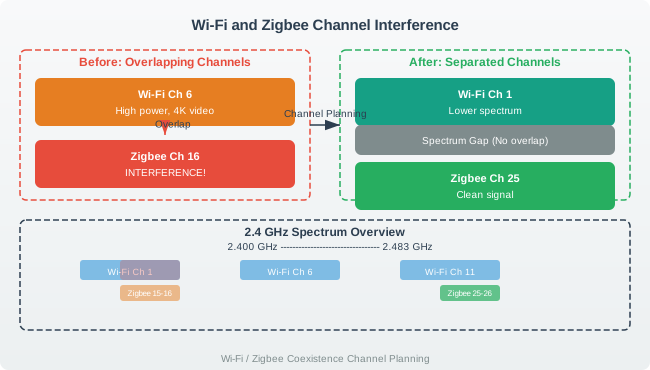
- Some 2.4 GHz 802.15.4 channels are often better candidates around common Wi-Fi channel plans, but the best choice is still local.
- Channel width, transmit power, physical distance, access-point placement, neighboring networks, and device support all matter.
Major section
Mitigation Options · Coexistence Evidence Record
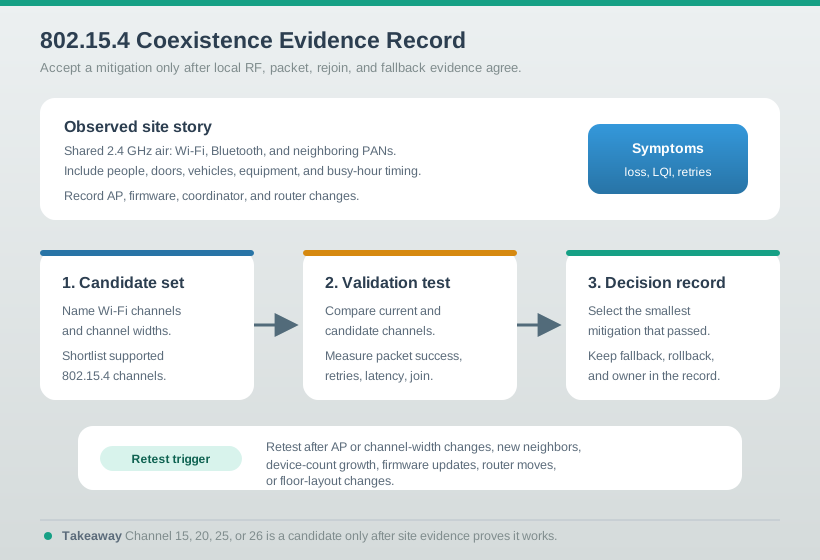
A channel number is meaningful only alongside interference, device support, packet behaviour, and power evidence.
- The owner and retest trigger carry that bounded result into operations, completing the chapter's evidence-led diagnosis.
- A coexistence fix is not complete until the team records the environment, symptom, candidate tests, decision, fallback, and retest trigger.
Major section
Worked Review Examples
An office lighting network becomes unreliable after access points are replaced.
- The sensors still show usable RSSI, but retries and latency increase during work hours.
- The answer must say why that channel is supported, why it is a better candidate in this site, and what evidence proves improvement.
- A warehouse has many battery tags that report when pallets move.
Major section
Worked Review Examples (continued)
Failures happen when shift changes trigger many events at once.
- If the channel is clean but every device reports at the same time, coexistence is not the main problem.
- The MAC is being overloaded by synchronized traffic.
- A tenant operates an 802.15.4 network in a building where Wi-Fi is managed by another organization.
Major section
The 2.4 GHz Band Is Crowded · Map 802.15.4 Channels Against Wi-Fi 1/6/11
802.15.4's 2.4 GHz band is shared license-exempt spectrum.
- The same 2400–2483.5 MHz carries Wi-Fi (802.11), Bluetooth and BLE, other 802.15.4 networks, and even microwave-oven leakage.
- Coexistence also protects battery life.
Major section
CCA Modes and Frequency Agility
CCA example.: A sensor wants to send a short alarm.
- Energy detection sees Wi-Fi and microwave energy, which is useful for coexistence.
- CCA still has limits.
- During a quiet hour, energy-detect CCA finds the channel clear on most attempts, so the alarm usually transmits on the first try.
- Delivery improves without increasing transmit power.
Major section
CCA Modes and Frequency Agility (continued)
It checks the channel before a frame begins; it does not protect against a hidden interferer that starts after the check, and it cannot make airtime appear when the channel is busy most of the time.
- If an access point is close to the coordinator and the channel is occupied during most application bursts, an 802.15.4 node can spend its time backing off, failing channel access, or retrying corrupted frames.
- During a Wi-Fi-heavy hour, CCA reports busy on many attempts.
- The packet problem is now visible as channel-access failures, retry count, and latency, not only as final packet loss.
Major section
CCA Modes and Frequency Agility (continued)
If the node needs three backoff rounds before it transmits, and the frame is then corrupted by another burst, the application sees both delay and retry energy.
- A network can detect a degraded channel through rising energy, falling delivery ratio, or persistent retries, then migrate the PAN to a cleaner supported channel.
- The migration is itself a risk: devices must hear the change, move together, rejoin if needed, and preserve application state.
- A coexistence design should therefore specify when agility is automatic, when it is a maintenance action, and how failed movers are recovered.
Major section
CCA Modes and Frequency Agility (continued)
Agility example.: A Zigbee network on channel 20 runs acceptably until an access point is retuned near Wi-Fi channel 11.
- Energy-detect CCA starts reporting busy, retries climb, and packet delivery drops in the rooms nearest the access point.
- A bounded test moves the PAN to channel 25, which the product supports and which measured better during the failure window.
- The acceptance record should still keep the old channel, candidate results, failed-device recovery procedure, and retest trigger, because coexistence is an ongoing measurement-and-agility loop rather than a one-time channel pick.
Major section
Summary · Key Takeaway
802.15.4 coexistence review is about local evidence.
- Wi-Fi overlap can matter, but so can synchronized 802.15.4 bursts, neighboring PANs, weak links, router placement, firmware changes, and join behavior.
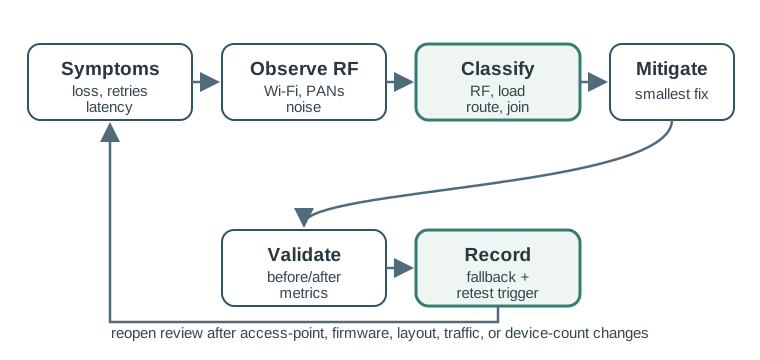
- A reliable review records symptoms, observes the RF environment, tests candidate mitigations, validates packet and latency improvements, and defines when the decision must be reopened.
- 802.15.4 Coexistence should treat interference as a deployment evidence problem, balancing channels, duty cycle, retries, placement, and coexistence with nearby Wi-Fi or other radios.
Deck summary
Key takeaways
At lunch, video traffic grows and some sensor reports vanish.
- The mathematical gist.: Wavelength is wave speed divided by frequency.
- The observation window should match the real problem.
- A channel number is meaningful only alongside interference, device support, packet behaviour, and power evidence.
- An office lighting network becomes unreliable after access points are replaced.
Retrieval practice
Recall check 1 of 5

Radio Remi says: answer from memory, then check your reasoning.
Q1An 802.15.4 lighting network starts missing commands after a Wi-Fi access-point swap; RSSI is fine but LQI drops and retries rise in busy hours. What should the reviewer do first?
Show answer
Answer: C Falling LQI and rising retries with good RSSI after a Wi-Fi change indicate interference; collect channel and loss evidence first.
Retrieval practice
Recall check 2 of 5

Radio Remi says: answer from memory, then check your reasoning.
Q2An 802.15.4 lighting network starts missing commands after a Wi-Fi access-point replacement. RSSI is still acceptable, but LQI drops and retries rise during busy office hours. What should the reviewer do first?
Show answer
Answer: D Coexistence review starts with local evidence, then chooses and validates the smallest mitigation that matches the cause.
Retrieval practice
Recall check 3 of 5

Radio Remi says: answer from memory, then check your reasoning.
Q3Why is channel selection the first coexistence lever for a 2.4 GHz 802.15.4 network sharing air with Wi-Fi?
Show answer
Answer: A With a ~30 dB power disadvantage, avoiding the interferer's spectrum is far more effective than raising 802.15.4 power. (Also: dodging Wi-Fi's channels beats trying to overpower them.).
Retrieval practice
Recall check 4 of 5

Radio Remi says: answer from memory, then check your reasoning.
Q4A building runs Wi-Fi on channels 1, 6, and 11. Which 802.15.4 channels best avoid that Wi-Fi traffic?
Show answer
Answer: A These are the classic recommended 802.15.4 channels because each dodges the 20 MHz Wi-Fi blocks on 1/6/11.
Retrieval practice
Recall check 5 of 5

Radio Remi says: answer from memory, then check your reasoning.
Q5Why is energy-detection CCA (Mode 1) often preferred over pure carrier-sense CCA (Mode 2) for coexistence with Wi-Fi?
Show answer
Answer: B Non-802.15.4 interferers are invisible to pure carrier sense, so energy detection gives a truer picture of a shared band. (Also: including Wi-Fi and microwave energy, whereas carrier sense reacts only to valid 802.15.4 signals.).
Print reference
Answers 1 of 2
Answer key.
- C · Falling LQI and rising retries with good RSSI after a Wi-Fi change indicate interference; collect channel and loss evidence first.
- D · Coexistence review starts with local evidence, then chooses and validates the smallest mitigation that matches the cause.
- A · With a ~30 dB power disadvantage, avoiding the interferer's spectrum is far more effective than raising 802.15.4 power. (Also: dodging Wi-Fi's channels beats trying to overpower them.).
Print reference
Answers 2 of 2
Answer key.
- A · These are the classic recommended 802.15.4 channels because each dodges the 20 MHz Wi-Fi blocks on 1/6/11.
- B · Non-802.15.4 interferers are invisible to pure carrier sense, so energy detection gives a truer picture of a shared band. (Also: including Wi-Fi and microwave energy, whereas carrier sense reacts only to valid 802.15.4 signals.).