Wi-Fi & 802.11 · Study deck

802.15.4 Specifications and Roles

Picture a warehouse tag that sends one short shelf update through a busy band.

Radio Remi is your guide for this deck.

ieee-802-15-4specificationscsma-ca
Radio Remi, the module guide, in a scene from this chapter.
iotclass.org

After studying this chapter

Learning objectives

You will be able to:

  • identify the 802.15.4 PHY and MAC features that affect design review
  • explain why nominal data rate is not the same as usable application throughput
  • review how frame fields and security overhead reduce payload space
  • distinguish non-beacon CSMA/CA from beacon-enabled scheduling and GTS
iotclass.org

Major section

Start With the Wireless Story

A product sheet lists range, rate, and low power, but the planner still has to fit an address, security data, and the reading into one small frame.

  • Nearby office traffic may also delay the send.
  • A supported feature is not proof of a working site.
  • This opening does not pick a stack or promise a fixed range.

Key terms

If any answer
If any answer is no, test again.
iotclass.org

Major section

Start With the Wireless Story (continued)

A low-power link can report and coordinate, but loss and delay still need a known local response.

  • Under the Hood examines timing, channel access, device roles, security cost, and the exact limits behind each choice.
  • If any answer is no, test again.
  • Specification choices become deployment limits.
iotclass.org

Major section

In 60 Seconds · Phoebe's Field Notes: Why the Same Chair Blocks 2.4 GHz But Not 915 MHz

IEEE 802.15.4 is a low-rate wireless PHY/MAC standard.

  • The most important review skill is knowing which feature belongs to the standard, which feature belongs to an upper-layer stack, and which deployment claim still needs measurement.

Numbers to remember

915 MHzThe mathematical gist.: At 915 MHz the wavelength is 0.328 m
0.328 mThe mathematical gist.: At 915 MHz the wavelength is 0.328 m
0.5 mso a 0.5 m obstacle is 1.52 wavelengths wide.
iotclass.org

Major section

Specification Review Map · What 802.15.4 Specifies
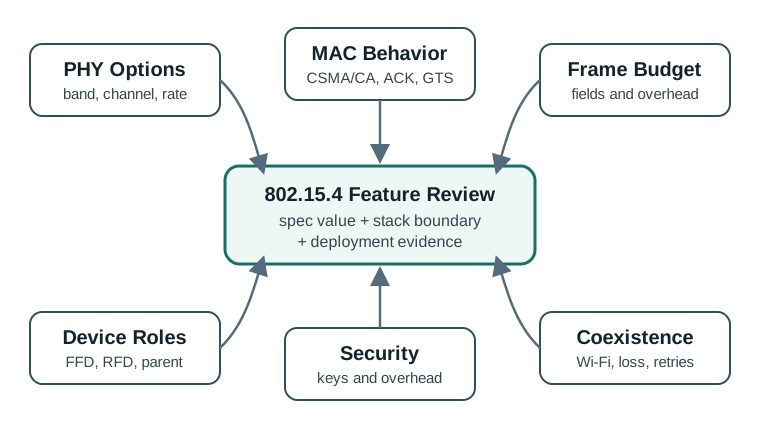
This separates what the standard permits from what the chosen hardware and deployment prove.

  • A design can be wrong even when a single data-rate, frequency, or channel number is correct.
IEEE 802.15.4 feature and specification review map.
iotclass.org

Major section

PHY Features To Review · MAC Features To Review

where $R_b$ is bit rate and $R_c$ is chip rate.

  • The common 2.4 GHz PHY uses channels 11 through 26, spaced 5 MHz apart from 2405 MHz to 2480 MHz, with a nominal 250 kbps rate.
  • Regional sub-GHz PHY options also exist, and their allowed channels and rates depend on region, amendment, and local regulation.
  • Legacy lower-rate sub-GHz PHYs use BPSK, where the carrier phase represents two symbol states.

Numbers to remember

2.4 GHzThe common 2.4 GHz PHY uses channels 11 through 26
iotclass.org

Major section

Frame Budget · Beacon Mode And GTS

The 802.15.4 frame is small enough that every field matters.

  • A payload estimate should count the MAC header, addressing fields, footer, security fields, and any upper-layer adaptation headers before claiming application capacity.
  • Beacon-enabled operation can organize time into a superframe.
  • The contention access period supports CSMA/CA traffic.
iotclass.org

Major section

Coexistence Review · Worked Review Examples
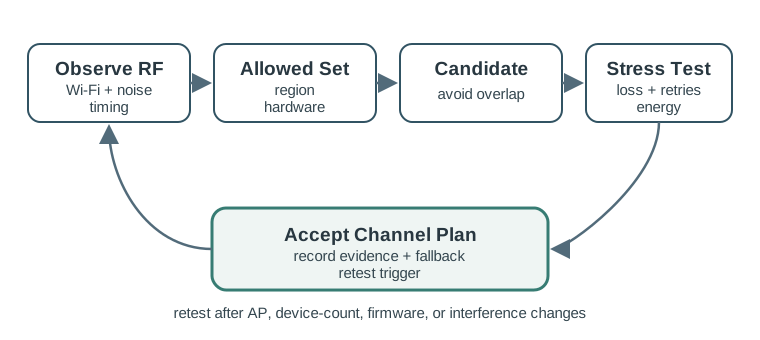
2.4 GHz 802.15.4 networks often share space with Wi-Fi and other radios.

  • A good channel plan starts with observation, not a universal "always use channel X" rule.
  • The route keeps spectrum observations, device capabilities, and service outcomes connected.
  • A classroom prototype has a few sensors sending short messages every minute.

Numbers to remember

2.4 GHz2.4 GHz 802.15.4 networks often share space with Wi-Fi
802.15.4 coexistence review path.
iotclass.org

Major section

Two Device Types and One Coordinator

802.15.4 defines two device classes.

  • A reduced-function device (RFD) is deliberately simpler.
  • It talks only to an FFD, does not become a coordinator, and is normally used as a low-power leaf node whose radio can sleep for long periods.
  • The role choice also affects failure analysis.

Key terms

reduced-function device (RFD)
reduced-function device (RFD) is deliberately simpler.
If a door sensor
If a door sensor is an RFD, it cannot be blamed for failing to relay a neighbour's packet; that was never its job.
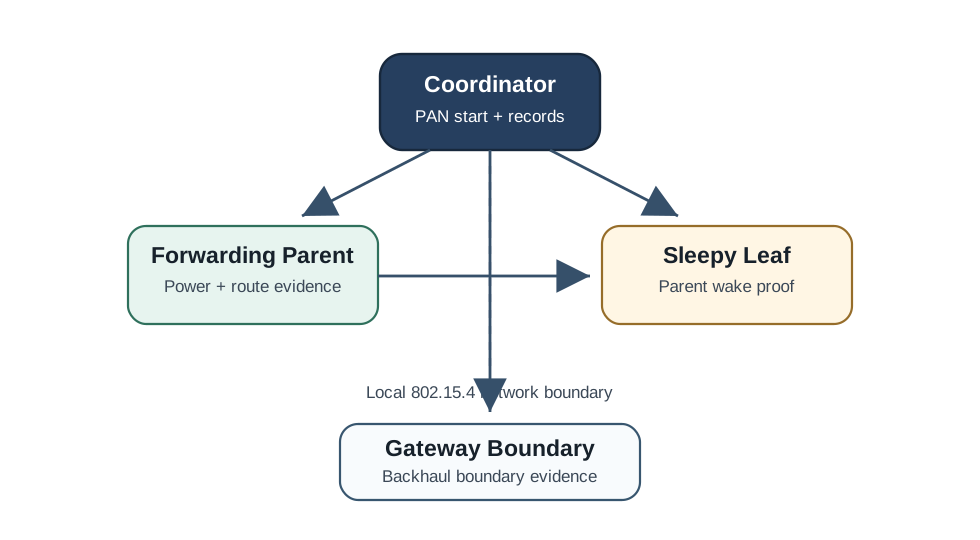
Role review starts by separating the local 802.15.4 network boundary from the upper-layer gateway boundary, then assigning coordinator, forwarding, and sleepy-leaf responsibilities to devices that can support them.
iotclass.org

Major section

Two Device Types and One Coordinator (continued)

The map therefore connects RFD and FFD capability to actual deployment duties while keeping upper-layer routing and gateway services outside the PHY/MAC claim.

  • That device is an FFD, starts the PAN, chooses or owns the 16-bit PAN identifier, and manages association for devices that join.
  • Worked topology example.: A room has 30 battery door sensors and 3 powered relay nodes.
  • If every node were treated as an FFD with receiver-on behavior, the design would waste energy on devices that never need to coordinate traffic.
  • Confusing FFD/RFD with Zigbee coordinator/router/end-device names makes this easy to miss.
iotclass.org

Major section

Two Device Types and One Coordinator (continued)

A cleaner mapping makes the door sensors RFD leaves and the powered relays FFD-capable infrastructure.

  • The PAN coordinator can assign short addresses and manage the network, while the upper-layer stack decides whether powered relays also route application traffic.
  • The specification review should write down which role is 802.15.4 and which role belongs to the upper layer.
  • If a door sensor is an RFD, it cannot be blamed for failing to relay a neighbour's packet; that was never its job.
  • A battery sensor is usually an RFD; a powered relay or PAN coordinator must use FFD capability.
iotclass.org

Major section

Addressing, Frame Types, and the Header Budget · The Frame Control Field and Indirect Transmission

The practical review habit is to ask for a frame budget table, not a sentence.

  • 802.15.4 nodes carry two addresses.
  • The 64-bit extended address is a globally unique IEEE EUI-64 associated with the radio.
  • Two FCF ideas reveal how sleepy RFDs are supported.

Numbers to remember

23 bytesOverhead becomes 11 + 12 = 23 bytes

Why it matters

It should also say whether the estimate is for ordinary data, a join/control exchange, or an alarm path, because those may use different frame types and different header combinations.

iotclass.org

Deck summary

Key takeaways

A product sheet lists range, rate, and low power, but the planner still has to fit an address, security data, and the reading into one small frame.

  • A low-power link can report and coordinate, but loss and delay still need a known local response.
  • IEEE 802.15.4 is a low-rate wireless PHY/MAC standard.
  • This separates what the standard permits from what the chosen hardware and deployment prove.
  • where $R_b$ is bit rate and $R_c$ is chip rate.
iotclass.org

Retrieval practice

Recall check 1 of 5

Radio Remi says: answer from memory, then check your reasoning.

Q1A team cites the 250 kbps PHY rate to justify adding a new sensor group to a 2.4 GHz 802.15.4 network. What evidence is still needed?

AOnly the marketing datasheet's headline range figure
BOnly confirmation that the radios operate at 2.4 GHz
CFrame budget, traffic timing, retry and loss evidence.
DOnly that the coordinator device powers on cleanly
Show answer

Answer: C A nominal PHY data rate needs frame-budget, timing, retry/loss, and coexistence evidence before a new sensor group is accepted.

iotclass.org

Retrieval practice

Recall check 2 of 5

Radio Remi says: answer from memory, then check your reasoning.

Q2A team says their 2.4 GHz 802.15.4 network can support a new sensor group because the PHY data rate is 250 kbps. What should the reviewer ask for before accepting the claim?

AOnly the number of sensors, because the PHY data rate already proves capacity.
BA guarantee that every device uses GTS.
CA statement that the network uses Zigbee.
DFrame budget, traffic timing, retry and loss evidence, coexistence observations.
Show answer

Answer: D Feature review separates nominal specification values from measured deployment capacity.

iotclass.org

Retrieval practice

Recall check 3 of 5

Radio Remi says: answer from memory, then check your reasoning.

Q3What best distinguishes a reduced-function device (RFD) from a full-function device (FFD) in 802.15.4?

ARFD is a leaf for one FFD; FFD can coordinate and use full MAC capability.
BRFD always uses more transmit power; FFD always uses less power.
CRFD uses a different 5 GHz PHY; FFD uses only 2.4 GHz channels.
DRFD must become PAN coordinator; FFD must remain a leaf node.
Show answer

Answer: A RFDs are minimal leaf nodes; FFDs carry the full MAC capability set and can act as coordinators.

iotclass.org

Retrieval practice

Recall check 4 of 5

Radio Remi says: answer from memory, then check your reasoning.

Q4Why do 802.15.4 nodes switch from their 64-bit extended address to a 16-bit short address after joining a PAN?

AShort addresses cut ~6 bytes per address field from the MAC header.
BThe 64-bit address stops working once a node joins a PAN.
CShort addresses are globally unique, unlike the 64-bit address.
DShort addresses double the data rate.
Show answer

Answer: A Two 64-bit addresses cost 12 more header bytes than two 16-bit ones; short addressing recovers payload.

iotclass.org

Retrieval practice

Recall check 5 of 5

Radio Remi says: answer from memory, then check your reasoning.

Q5How does a coordinator deliver data to a sleepy RFD that keeps its radio off most of the time?

AIt transmits continuously until the RFD happens to be awake.
BIt buffers data and advertises pending data when the RFD polls.
CThe RFD must keep its radio on at all times to receive.
DIt broadcasts the command on every channel simultaneously.
Show answer

Answer: B The RFD sends a data-request when awake, then receives the queued frame through indirect transmission.

iotclass.org

Print reference

Answers 1 of 2

Answer key.

  1. C · A nominal PHY data rate needs frame-budget, timing, retry/loss, and coexistence evidence before a new sensor group is accepted.
  2. D · Feature review separates nominal specification values from measured deployment capacity.
  3. A · RFDs are minimal leaf nodes; FFDs carry the full MAC capability set and can act as coordinators.
  4. A · Two 64-bit addresses cost 12 more header bytes than two 16-bit ones; short addressing recovers payload.
iotclass.org

Print reference

Answers 2 of 2

Answer key.

  1. B · The RFD sends a data-request when awake, then receives the queued frame through indirect transmission.
iotclass.org