Wi-Fi & 802.11 · Study deck
IEEE 802.15.4: Collision Analysis
IEEE 802.15.4 defines radio and medium-access rules for low-data-rate devices.
Radio Remi is your guide for this deck.

After studying this chapter
Learning objectives
You will be able to:
- identify which evidence should drive an advanced 802.15.4 decision
- compare CSMA/CA tuning, scheduled access, and sparse collision-identification approaches
- explain the Boolean OR model used in group-testing-style collision identification
- recognize when sparse activation makes group testing attractive and when it does not
Major section
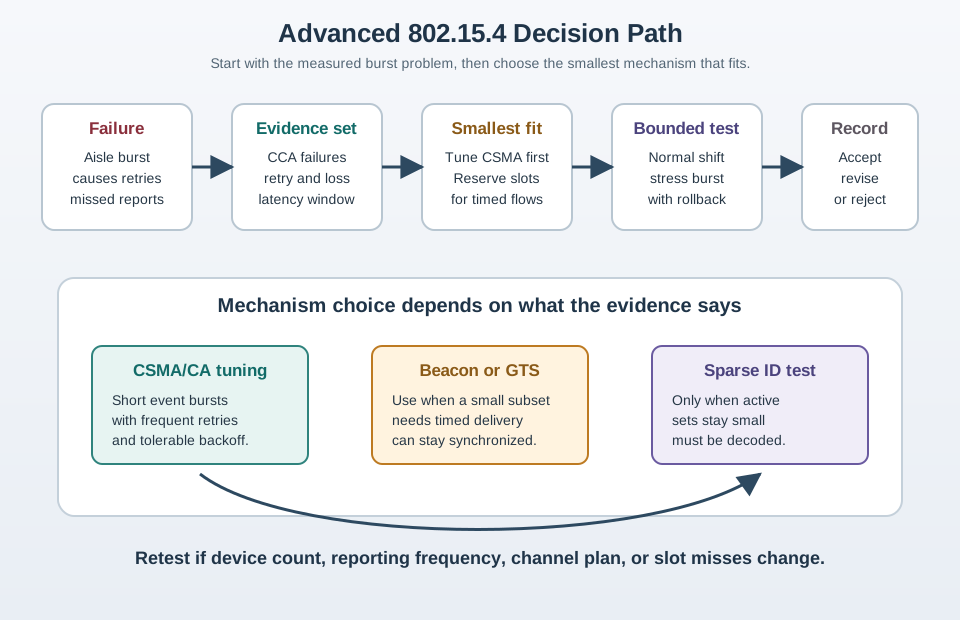
Start With the Decision
IEEE 802.15.4 defines radio and medium-access rules for low-data-rate devices.
- A link is the communication path between a sender and receiver.
- A collision occurs when overlapping transmissions interfere with reception.
- In the sparse-activity model used here, group tests query selected sets of devices to identify the few that transmitted.
Major section
Start With the Wireless Story
Latency is the time a message takes to arrive.
- A payload is the useful data inside that message.
- A schedule can cut clashes but needs shared time and may waste empty slots.
- Random access is simple under light use but can fail in a burst.
- This warehouse story cannot make one advanced method the default.
Major section
CSMA/CA Tuning
CSMA/CA tuning is usually the first option because it works with the normal contention model.
- IEEE 802.15.4 uses carrier sense multiple access with collision avoidance for contention-based traffic.
- The device listens before transmitting and uses random backoff when the channel appears busy.
- If the evidence shows bounded periodic traffic, scheduled access may be a better fit.
Major section
Reservation And Random Access Tradeoff
A large population may have only a few devices active at once, and each active device may send only a few bits or bytes.
- In that regime, reservation overhead can become the bottleneck: the schedule request, grant, synchronization, and identity exchange may cost more airtime or energy than the payload itself.
- Random access systems reduce that coordination burden by letting devices contend.
- Aloha-style access avoids much of that listening, but accepts higher collision rates.
Major section
Sparse Collision Identification
Sometimes the problem is not only avoiding a collision.
- The system may need to identify which devices were active during a burst.
- With a carefully designed test matrix, each device has a unique response pattern.
- The observed results can be decoded to infer the active devices.
- Entry Aji=1 means device i participates in test slot j.

Major section
Sparse Collision Identification (continued)
The private identity row reminds us that t=N is the trivial design; sparse recovery targets t proportional to d log N only under the stated OR and noise assumptions.
- The trivial design is A=IN: give every device a private slot.
- It always identifies the active set but needs t=N tests.
- Sparsity changes the information requirement.
Major section
Sparse Collision Identification (continued)
If yj=0, every device whose column contains a 1 in row j is inactive.
- Suitable probabilistic or adaptive designs approach the commonly stated sparse scaling t=Θ(dlogN) under their decoding and error assumptions, instead of N identity tests.
- Decode from negative tests first.
- Each matrix column is a device's on-off signature.
Major section
Sparse Collision Identification (continued)
For N=1024 and d=4, the scale term is dlog2N=40, compared with 1024 private tests.
- Forty is not a guaranteed production slot count: constants, noise protection, nonadaptive exact-recovery requirements, synchronization, and false-positive targets can require more tests.
- In a noisy receiver, use repeated chips, threshold margins, and an error-tolerant decoder rather than interpreting one energy detection as a perfect Boolean value.
- Distinct columns are enough when at most one device is active.
Major section
Sparse Collision Identification (continued)
Identification can carry information as well as presence. Figure: Collision-resolving code path from user-owned columns to Boolean-OR assigns multiple columns per user so the decoder recovers identity and one payload bit together.
- During slot j, active device i transmits energy when Aji=1 and stays silent when Aji=0.
- The stronger construction is d-disjunct: for every column i and every set S of at most d other columns, there is a row where Aji=1 and all columns in S are zero.
- That private witness prevents any union of up to d other signatures from covering device i.

Major section
Sparse Collision Identification (continued)
Identity and information can be carried jointly by assigning multiple columns per device.
- If device i may send message m, provision a codeword Ai,m for every allowed message symbol.
- The device transmits the column matching both its identity and its information.
- More message choices increase the number of columns and therefore test length or decoding difficulty.
Major section
Sparse Collision Identification (continued)
The expanded codebook must forbid choosing two messages for the same device and must remain separable for the allowed number of simultaneous users.
- Hidden terminals, capture effect, near-far power imbalance, clock error, fading, and regulatory airtime limits can turn a logical 1 into a missed or ambiguous test.
- A collision-resolving design is accepted only after testing those conditions against ordinary CSMA/CA or scheduled access on the same workload.
- A candidate that survives all negative tests is possibly active; a d-disjunct or otherwise suitable matrix ensures the remaining positive-test pattern separates all allowed active sets.
Deck summary
Key takeaways
IEEE 802.15.4 defines radio and medium-access rules for low-data-rate devices.
- Latency is the time a message takes to arrive.
- CSMA/CA tuning is usually the first option because it works with the normal contention model.
- A large population may have only a few devices active at once, and each active device may send only a few bits or bytes.
- Sometimes the problem is not only avoiding a collision.
Retrieval practice
Recall check 1 of 3

Radio Remi says: answer from memory, then check your reasoning.
Q1Only a few sensors transmit during each burst. When is group testing worth a trial?
Show answer
Answer: A Sparse activity helps only if the model and field errors are controlled.
Retrieval practice
Recall check 2 of 3
Radio Remi says: answer from memory, then check your reasoning.
Q2Before tuning CSMA/CA or adding guaranteed time slots in an 802.15.4 network, what must a reviewer establish first?
Show answer
Answer: A Advanced 802.15.4 tuning starts from knowing what behavior is failing and what measurement proves it.
Retrieval practice
Recall check 3 of 3
Radio Remi says: answer from memory, then check your reasoning.
Q3In the ideal Boolean-OR group-testing model, when is a test result 1?
Show answer
Answer: A The ideal OR output is 1 when at least one participating active device transmits; field RF errors still need separate testing.
Print reference
Answers
Answer key.
- A · Sparse activity helps only if the model and field errors are controlled.
- A · Advanced 802.15.4 tuning starts from knowing what behavior is failing and what measurement proves it.
- A · The ideal OR output is 1 when at least one participating active device transmits; field RF errors still need separate testing.