Zigbee, Thread & Matter · Study deck
6LoWPAN Failure Patterns
6LoWPAN failures are usually not single-layer mysteries.
Radio Remi is your guide for this deck.

After studying this chapter
Learning objectives
You will be able to:
- Diagnose common 6LoWPAN failure patterns using evidence from packet captures, counters, routing state, and border-router logs.
- Distinguish fragmentation pressure from compression-context, RPL, link-quality, and application-payload problems.
- Review whether a proposed fix addresses the real boundary instead of only masking the symptom.
- Build a concise debugging record that names the symptom, evidence, fix, retest result, and remaining risk.
Major section
Start With the IPv6 Packet That Must Fit
The Internet Protocol is a set of rules for addressed packets.
- IPv6 means Internet Protocol version 6.
- 6LoWPAN means IPv6 over Low-Power Wireless Personal Area Networks.
- Firmware is the software stored inside a device.
- A payload is the useful content carried in a message.
Major section
Start With the IPv6 Packet That Must Fit (continued)
Routing Protocol for Low-Power and Lossy Networks (RPL) helps devices choose paths.
- The larger packet may need several radio frames.
- Losing one frame can lose the whole packet.
- A route or memory limit may make the same symptom look like a cloud fault.
- One successful ping does not prove the workload.
Major section
In 60 Seconds · Debugging Claim
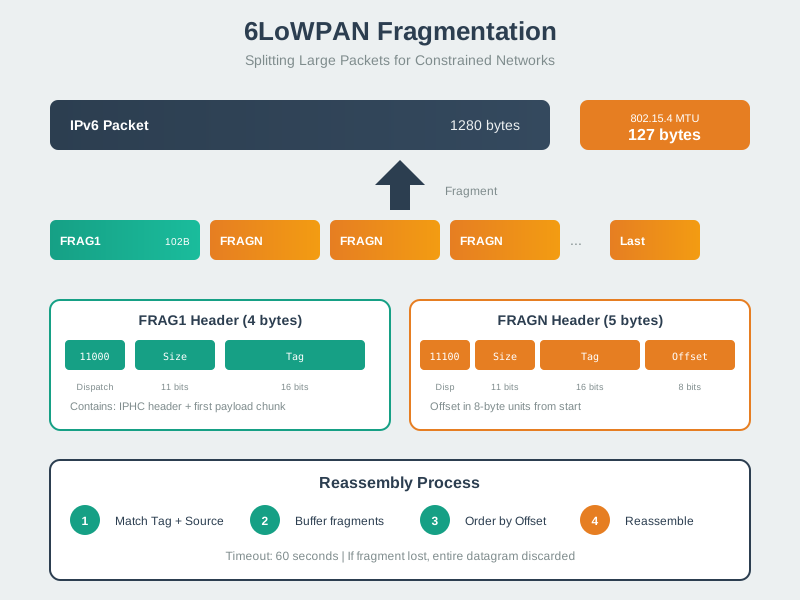
Fragmentation is a risk multiplier because every fragment must arrive before the IPv6 packet can be reconstructed.
- IPHC compression failures usually mean the receiver cannot reconstruct an elided field from link addresses, shared context, or known header state.
- RPL parent choices should be judged by path behavior and objective-function evidence, not by signal strength alone.
- This keeps the chapter away from broad advice such as "keep payloads small" without proof.
Major section
Debugging Review Path
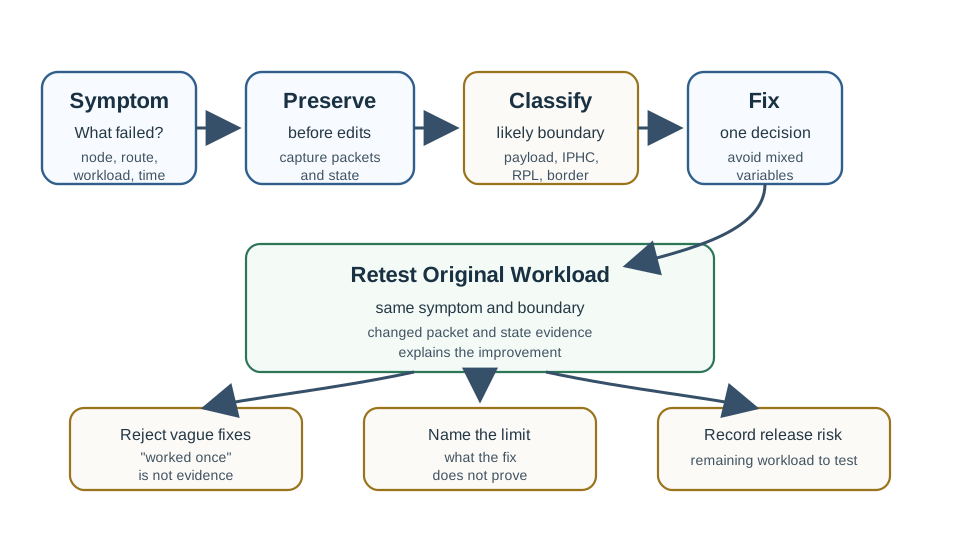
The path is deliberately evidence-first.
- If the first attempted fix changes several variables at once, the retest cannot prove which decision corrected the issue.
Major section
Pitfall Families · Failure Map
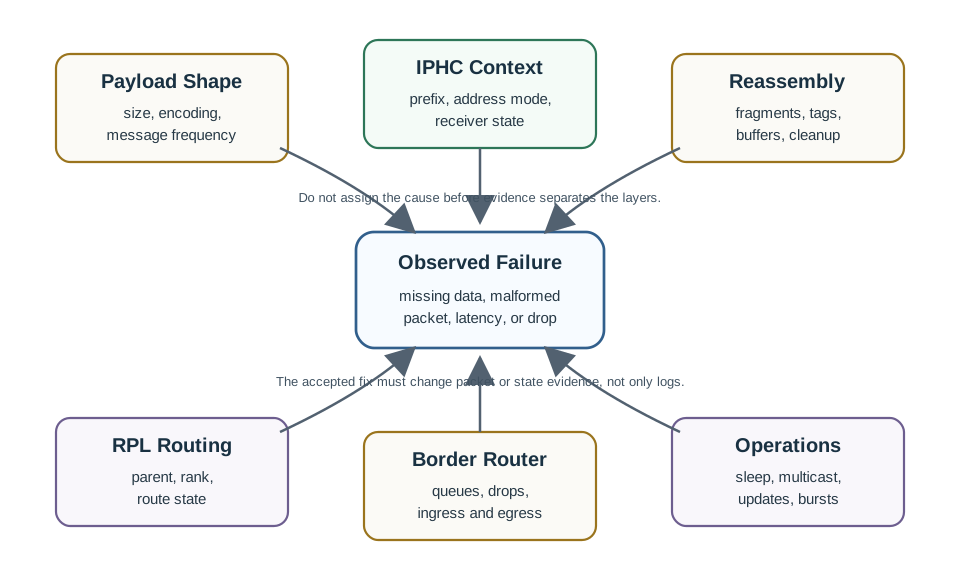
The useful review question is not "which family sounds familiar?" but "which evidence would distinguish this family from its neighbors?".
- Packet-shape pressure: Large or verbose payloads produce more adaptation work than the link budget can absorb.
- Compression-context mismatch: The sender elides fields that the receiver cannot reconstruct.
Major section
Fragmentation Pressure · Fragmentation Release Gate
Fragmentation is not wrong by itself.
- That dependency increases the number of events that must succeed before the application sees one message.
- Symptom: Telemetry appears in bursts, larger readings fail more often than smaller readings, or the receiver sees incomplete reassembly contexts.
- The gate is intentionally conservative.
- A single clean large transfer is not enough.
Major section
Compression Context Failures · Border-Router Boundary Mistakes
IPHC saves bytes by omitting fields the receiver can infer.
- If the sender and receiver disagree about link-layer address derivation, context identifiers, prefix lifetimes, or next-header expectations, compression becomes a decoding problem rather than a bandwidth benefit.
- Symptom: Packets are visible on the constrained link, but the reconstructed IPv6 packet is missing, malformed, addressed unexpectedly, or accepted by only part of the network.
- The border router is not just a forwarding box.
Major section
Multicast and Group Traffic · RPL and Parent-Selection Pitfalls · Reassembly and Memory Pressure
Group traffic can be useful for discovery, coordination, and announcement patterns.
- It becomes risky when the design expects every receiver to reconstruct a fragmented message without per-receiver recovery evidence.
- Signal strength alone is not enough to approve a parent-selection fix.
- Reassembly state is temporary custody.
Major section
Silent Adaptation Failures · Worked Review: Missing Telemetry After Payload Change
A lost fragment, mismatched compression context, or exhausted reassembly buffer can leave the datagram malformed, incomplete, or dropped while the sender only sees a missing response.
- The discipline that breaks the deadlock is measurement.
- Turning "the network is flaky" into "a three-fragment datagram at measured per-frame loss" makes the review solvable.
- The important review detail is that the application meaning changed.
Major section
Worked Review: Compression Context Drift · Worked Review: Downward Command Loss
This pattern shows why layer isolation matters.
- Symptom: A group of nodes can hear traffic but cannot reconstruct packets after a border-router replacement.
- Evidence: The sender uses context-based compression for a prefix that some receivers have not learned.
- Upward telemetry success does not prove downward control readiness.
Major section
Common Mistakes
Testing only the happy path: One successful ping or telemetry message does not cover larger payloads, route changes, sleepy nodes, or update traffic.
- Fixing by changing several variables: Changing payload size, routing policy, channel, and retry behavior at the same time makes the retest hard to interpret.
- Treating RSSI as route proof: A strong neighbor can still be a poor parent if path cost, churn, congestion, or downward route evidence is weak.
- Ignoring receiver-side evidence: A sender log can prove transmission attempts, but it cannot prove reconstruction, route acceptance, or application delivery.
- Overstating battery or reliability impact: Battery and reliability claims need measured workload evidence.
Major section
Debugging Record Checklist · Summary
6LoWPAN pitfall review is strongest when it treats debugging as evidence work.
- The same visible symptom can come from payload shape, compression context, reassembly custody, border-router behavior, routing instability, group traffic, or operational blind spots.
- The reviewer should preserve captures and state before changing configuration, apply a focused fix, and retest the original workload.
- The most important habit is boundary clarity.
Major section
Key Takeaway · Concept Relationships
6LoWPAN Pitfall Debugging Evidence should review 6LoWPAN architecture against header compression, fragmentation, RPL behavior, security, interoperability, and deployment evidence.
- Fragmentation pressure belongs with 6LoWPAN Fragmentation and Reassembly Evidence, where fragment custody and reconstruction are reviewed in detail.
- Compression-context failures belong with 6LoWPAN Header Compression Evidence, where IPHC reconstruction assumptions are inspected.
- Route instability belongs with 6LoWPAN Routing with RPL, where RPL parent choice and downward routing behavior are reviewed.
Deck summary
Key takeaways
The Internet Protocol is a set of rules for addressed packets.
- Routing Protocol for Low-Power and Lossy Networks (RPL) helps devices choose paths.
- Fragmentation is a risk multiplier because every fragment must arrive before the IPv6 packet can be reconstructed.
- The path is deliberately evidence-first.
- The useful review question is not "which family sounds familiar?" but "which evidence would distinguish this family from its neighbors?".
Retrieval practice
Recall check 1 of 5

Radio Remi says: answer from memory, then check your reasoning.
Q1Telemetry from a 6LoWPAN node stops right after its message payload grew larger. What is the first thing to investigate?
Show answer
Answer: A A payload that outgrows a single frame forces fragmentation, and one failed fragment stops telemetry, so check fragmentation first.
Retrieval practice
Recall check 2 of 5
Radio Remi says: answer from memory, then check your reasoning.
Q2Why do 6LoWPAN compression and fragmentation bugs often look like silent packet loss rather than explicit errors?
Show answer
Answer: A 6LoWPAN adaptation failures often have no application-level error signal, so debugging depends on captures, counters, and state evidence.
Retrieval practice
Recall check 3 of 5
Radio Remi says: answer from memory, then check your reasoning.
Q3A vendor promises long battery life after one clean small-packet demo. What should the review require?
Show answer
Answer: A A toy transfer cannot establish deployed energy or reliability.
Retrieval practice
Recall check 4 of 5
Radio Remi says: answer from memory, then check your reasoning.
Q4A 6LoWPAN deployment starts losing only the larger diagnostic reports after a firmware update. Which first evidence best separates fragmentation pressure from a general radio problem?
Show answer
Answer: B If the old report travels without fragmentation and the new report creates multiple fragments or incomplete reassembly contexts, the evidence points to fragmentation pressure rather than a general link outage.
Retrieval practice
Recall check 5 of 5
Radio Remi says: answer from memory, then check your reasoning.
Q5After replacing a 6LoWPAN border router, several nodes can hear compressed packets but cannot reconstruct valid IPv6 packets. What is the most defensible next review action?
Show answer
Answer: B The symptom points to context drift: the sender is eliding fields the receiver cannot reconstruct.
Print reference
Answers 1 of 2
Answer key.
- A · A payload that outgrows a single frame forces fragmentation, and one failed fragment stops telemetry, so check fragmentation first.
- A · 6LoWPAN adaptation failures often have no application-level error signal, so debugging depends on captures, counters, and state evidence.
- A · A toy transfer cannot establish deployed energy or reliability.
- B · If the old report travels without fragmentation and the new report creates multiple fragments or incomplete reassembly contexts, the evidence points to fragmentation pressure rather than a general link outage.
Print reference
Answers 2 of 2
Answer key.
- B · The symptom points to context drift: the sender is eliding fields the receiver cannot reconstruct.