Zigbee, Thread & Matter · Study deck
Why 6LoWPAN Exists
Picture a greenhouse sensor sending a short moisture reading over a very small radio frame.
Radio Remi is your guide for this deck.

After studying this chapter
IPv6 meaning must survive the small link
Constrained IPv6 needs evidence that the intended message survives each adaptation boundary.
- 6LoWPAN adapts IPv6 packets to constrained low-power links.The greenhouse sensor needs addressing and packet meaning preserved despite the small frames carried by IEEE 802.15.4.
- Compression depends on successful reconstruction at the receiver.Flags, shared context, and link evidence must restore shortened or omitted fields to the intended IPv6 packet.
- Fragmentation needs delivery, memory, and recovery evidence.A message split across frames can fail when a piece is lost or reassembly runs out of time or buffer space.
- The border router owns a reviewable handoff to wider IPv6.Prefix, context, routing visibility, restoration, and recovery evidence keep the approved workload tied to the tested configuration.
Major section
A greenhouse reading needs more than payload space (1/2)
A complete packet budget includes the reading and the bytes required for delivery.
- The payload is only the useful content inside the message.The packet budget also needs transport, addressing, MAC, and security overhead before the team decides whether one radio frame is enough.
- The reading needs identity, units, source time, and an age limit.A delivered moisture value loses usefulness if the application cannot identify its source or decide whether it is current.
Major section
A greenhouse reading needs more than payload space (2/2)
- IPv6 provides addressing and packet semantics across the network.The adaptation layer must preserve that intended meaning as the greenhouse message crosses the constrained radio link.
- IEEE 802.15.4 supplies small frames on a low-power shared channel.6LoWPAN handles the mismatch between that constrained link and the IPv6 packet rather than removing the link limits.
Major section
The largest real message defines the harder test
A split packet needs a known failure outcome before its delivery claim is credible.
- A successful small packet does not approve a larger fragmented message.The largest real payload may introduce extra frames, more reassembly state, and a different loss outcome.
- Loss and disorder test whether reconstruction handles incomplete delivery.A missing piece, duplicate, or out-of-order fragment must lead to a known rejection or recovery result.
- A receiver restart can interrupt a partially assembled reading.The release check restarts the receiver before the final frame and verifies that incomplete data never appears complete.
- Local urgent action needs a path that survives late split packets.Greenhouse reporting and coordination can use wider IPv6 without making that path the only route to time-bound safe action.
Activity 1 · Draw it
✎ Sketch a packet and its failure check

I need a sketch that shows where an incomplete reading must stop.
Draw the greenhouse sensor, adapted radio frames, receiver reassembly, and wider IPv6 handoff. Cross out one middle frame and show a receiver restart before the final frame. Label the acceptable outcome and the local urgent-action path.
4 minutes · Pen and paper · Answer: Activity 1
Major section
A packet change reopens the release record
The saved packet and failure results define what the release actually approves.
- The original packet and adapted frames preserve reconstruction evidence.The release record can connect the intended reading with the radio representation and the final reassembly outcome.
- Route or parent state belongs beside the packet capture.A correctly encoded message can still fail delivery when the constrained path to the border router changes.
- Payload and security changes can increase the required fragment count.A newly split message needs fresh time, memory, and loss results before the earlier delivery claim can cover that workload.
- Radio rules and software versions can also reopen the test.The retest trigger keeps approval attached to the observed link behaviour and implementation instead of a permanent protocol label.
Major section
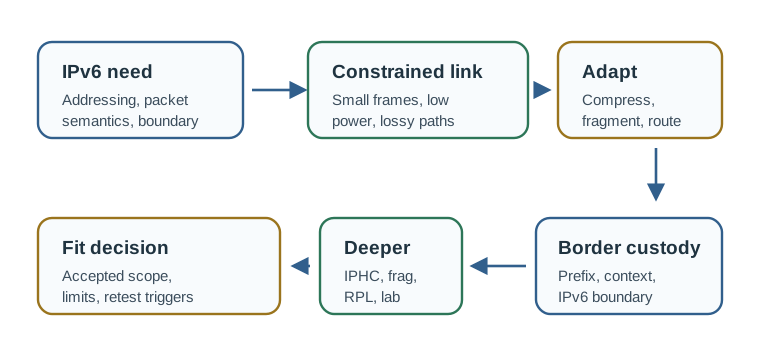
The fit path starts with an IPv6 need
The fit path links IPv6 need to approval; follow adaptation through border custody and deeper evidence into the final decision.
- The opening IPv6 need explains why adaptation belongs in the design.A low-power radio alone cannot establish that the application benefits from IPv6 addressing and packet semantics.
- The constrained-link stage makes the small-frame limits explicit.Compression and fragmentation handle packet fit while power and loss constraints still bound the workload.
- Border custody connects adaptation to the wider network.The border router owns prefix and context behaviour as well as restoration and visibility at the IPv6 handoff.
- The final fit decision depends on deeper evidence and retest triggers.Packet, route, and recovery results support a limited approval without automatically proving range, battery life, security, or cloud reachability.
Major section
Compression and fragmentation solve different problems
Header reconstruction and multi-frame delivery need separate evidence.
- Compression removes or shortens only reconstructable header information.The receiver needs the correct flags, context, and link evidence before omitted fields can recover their intended meaning.
- Fragmentation handles a packet that still exceeds the frame budget.Splitting introduces tags, offsets, buffering, timeouts, and recovery checks that a one-frame success cannot establish.
- The border router has protocol state with an explicit owner.Prefix, context, routing visibility, restoration, diagnostics, and recovery require more responsibility than a generic gateway label suggests.
- The workload determines whether fragmented traffic is an acceptable risk.Small messages may avoid frequent splitting, while larger diagnostics need direct reassembly and loss evidence for approval.
Major section
The review record begins with the packet boundary
The evidence record should connect the architecture need to the tested packet representation.
- The IPv6 need connects the protocol choice to the application.The record explains addressing, transport behaviour, and the gateway boundary before treating adaptation as the right architecture choice.
- The packet shape determines the useful frame budget.Payload size, transport header, addressing mode, and security overhead show whether the tested message fits without fragmentation.
- Compression evidence names how each field is reconstructed.Inline, omitted, context-derived, and link-derived fields need enough capture evidence to recover the intended IPv6 packet.
- A lab capture supports only the conditions represented by that run.Tested packet types, contexts, route changes, border-router recovery, and application delivery define the observed scope of approval.
Major section
Fragment and route ownership make the record usable
A fragmented workload needs explicit ownership of both reassembly and the onward path.
- Fragment tags and offsets connect pieces to the intended datagram.The record also needs fragment count, timeout, loss behaviour, and buffer ownership when the message exceeds one frame.
- Routing evidence explains how the adapted packet reaches border custody.Route-over or mesh-under assumptions, RPL observations, route depth, and parent changes bound the tested path.
- The border-router record assigns prefix, context, and recovery responsibilities.Diagnostics and backup ownership make a failed constrained-to-IPv6 handoff observable and recoverable within the reviewed configuration.
- Application delivery establishes whether the reconstructed reading remains useful.A successful packet capture alone cannot settle freshness when retries, reassembly, and route recovery add delay.
Major section
Building telemetry has a limited approval
Building telemetry approval must stay limited to the workload and configuration that were tested.
- Small building reports may fit constrained IPv6 without frequent fragmentation.The fit still depends on useful IPv6 integration, owned prefix and context state, observed route recovery, and fresh application readings.
- Payloads and reporting intervals belong in the approval boundary.Tested route depth, border-router configuration, and security mode also limit what the building telemetry result establishes.
- Diagnostic traffic needs its own fragmentation and loss evidence.Tiny telemetry success cannot approve a larger message that requires multiple fragments and fails under loss.
- Growth and configuration changes trigger another evidence review.Payload size, security wrapping, route depth, and border-router context can change the packet and delivery behaviour after release.
Activity 2 · Predict
✎ Predict the effect of larger security overhead
I want to know which evidence becomes stale when this packet stops fitting.
A security-mode change makes previously single-frame building reports fragment. Predict which evidence needs review before approving the changed workload. Explain why the earlier small-packet success is insufficient.
3 minutes · Pen and paper · Answer: Activity 2
Major section
The adaptation boundary preserves packet meaning
Each adaptation handoff has its own state and failure conditions.
- The adaptation layer preserves meaning across an awkward frame-size boundary.The intended IPv6 header and payload must survive a link that cannot efficiently carry every packet shape unchanged.
- Header state determines how much compression is possible.Flags, address mode, next-header handling, shared context, and link information constrain what the receiver can reconstruct.
- Reassembly state determines whether all pieces become the original packet.Fragment tracking, available buffers, and timeout behaviour matter whenever the sender exceeds the useful frame budget.
- The wider-network handoff depends on border-router state.Prefixes, contexts, routes, diagnostics, and recovery behaviour must remain consistent with the packet and configuration that were approved.
Major section
Context loss and packet growth create distinct failures
A changed context or packet budget can invalidate an earlier successful delivery result.
- Missing or stale context can prevent intended header reconstruction.A changed prefix, firmware version, or commissioning state may leave the receiver without the information needed to restore omitted fields.
- A lost fragment can prevent the original application message from arriving.Correct compression cannot recover a datagram whose reassembly lacks one of the required pieces.
- Extra security or payload bytes can cross the one-frame boundary.A formerly simple report may now require buffers, timeout handling, and failure tests that were absent from its earlier approval.
- A border-router change can alter both prefix and route behaviour.The handoff needs fresh evidence when the configuration changes, even if the constrained node keeps encoding packets correctly.
Major section
Tags, parents, and contexts need separate observations
Correct encoding alone cannot establish a reliable route to the border router.
- Fragment identity and position are part of delivery evidence.Tags and offsets need to work alongside buffers and timeouts so received pieces can become the intended packet.
- A parent change can break delivery without breaking packet encoding.Route-over behaviour, RPL state, and border-router reachability need observations that explain the changed constrained path.
- Context mismatch needs a reconstruction test after configuration changes.Prefix, firmware, commissioning, or shared-context changes can invalidate previously successful compressed packets.
- State ownership makes a boundary failure diagnosable.The record must identify who owns context, route, buffer, and border-router recovery instead of hiding those responsibilities behind a gateway.
Major section
Acceptance includes boundaries and failure cases
Acceptance needs enough normal and failure evidence to cover the actual deployment claim.
- Normal small-packet delivery establishes the basic tested workload.The record also needs a context reconstruction case and a packet-size boundary check before broader adaptation claims are justified.
- A border-router handoff record connects constrained delivery with wider IPv6.Prefix, context, diagnostics, restoration, and recovery behaviour must stay visible in the accepted configuration.
- Claimed failure behaviour needs a corresponding injected case.Fragmentation, route recovery, security overhead, and sleepy-node behaviour need extra evidence when the deployment depends on those mechanisms.
- A retest trigger prevents configuration drift from inheriting old approval.Packet growth, next-header changes, new parents, or altered border-router state can reopen delivery and reconstruction evidence.
Deck summary
A fit claim belongs to a tested workload
The useful promise is preserved IPv6 meaning under tested constrained-link conditions.
- 6LoWPAN is useful when constrained devices need IPv6 semantics.The protocol choice needs an application and addressing reason beyond the presence of a low-power radio.
- Compression and fragmentation require different reconstruction evidence.Shared context restores omitted fields, while complete fragment handling must recover packets that exceed the frame budget.
- Routing and border custody remain part of successful application delivery.A valid encoded packet can still fail before a fresh reading reaches the wider IPv6 application.
- Approval follows the tested packet shape and recovery limits.Payload, security, firmware, context, route, and border-router changes can require fresh evidence before the earlier claim is extended.
Retrieval practice
Recall check 1 of 3
Radio Remi says: answer from memory, then check your reasoning.
Q1What is the safest first-pass claim for a 6LoWPAN design?
Show answer
Answer: A 6LoWPAN is best reviewed as bounded constrained-IPv6 adaptation evidence, not as a broad radio or deployment promise.
Retrieval practice
Recall check 2 of 3
Radio Remi says: answer from memory, then check your reasoning.
Q2A 6LoWPAN test succeeds with tiny telemetry packets, but a later diagnostic payload requires multiple fragments and fails under loss. What should the review conclude?
Show answer
Answer: A A practical record keeps small-packet, fragmented-packet, and recovery claims separate.
Retrieval practice
Recall check 3 of 3
Radio Remi says: answer from memory, then check your reasoning.
Q3A 6LoWPAN deployment changes its security mode, increasing per-frame overhead so formerly single-frame messages now fragment. Which evidence should be revisited first?
Show answer
Answer: A Under-the-hood review reopens packet-fit, fragmentation, and border-router evidence when overhead or packet shape changes.
Print reference
Answers
Answer key.
- A · 6LoWPAN is best reviewed as bounded constrained-IPv6 adaptation evidence, not as a broad radio or deployment promise.
- A · A practical record keeps small-packet, fragmented-packet, and recovery claims separate.
- A · Under-the-hood review reopens packet-fit, fragmentation, and border-router evidence when overhead or packet shape changes.
Print reference
Activity 1 answer
Model answer.
Draw it: The sketch keeps the original reading connected to its fragments and reassembly. A missing fragment or restart produces a known rejection or recovery outcome, never a complete-looking partial reading. Urgent greenhouse action remains local when the wider path is late.
Print reference
Activity 2 answer
Model answer.
Predict: Recheck frame budget, compression result, fragment count, reassembly, loss handling, buffer use, and timeout behaviour. Verify border-router diagnostics and fresh application delivery. The earlier result covered a different packet shape without these fragmentation risks.