Zigbee, Thread & Matter · Study deck
6LoWPAN Deployment Planning
Deploying 6LoWPAN is not just placing small radios and declaring that IPv6 is available.
Radio Remi is your guide for this deck.

After studying this chapter
Learning objectives
You will be able to:
- Build a 6LoWPAN deployment claim that names the devices, traffic, border-router duties, and release boundary.
- Review border-router placement using coverage, routing, backhaul, monitoring, ownership, and recovery evidence.
- Plan addressing, compression context, fragmentation policy, and routing resilience without relying on unsupported fixed numbers.
- Decide when raw 6LoWPAN, Thread, Zigbee, Bluetooth LE, or LPWAN is the better fit for a scenario.
Major section
Start With the IPv6 Packet That Must Fit
The team wants normal Internet addressing, but the small radio frame cannot carry a large packet without help.
- Internet Protocol is a set of rules for addressed packets: IPv6 is version six of Internet Protocol.
- 6LoWPAN means using IPv6 over a low-power wireless personal area network: It adapts IPv6 for small low-power radio frames.
- A payload is the useful content carried inside a message.
Major section
Start With the IPv6 Packet That Must Fit (continued)
A protocol is an agreed set of rules for an exchange: Zigbee is a set of low-power mesh rules with its own network and application model.
- The first packet test cannot prove every route or busy hour.
- Under the Hood explains memory, reassembly, sleepy forwarding, and security limits.
- 6LoWPAN Deployment Planning is the place to ask how a packet is compressed, fragmented, routed, and handed to the border router without losing the design claim.
Major section
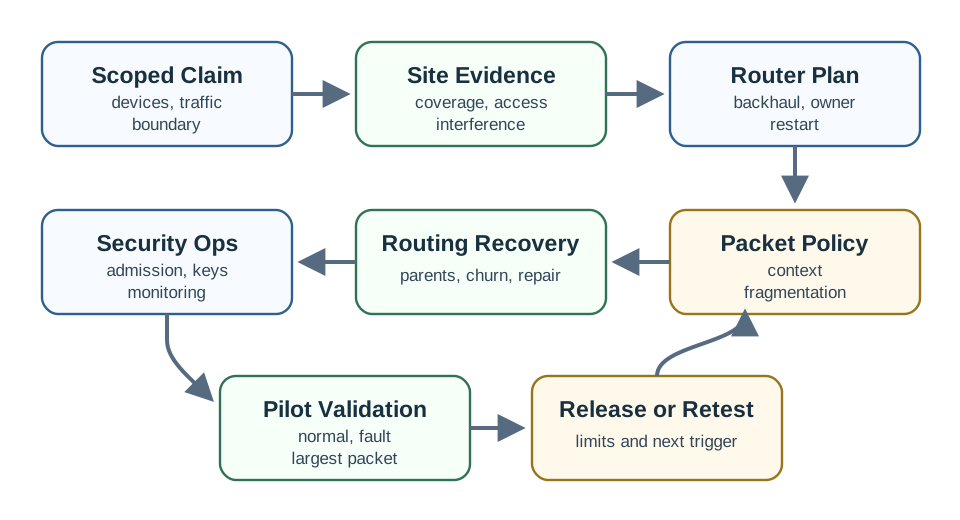
Deployment Decision Path
The path is intentionally ordered.
- If the design jumps directly from "short-range mesh" to "deploy one router per area," it can miss packet growth, inconsistent compression context, ownership gaps, or recovery behavior that only appears during a pilot.
Major section
Scope Before Topology
Topology is easier to draw than scope, but scope is what keeps the deployment honest.
- A useful plan names both the desired behavior and the evidence that will be used to reject a weak design.
- A comfort-monitoring network, a control loop, and a maintenance network do not need the same evidence.
- This scope-first step also makes protocol selection clearer.
Major section
Border-Router Placement
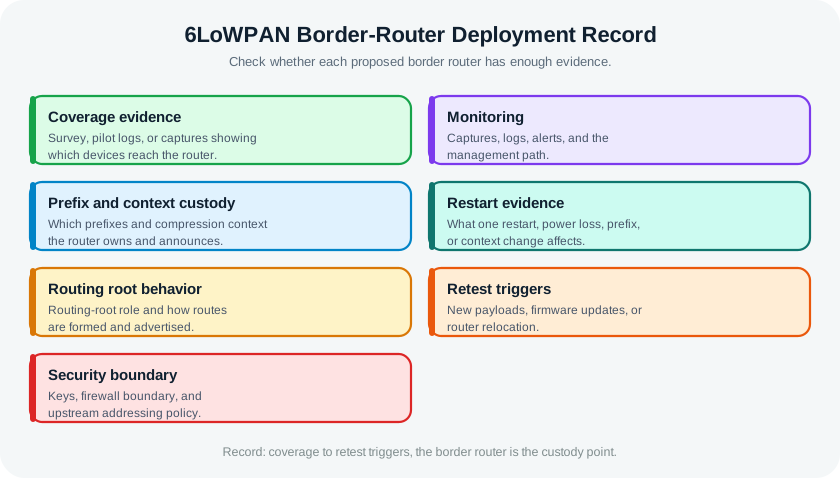
The border router is the deployment custody point.
- It connects the constrained IPv6 network to ordinary infrastructure, but it also owns context distribution, routing-root behavior, monitoring, captures, logs, restart behavior, and often the first practical troubleshooting boundary.
- The accepted count comes from coverage, path quality, backhaul, failure containment, operations, and pilot results.
Major section
Frame-Budget Triage
IEEE 802.15.4 frames are small before 6LoWPAN, UDP, application headers, and link security consume their share.
- A deployment record does not need to guess one universal usable byte count during early planning; it does need to classify traffic against the tested frame budget.
- A 24-byte sensor payload plus compact UDP application metadata may be a single-frame candidate after valid header compression.
- A 180-byte diagnostic response is not.
Major section
Frame-Budget Triage (continued)
The first can be approved for the normal telemetry path if the pilot capture proves reconstruction.
- The second needs a separate fragmentation gate with reassembly timeout, loss, retry, memory, and operator-status evidence.
- A mesh with 30 sleepy sensors sending small periodic readings may be easier to release than a mesh with five nodes that send large configuration dumps during faults.
- The planner should record which traffic is normal, which traffic is maintenance-only, which messages may fragment, and which messages stay out of scope until a pilot proves them.
Major section
Routing and Recovery
A command path that changes equipment state needs stronger recovery, authorization, and operator-feedback evidence.
- Many 6LoWPAN deployments use route-over IPv6 forwarding with RPL, but the review still needs to show how routing behaves in this site.
- Route stability is application-specific.
- A maintenance-monitoring network may tolerate a visible delay.
Major section
Node Capacity and Sleepy Forwarding Limits
Constrained nodes have hard state limits that shape deployment topology.
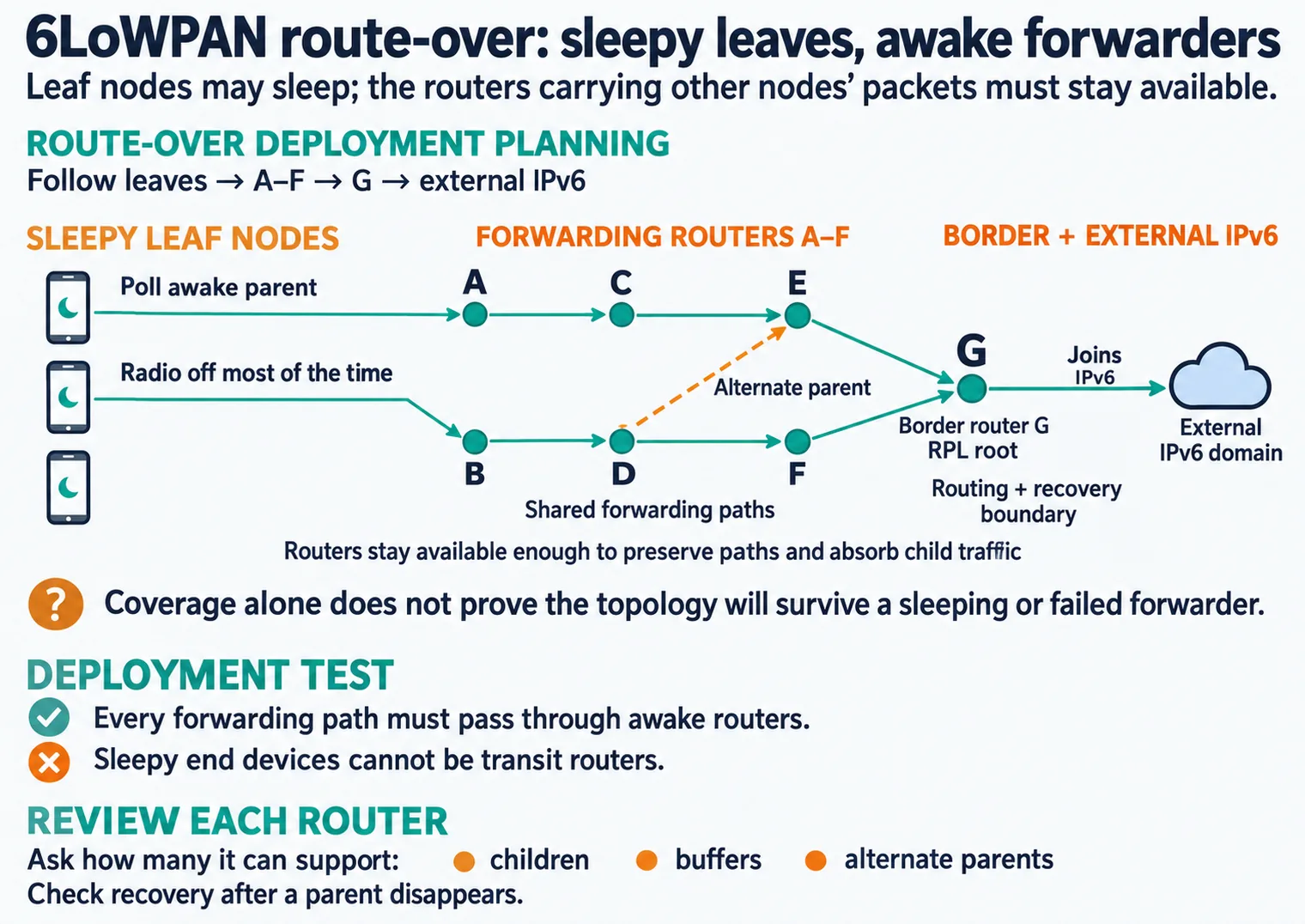
- Leaves can conserve energy because they do not carry other nodes' packets; routers must remain available enough to preserve paths and absorb child traffic.
- Coverage alone does not prove that the topology will survive a sleeping or failed forwarder.
Major section
Node Capacity and Sleepy Forwarding Limits (continued)
The sharpest topology consequence is that sleepy end devices cannot be transit routers.
- A battery leaf saves energy by turning its radio off most of the time, so it is not listening when a neighbor needs a relay.
- Forwarding requires always-on routers, and every sleepy leaf must have an awake parent it can poll for messages that arrived while it slept.
- If one fragment from each datagram is lost, the router may hold partial state until timeout, blocking later fragments or forcing drops.
Major section
Node Capacity and Sleepy Forwarding Limits (continued)
Even when every individual packet is valid IPv6, the constrained node is spending memory on unfinished work rather than forwarding the next small sensor reading.
- A route-over mesh with a border router as RPL root therefore needs stable parent choices, usable link metrics, and recovery after a parent disappears.
- If a floor plan leaves three sleepy devices reachable only through another sleepy device, the topology is not merely inefficient; it is invalid for forwarding.
- The deployment test is simple: every forwarding path must pass through awake routers, and every exception must be visible in the pilot evidence.
Major section
Worked Deployment: Building Environmental Telemetry
Good starting claim: The network supports low-rate telemetry from named rooms to an internal IPv6 service through monitored border routers.
- Revision trigger: Retest if rooms are remodeled, routers move, payloads grow, new interference appears, or support ownership changes.
- The accepted topology might use one or more border routers per physical area, but the page should not claim a universal count.
- The count is accepted only when coverage, failure-domain, and operational evidence agree.
Major section
Protocol Selection Boundary
Protocol selection is part of deployment quality.
- The goal is not to promote one stack.
- The goal is to make the reason for the stack visible.
- A mature deployment record explains why the selected protocol fits the specific site, support model, traffic pattern, and integration requirement.
Major section
Deployment Checklist
Scope fit: The claim names device roles, traffic classes, site boundary, support owner, and non-goals.
- Border-router fit: Coverage, backhaul, failure domain, restart behavior, monitoring, and ownership are documented.
- Packet fit: Ordinary and largest expected packets are reviewed against compression, fragmentation, and loss behavior.
- Routing fit: Root behavior, parent changes, depth, churn, and repair evidence are visible.
Deck summary
Key takeaways
The team wants normal Internet addressing, but the small radio frame cannot carry a large packet without help.
- A protocol is an agreed set of rules for an exchange: Zigbee is a set of low-power mesh rules with its own network and application model.
- The path is intentionally ordered.
- Topology is easier to draw than scope, but scope is what keeps the deployment honest.
- The border router is the deployment custody point.
Retrieval practice
Recall check 1 of 5

Radio Remi says: answer from memory, then check your reasoning.
Q1When planning a 6LoWPAN deployment, what should decide where border routers are placed?
Show answer
Answer: A Border-router placement should follow coverage, ownership, power, backhaul, and failure-domain evidence.
Retrieval practice
Recall check 2 of 5
Radio Remi says: answer from memory, then check your reasoning.
Q2A border router changes the mesh prefix. What plan prevents compressed packets from being misread?
Show answer
Answer: A Both ends must agree on reconstruction while paths recover.
Retrieval practice
Recall check 3 of 5
Radio Remi says: answer from memory, then check your reasoning.
Q3Why can't sleepy battery end devices be relied on to forward traffic for other 6LoWPAN nodes?
Show answer
Answer: A Sleepy end devices duty-cycle their radios off, so forwarding paths need awake routers and reviewable parent evidence.
Retrieval practice
Recall check 4 of 5
Radio Remi says: answer from memory, then check your reasoning.
Q4A deployment plan says each area will get a border router, but it does not include coverage logs, backhaul notes, restart behavior, or an owner for keys and monitoring. How should reviewers decide whether the border-router plan is ready?
Show answer
Answer: A 6LoWPAN deployment quality depends on evidence-backed border-router placement and custody, not fixed placement rules.
Retrieval practice
Recall check 5 of 5
Radio Remi says: answer from memory, then check your reasoning.
Q5A telemetry pilot passes, but the largest diagnostic message has not been tested and may fragment. Which deployment decision is safest?
Show answer
Answer: A A deployment can approve bounded traffic while keeping untested fragmented traffic behind a review gate.
Print reference
Answers
Answer key.
- A · Border-router placement should follow coverage, ownership, power, backhaul, and failure-domain evidence.
- A · Both ends must agree on reconstruction while paths recover.
- A · Sleepy end devices duty-cycle their radios off, so forwarding paths need awake routers and reviewable parent evidence.
- A · 6LoWPAN deployment quality depends on evidence-backed border-router placement and custody, not fixed placement rules.
- A · A deployment can approve bounded traffic while keeping untested fragmented traffic behind a review gate.