Zigbee, Thread & Matter · Study deck
6LoWPAN Architecture: Addressing and Forwarding Decisions
6LoWPAN is the adaptation architecture that lets IPv6 packets cross IEEE 802.15.4 radio links.
Radio Remi is your guide for this deck.

After studying this chapter
Learning objectives
You will be able to:
- Explain: A node can form a link-local address from the link-local prefix plus an interface identifier derived from its 64-bit extended address, or from a configured short address under controlled assumptions.
- Explain: For an uncompressed teaching example, if the first fragment carries the first 80 octets of the datagram, the next fragment uses offset 80/8=10=0x0A.
- Explain: At the fundamentals level, the important point is that forwarding mode is an architecture boundary, not a label to add after the network is already built.
- Explain: Assuming best-case compression: Compression depends on context.
Major section
Stateless Address Reconstruction
A node can form a link-local address from the link-local prefix plus an interface identifier derived from its 64-bit extended address, or from a configured short address under controlled assumptions.
- The architecture review should name which method is used and where uniqueness is checked.
- This derivation also explains why IPHC can remove so many bytes.
- The risk is context drift.
- Good architecture evidence therefore pairs every compression assumption with ownership, rollout, and retest rules.
Major section
Forwarding Roles
An ordinary host originates or consumes packets without forwarding for neighbours.
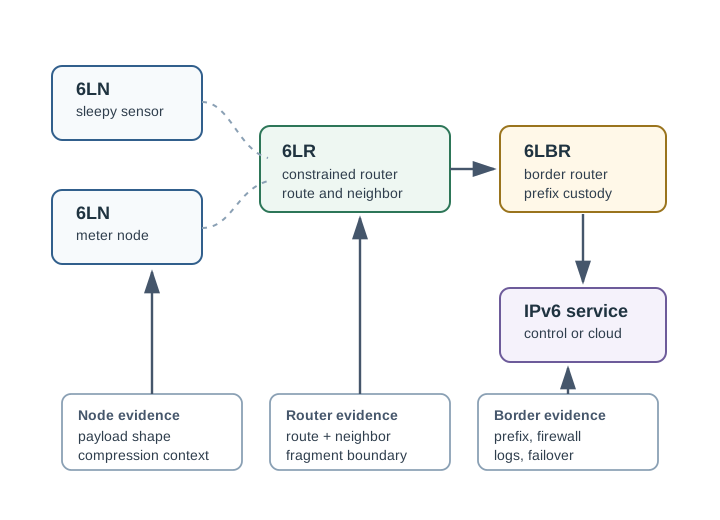
- A 6LR forwards within the low-power mesh and must maintain enough availability and state for that duty.
- Address compression does not erase these roles; troubleshooting should record which node formed the address, which router forwarded it, and where the external route began.
Major section
Forwarding Roles (continued)
The same radio technology can appear in several roles.
- A sleepy sensor may only originate or receive application traffic.
- A router forwards traffic for other nodes and needs stable power, route state, and monitoring.
- A border router connects the constrained network to the larger IPv6 domain and becomes an operations boundary.
Major section
Route-Over And Mesh-Under
Forwarding can be described as route-over or mesh-under.
- The review should avoid treating either phrase as automatically better.
- Route-over means IPv6 routing decisions are made at the network layer, often with RPL in a low-power and lossy network.
- It keeps per-hop routing evidence visible.
Major section
Route-Over And Mesh-Under (continued)
Mesh-under means the adaptation or link layer hides mesh forwarding beneath IPv6.
- Thread uses mesh-under forwarding rather than RPL route-over.
- Mesh-under can simplify the IPv6 view but can make fragment handling and per-hop evidence harder to inspect.
- At the fundamentals level, the important point is that forwarding mode is an architecture boundary, not a label to add after the network is already built.
Major section
Thread Relationship
Thread uses IEEE 802.15.4 and 6LoWPAN concepts to support IPv6 in a managed low-power mesh.
- Shared foundation: Thread depends on constrained IPv6 adaptation, header compression, and low-power mesh assumptions.
- Added system rules: Thread adds commissioning, security, role management, and operational behavior that raw 6LoWPAN does not define by itself.
- This distinction keeps the course from mixing Zigbee, Thread, 6LoWPAN, Matter, and generic IEEE 802.15.4 into one vague "short-range mesh" category.
Major section
Common Mistakes
Calling it a gateway protocol 6LoWPAN is an adaptation layer used by nodes on the constrained link, not only a function inside a border router.
- Assuming best-case compression: Compression depends on context.
- Global prefixes, multicast, security, diagnostics, and unusual ports may require more bytes.
- Normalizing fragmentation: Fragmentation support does not mean large packets are healthy traffic for a constrained mesh.
- Hiding route evidence: If the operator cannot inspect neighbor and route state, root cause analysis becomes guesswork.
Major section
Release Checklist
Traffic classes named: Normal, commissioning, diagnostic, control, and maintenance traffic are separated.
- Packet fit captured: Representative packets show compression behavior and identify the paths that still need fragmentation.
- Context controlled: Address, prefix, hop-limit, UDP, and security context assumptions are documented and retestable.
- Roles assigned: Node, router, border-router, support, monitoring, and failure-response duties are explicit.
Major section
Encapsulation Header Formats
6LoWPAN uses a chain of small, orthogonal headers rather than one fixed adaptation header.
- A header is present only when that frame needs its job.
- A mesh-under forwarder must see originator, final destination, and hops left before interpreting the fragment.
- A reassembly endpoint must see datagram identity before interpreting the compressed IPv6 content.
Major section
Fragment and Mesh Header Fields
For an uncompressed teaching example, if the first fragment carries the first 80 octets of the datagram, the next fragment uses offset 80/8=10=0x0A.
- An arbitrary 11-bit byte offset is therefore replaced by an 8-bit count of eight-byte blocks.
- V=0 means the originator address is an extended 64-bit address; V=1 means it is a short 16-bit address.
- If the result is zero, it drops the frame.
Major section
Fragment and Mesh Header Fields (continued)
That distinction is what lets reassembly use a stable datagram identity across forwarders.
- The shortest base mesh header is therefore 1+2+2=5 octets, and the longest is 1+8+8=17 octets.
- If the four-bit Hops Left field is 0xF, an extra Deep Hops Left octet follows the control byte, extending those sizes by one.
- Short addresses save airtime, but only if address assignment and lifecycle remain trustworthy.
Major section
Concept Relationships
6LoWPAN and IPHC: IPHC is the compression mechanism that makes many IPv6 packets practical on constrained frames.
- 6LoWPAN and RPL: RPL is commonly used to route IPv6 traffic through low-power and lossy networks, especially in route-over designs.
- 6LoWPAN and Thread: Thread uses constrained IPv6 foundations but adds its own managed mesh, commissioning, and security behavior.
- 6LoWPAN and Zigbee: Zigbee shares the IEEE 802.15.4 radio family but uses a different network and application stack than IPv6-based 6LoWPAN or Thread.
Deck summary
Key takeaways
A node can form a link-local address from the link-local prefix plus an interface identifier derived from its 64-bit extended address, or from a configured short address under controlled assumptions.
- An ordinary host originates or consumes packets without forwarding for neighbours.
- The same radio technology can appear in several roles.
- Forwarding can be described as route-over or mesh-under.
- Mesh-under means the adaptation or link layer hides mesh forwarding beneath IPv6.
Retrieval practice
Recall check 1 of 3

Radio Remi says: answer from memory, then check your reasoning.
Q1A constrained IP frame omits its link-local source address. How can the receiver recover it?
Show answer
Answer: A The omitted address can be rebuilt only from agreed context and mode.
Q2Which forwarding model exposes network-layer routing choices at each hop?
Show answer
Answer: A Route-over makes routing decisions at the network layer.
Retrieval practice
Recall check 2 of 3
Radio Remi says: answer from memory, then check your reasoning.
Q3Which statement best describes the role of 6LoWPAN in an IEEE 802.15.4 IoT network?
Show answer
Answer: B 6LoWPAN is an adaptation architecture between IPv6 and IEEE 802.15.4. It compresses headers when context allows, fragments packets that still cannot fit, and keeps constrained IPv6 behavior reviewable.
Retrieval practice
Recall check 3 of 3
Radio Remi says: answer from memory, then check your reasoning.
Q4A review finds that normal telemetry fits after IPHC compression, but diagnostics sometimes require fragmented 6LoWPAN datagrams. What is the strongest architecture response?
Show answer
Answer: C Normal telemetry can remain release-ready while diagnostics get their own evidence gate.
Print reference
Answers
Answer key.
- A · The omitted address can be rebuilt only from agreed context and mode.
- A · Route-over makes routing decisions at the network layer.
- B · 6LoWPAN is an adaptation architecture between IPv6 and IEEE 802.15.4. It compresses headers when context allows, fragments packets that still cannot fit, and keeps constrained IPv6 behavior reviewable.
- C · Normal telemetry can remain release-ready while diagnostics get their own evidence gate.