Cellular IoT · Study deck

5G URLLC: Capabilities and Roadmap

A 5G label does not promise a one-millisecond service at every site.

Radio Remi is your guide for this deck.

urllcfuture
Radio Remi, the module guide, in a scene from this chapter.
iotclass.org

After studying this chapter

Learning objectives

You will be able to:

  • Analyze URLLC (Ultra-Reliable Low-Latency Communications) latency budgets and reliability requirements for mission-critical IoT
  • Design end-to-end URLLC connectivity for safety-critical applications using mini-slots, grant-free transmission, and MEC
  • Configure 5G power saving features (PSM, eDRX, WUS) for battery-powered IoT devices
  • Evaluate 6G capabilities and timeline to assess their impact on future IoT planning
iotclass.org

Major section

Start With the Story

Packet loss means that a sent message does not arrive.

  • An actuator is a part that makes a physical change.
  • Latency is the time a message and response take.
  • QoS means rules that give some traffic a stated level of service.
  • A quick average can hide the slow event that causes harm.

Why it matters

Extra copies or reserved service can reduce risk, but they use more radio time, energy, and system capacity.

iotclass.org

Major section

Start With the Story (continued)

This robot story does not prove that any 5G site meets the stop claim.

  • The exact site, load, device, and safety path need direct tests.
  • The deeper work narrows the claim; it does not replace end-to-end proof.
  • The radio waits for service.
  • The brake takes hold.
iotclass.org

Major section

Phoebe's Field Notes: Why A Truck At 70 mph Breaks A Stationary-Tuned Handover

The mathematical gist.: At 70 mph and an illustrative 850 MHz carrier, maximum Doppler shift is 88.7 Hz and the Clarke coherence-time estimate is 4.77 ms.

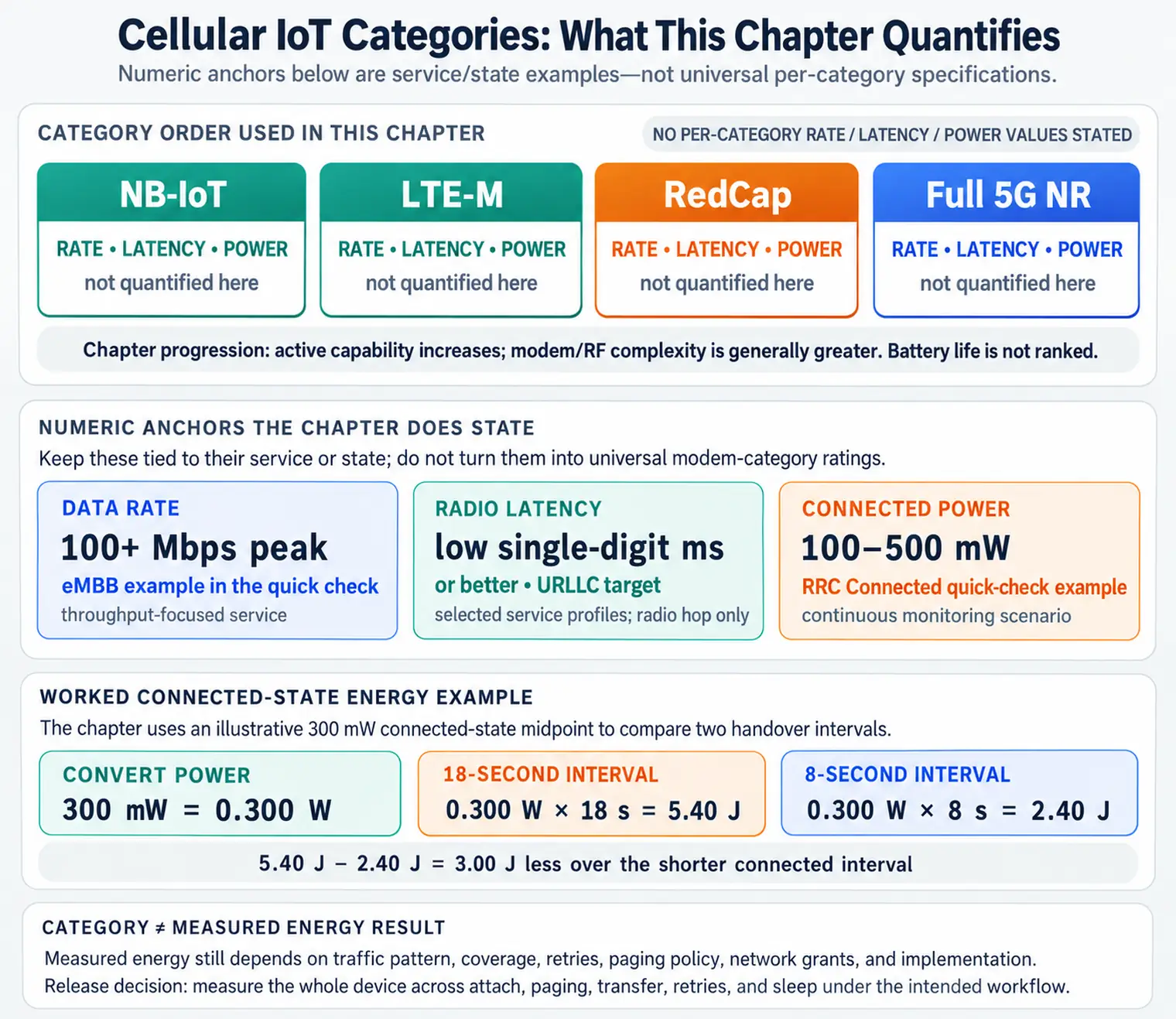
  • At the chapter's illustrative 300 mW connected-state midpoint, the shorter interval changes 5.40 J to 2.40 J.

Numbers to remember

850 MHzan illustrative 850 MHz carrier, maximum Doppler shift is 88.7 Hz
88.7 Hzmaximum Doppler shift is 88.7 Hz
4.77 msthe Clarke coherence-time estimate is 4.77 ms.
iotclass.org

Major section

URLLC for Critical IoT
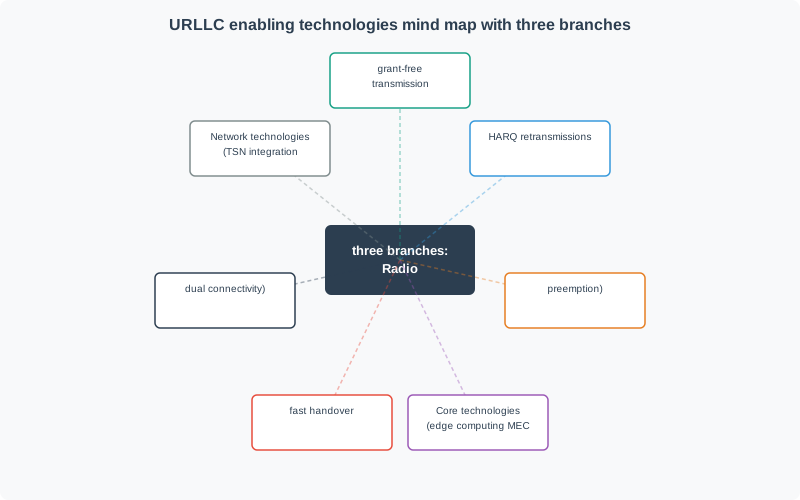
The stack shows which radio, transport, compute, synchronization, and operational controls must cooperate for a bounded service.

  • Finish at validation and operations, where timing, failure, and change evidence are retained.
URLLC enabling technologies across radio, core, edge, and operations
iotclass.org

Major section

5G Power Saving for IoT

Future capability is useful only when its energy profile fits the device.

  • Operator configuration, subscription, modem firmware, reporting cadence, or coverage changes reopen both the reachability and energy decision.
Power profile comparison across cellular IoT categories
iotclass.org

Major section

6G Vision for IoT

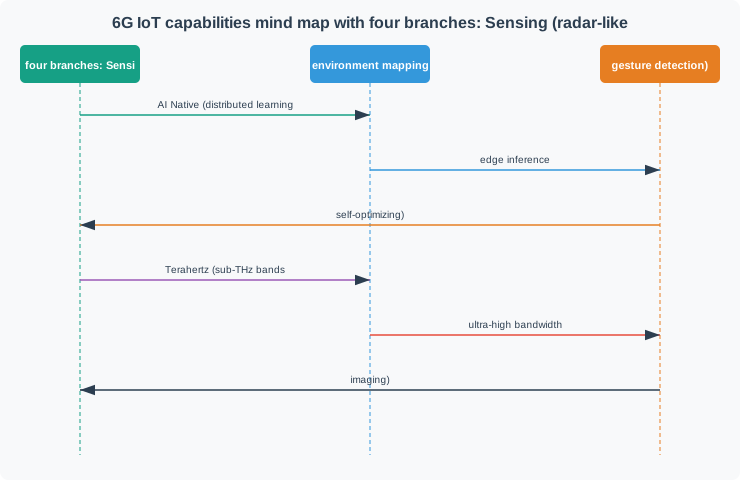
6G is best treated as an IMT-2030 planning horizon, not a product you can buy today.

  • ITU-R has defined the IMT-2030 framework and usage scenarios, while detailed radio specifications and commercial deployment plans remain future work.
6G and IMT-2030 IoT capability themes
iotclass.org

Deck summary

Key takeaways

Packet loss means that a sent message does not arrive.

  • This robot story does not prove that any 5G site meets the stop claim.
  • The mathematical gist.: At 70 mph and an illustrative 850 MHz carrier, maximum Doppler shift is 88.7 Hz and the Clarke coherence-time estimate is 4.77 ms.
  • The stack shows which radio, transport, compute, synchronization, and operational controls must cooperate for a bounded service.
  • Future capability is useful only when its energy profile fits the device.
iotclass.org

Retrieval practice

Recall check 1 of 3

Radio Remi says: answer from memory, then check your reasoning.

Q1A soil moisture sensor in an agricultural deployment sends a 50-byte reading once per hour and must receive firmware update commands from the server. Which 5G power saving configuration is most appropriate?

APSM with T3412 set to 1 hour -- device wakes hourly to transmit, then returns to deep sleep
BeDRX with a 20-minute paging cycle -- periodic downlink reachability with moderate power savings
CRRC Connected mode with continuous monitoring -- always reachable for commands
DWUS (Wake-Up Signal) without any DRX or PSM -- rely solely on wake-up signal
Show answer

Answer: B eDRX provides the best balance for devices that need both low power consumption and periodic downlink reachability.

iotclass.org

Retrieval practice

Recall check 2 of 3

Radio Remi says: answer from memory, then check your reasoning.

Q2For the autonomous forklift scenario, if obstacle detection takes 20ms and braking takes 50ms, what is the maximum acceptable network latency for the control command?

A100 ms (the full budget)
B50 ms (same as braking)
C30 ms or less (100 - 20 - 50 = 30)
D10 ms (conservative margin)
Show answer

Answer: C The latency budget is: 100 ms total - 20 ms detection - 50 ms braking = 30 ms for the network path.

Q3Why is URLLC more appropriate than eMBB for this safety-critical forklift application?

AURLLC provides higher data throughput
BBounded latency and high reliability
CURLLC is less expensive per device
DURLLC uses less power
Show answer

Answer: B URLLC-style service is appropriate when the safety case requires bounded latency and high reliability.

iotclass.org

Retrieval practice

Recall check 3 of 3

Radio Remi says: answer from memory, then check your reasoning.

Q4Which 6G capability would enable forklifts to detect obstacles using the same network used for communication?

AIntegrated sensing
BAI-native networks
CTerahertz communications
DZero-energy IoT
Show answer

Answer: A Integrated sensing and communication (ISAC) is the 6G/IMT-2030 direction that combines communication with radar-like sensing.

iotclass.org

Print reference

Answers

Answer key.

  1. B · eDRX provides the best balance for devices that need both low power consumption and periodic downlink reachability.
  2. C · The latency budget is: 100 ms total - 20 ms detection - 50 ms braking = 30 ms for the network path.
  3. B · URLLC-style service is appropriate when the safety case requires bounded latency and high reliability.
  4. A · Integrated sensing and communication (ISAC) is the 6G/IMT-2030 direction that combines communication with radar-like sensing.
iotclass.org