Cellular IoT · Study deck
5G URLLC: Latency Evidence and Deployment
A latency target is the longest delay the service can allow.
Radio Remi is your guide for this deck.

After studying this chapter
Learning objectives
You will be able to:
- Explain: If unloaded tests report an 8 ms average but a 55 ms p99 during handover, the system still fails the requirement because one packet in a hundred can arrive after the safe window.
- Explain: Reliability targets have the same shape: a one-hour demo with no drops does not prove a 99.999% requirement unless the test volume, confidence level, and failure model are stated.
- Explain: Approval proves the site can meet the budget at acceptance time; monitoring proves it keeps meeting the budget after antenna changes, firmware updates, floor-plan changes, and new traffic.
Major section
Putting Numbers to It
The source trace spans 18 seconds from its first logged event to bearer re-establishment; it does not measure an 18-second handover or data outage.
- Buffering preserves time-stamped GPS fixes for later delivery; it does not restore live reachability.
- Key Insight: LTE-M supports connected mobility, but route handover behavior depends on the operator and configuration.
- For highway tracking, validate the actual route and buffer time-stamped GPS fixes for later delivery when service is interrupted.
Major section
URLLC Cost-Benefit Decision Framework
The following framework helps determine whether URLLC is justified for a given IoT application or whether a less expensive alternative (LTE-M, Wi-Fi, or wired) suffices.
- Step 1: Determine your actual latency and reliability requirements: Many IoT projects claim "real-time" requirements that, upon analysis, can tolerate 50-200 ms latency.
- URLLC-style design is needed only when exceeding the latency threshold causes physical harm, financial loss, or system failure.
- The supplier chooses the private 5G option only if measured Wi-Fi roaming and interference risk exceed the safety case.
Major section
URLLC Budget Validation
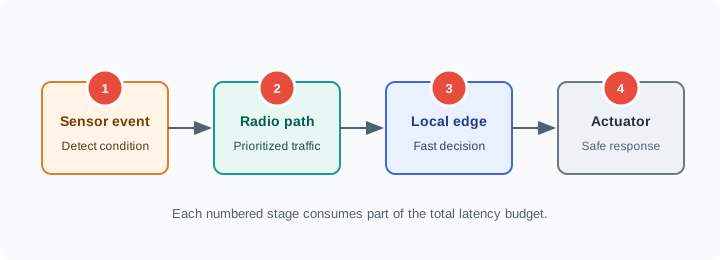
URLLC is useful only when it is tied to a measured end-to-end latency and reliability budget.
- Every stage consumes part of the same deadline, while queueing, retries, and failure handling consume margin.
- If delayed packets create safety risk, equipment damage, or unacceptable downtime, then the network design must prove worst-case behavior, not average speed.
Major section
URLLC Budget Validation (continued)
This ledger connects network selection to the physical consequence: validate tail latency and reliability for the complete loop under load, mobility, interference, and maintenance conditions, and retain local fallback when the wireless path misses its bound.
- A warehouse AGV moving at 2 m/s covers 0.5 m in 250 ms, so a collision-avoidance path that promises to stop within that distance cannot spend the full 250 ms on networking.
- The radio may advertise single-digit millisecond service, but the release decision must use the remaining system budget.
- A dashboard update, asset-status message, or batch upload usually does not.
Major section
Critical IoT Validation Record
A critical IoT validation record connects the safety or operations case to the network evidence.
- It should make the release decision auditable when someone asks why public cellular, private 5G, Wi-Fi, wired Ethernet, or local fallback was selected.
- A statement such as "private 5G is low latency" is not evidence.
- Approval proves the site can meet the budget at acceptance time; monitoring proves it keeps meeting the budget after antenna changes, firmware updates, floor-plan changes, and new traffic.
Major section
Tail Latency and Control Loops
Average latency is a weak metric for critical IoT.
- A control loop fails when rare delay, packet loss, handover, or queueing pushes a response past the deadline.
- Each feature moves one part of the distribution, but none removes the need to validate the complete site path.
- The robust design is layered.
Major section
Tail Latency and Control Loops (continued)
Reliability targets have the same shape: a one-hour demo with no drops does not prove a 99.999% requirement unless the test volume, confidence level, and failure model are stated.
- A configured grant can help the uplink while the downlink command still waits behind a congested queue.
- Edge placement can remove WAN delay while the edge service itself becomes the bottleneck.
- If unloaded tests report an 8 ms average but a 55 ms p99 during handover, the system still fails the requirement because one packet in a hundred can arrive after the safe window.
Deck summary
Key takeaways
The source trace spans 18 seconds from its first logged event to bearer re-establishment; it does not measure an 18-second handover or data outage.
- The following framework helps determine whether URLLC is justified for a given IoT application or whether a less expensive alternative (LTE-M, Wi-Fi, or wired) suffices.
- URLLC is useful only when it is tied to a measured end-to-end latency and reliability budget.
- This ledger connects network selection to the physical consequence: validate tail latency and reliability for the complete loop under load, mobility, interference, and maintenance conditions, and retain local fallback when the wireless path misses its bound.
Retrieval practice
Recall check 1 of 3

Radio Remi says: answer from memory, then check your reasoning.
Q1What physical event starts the end-to-end latency clock in a URLLC test?
Show answer
Answer: B The measured physical event starts the end-to-end latency clock.
Retrieval practice
Recall check 2 of 3
Radio Remi says: answer from memory, then check your reasoning.
Q2Complete the latency-budget code for a URLLC-style control loop:
Show answer
Answer: A The code subtracts sensor, actuator, and safety-margin time from the total control-loop budget.
Retrieval practice
Recall check 3 of 3
Radio Remi says: answer from memory, then check your reasoning.
Q3A warehouse robot project reports average private-5G latency of 8 ms, but collision avoidance fails if p99 latency exceeds 40 ms during handover. What should the URLLC validation record require?
Show answer
Answer: A Critical IoT needs tail-latency and failure-mode evidence against the full control-loop budget, not only average radio latency.
Print reference
Answers
Answer key.
- B · The measured physical event starts the end-to-end latency clock.
- A · The code subtracts sensor, actuator, and safety-margin time from the total control-loop budget.
- A · Critical IoT needs tail-latency and failure-mode evidence against the full control-loop budget, not only average radio latency.