Cellular IoT · Study deck
5G Network Slicing for IoT
Picture a yard with cameras, moving vehicles, and small asset tags.
Radio Remi is your guide for this deck.

After studying this chapter
Learning objectives
Different workloads need different service tests even when they share the same network.
- A slice gives selected traffic a managed service profile.The yard’s cameras, vehicle controls, and pallet tags can share towers, transport, and core functions while needing different treatment.
- Cameras, vehicle commands, and tags need different service tests.Steady video upload cannot establish that a vehicle command stays fast or that tag reports remain battery-friendly during busy periods.
- Authorization and loaded service tests answer different questions.Allowed NSSAI confirms the permitted slice, while competing traffic reveals the capacity, delay, and fallback behavior delivered to the application.
- Private networks need named owners for their operating duties.Radio planning, SIM identity, routing, monitoring, and incident response need named owners before the yard can rely on local control.
Major section
Overview: A Slice Is a Managed Service Profile
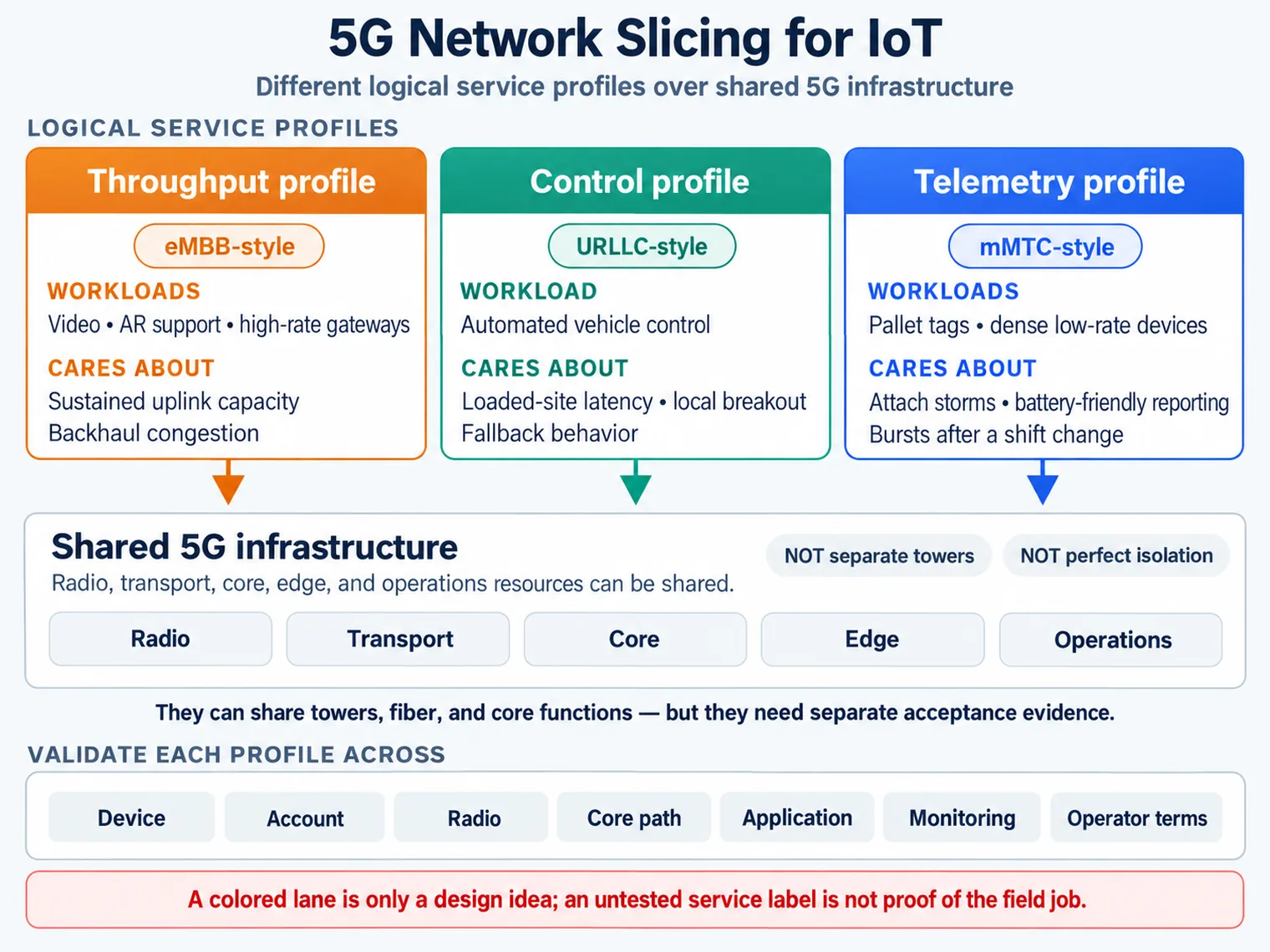
The shared network supports three service profiles with different acceptance needs.
- The eMBB branch serves traffic that needs sustained capacity.Gate cameras and high-rate gateways need sufficient uplink and backhaul capacity while the other service profiles are also carrying traffic.
- The control branch needs engineered latency and a safe fallback.Vehicle commands depend on loaded radio tests, suitable local routing, monitoring, and an application response when the service path degrades.
- The telemetry branch serves many devices sending small reports.Pallet tags need efficient access, battery-aware reporting, and a platform that can absorb bursts when the yard’s shift changes.
- All three branches need their own acceptance evidence.Shared towers, fiber, and core functions mean a strong camera throughput result cannot establish control latency or dense tag behavior.
Major section
The complete device-to-application path
A service profile depends on the whole path from the device to its application.
- The device and SIM must support the authorized profile.Modem firmware, subscription policy, and allowed NSSAI belong in the record because a requested slice may not be permitted at the site.
- Radio scheduling, transport, and core routing can affect delivered service.A correctly selected control slice can still miss its target when the scheduler is congested or transport shares a bottleneck.
- The application endpoint completes the path that needs measurement.A remote edge anchor or saturated application queue can delay the vehicle command even when slice selection remains correct.
- Monitoring and operator terms define how service problems are handled.The yard’s record needs an observed bottleneck, alert owner, fallback action, and retest trigger for the particular workload under review.
Major section
Practitioner: Build the Slice Validation Record
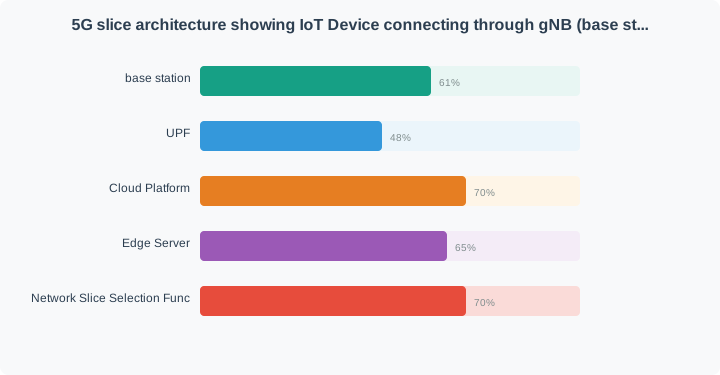
This diagram separates session control from the route that carries application traffic.
- The IoT UE reaches the gNB before the paths separate.The diagram begins at the device and radio access point, where the tested firmware and SIM policy identify the participating endpoint.
- AMF, NSSF, and SMF are responsible for the session’s control context.Registration, allowed-slice selection, and session setup determine which service path the device may use before application packets can follow that route.
- The UPF carries user traffic toward the application.Its route to an edge or cloud endpoint is the data path that the workload record must connect with observed packets.
- Validation joins the allowed policy with the application result.A warehouse record links busy-hour radio conditions, UPF or edge anchor, endpoint, bottleneck, and fallback action for each separate traffic profile.
Major section
Under the Hood: Selection and Isolation Are Separate
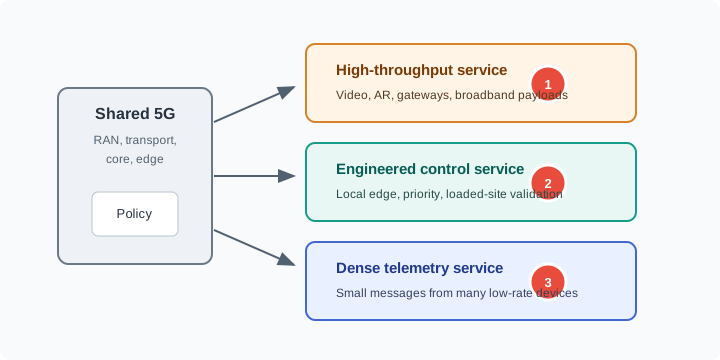
This diagram separates choosing a service profile from proving its behavior under load.
- The throughput branch needs capacity evidence under competing load.A video or gateway burst exercises shared resources while telemetry and control remain active, exposing limits hidden by an isolated throughput test.
- The control branch needs latency and fallback evidence.Moving application timestamps suggest an endpoint queue, while changing retransmissions, scheduler delay, or QoS counters support a radio investigation.
- The telemetry branch needs dense access and reporting evidence.A background telemetry load keeps the tag workload present while the test adds control traffic and then a video burst.
- Correct selection cannot establish separation at shared bottlenecks.The slice may be authorized and steered correctly while radio scheduling, transport, edge routing, or application queues still break the service target.
Activity 1 · Predict
✎ Add a video burst

I want you to challenge the control path when the radio gets busy.
On paper, keep telemetry active and add a video burst. Predict two places that could delay control traffic. Explain which measurement would distinguish an endpoint queue from a radio bottleneck.
3 minutes · Pen and paper · Answer: Activity 1
Major section
Private 5G Networks for IoT
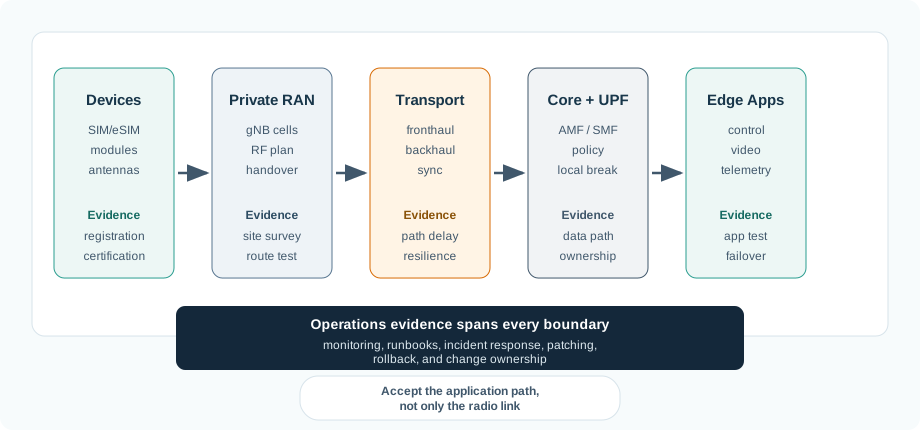
This diagram traces private-network responsibilities from devices through applications and operations.
- Device modules connect to the site’s private radio network.Guided carts, cameras, and sensors need coverage and movement evidence for their actual routes, antenna placement, and installed radio conditions.
- Transport carries traffic while core functions manage identities and sessions.Device admission, policy rules, session handling, monitoring, and backup responsibilities define the core boundary that the operating team must support.
- The UPF routes application data toward local and business systems.The application review follows firewall, name-service, and endpoint paths because strong radio reception cannot establish local routing or acceptable application delay.
- The evidence side must assign measurements and owners to each handoff.Runbooks, SIM lifecycle, patching, rollback, and incident response turn the private-network diagram into duties the site can actually operate.
Major section
Who operates the private network
Deployment models divide responsibility differently between the site and its service providers.
- Standalone networks have more radio, core, and edge responsibility locally.The enterprise needs credible ownership or a managed-service contract for identity, policy, monitoring, and UPF operation before accepting the extra local control.
- Hybrid models have duties divided between site and operator.Spectrum, RAN, core, edge, and support responsibilities need explicit boundaries because the private-network label does not identify who controls each service decision.
- Carrier slices need more provider operations and evidence.A carrier-managed service may cover multiple yards quickly, but its actual device behavior, user-plane route, and escalation process still require verification.
- Every model needs named identity, routing, and incident owners.A local-breakout requirement cannot be approved from a public speed test; the team needs evidence for its own complete workload path.
Major section
Coverage, application delay, and daily operation
Local control is useful only when the operating team can support the workload.
- Coverage and movement tests must represent the installed devices.Real obstructions, moving equipment, loaded cells, and mounting positions can expose route problems that a static coverage map or drive-by test misses.
- Application delay includes routing and endpoint behavior.Transport, UPF, firewall, authentication, and edge compute can break a response-time target even when the private radio has strong signal strength.
- SIM management, patching, backups, and rollback need daily owners.A successful pilot still lacks production evidence if the operating team cannot diagnose faults, restore service, or carry out the agreed support handoff.
- Simpler networks may satisfy the workload with less operating work.Wi-Fi, Ethernet, public cellular, or low-power networks remain useful where private 5G’s local control and movement support do not solve a specific need.
Major section
Summary
A slice is ready only when its service claim survives a realistic workload test.
- Separate workload records keep one strong result from hiding another weakness.The yard’s video throughput pass cannot substitute for loaded vehicle-command latency or the access and reporting behavior of dense pallet tags.
- Selection identifies the allowed path; load tests reveal delivered service.The control slice can remain correctly selected while radio congestion, shared transport, or the application queue causes the response target to fail.
- Monitoring must connect degradation with a fallback and an owner.Changing timestamps or radio counters need an agreed investigation path, while the application needs a practical response when the slice is lost.
- Private-network approval includes evidence that the site can operate its duties.Radio, identity, core, local routing, patches, and incident response remain part of the service claim after the initial device connection succeeds.
Deck summary
Key takeaways
Service evidence must connect workload needs, network behavior, and operational responsibility.
- A slice applies different treatment over shared network infrastructure.The throughput, control, and telemetry profiles can use the same towers and core without gaining a promise of perfect isolation.
- Device, policy, radio, core, and application must support one service claim.The yard’s record joins tested device capability, allowed NSSAI, user-plane route, endpoint, and observed bottleneck for the same workload boundary.
- Competing traffic reveals limits that a slice identifier cannot establish.Adding a video burst while telemetry and control run can expose scheduler, QoS, transport, or endpoint delays despite correct authorization.
- Ownership and retest triggers keep the claim useful after release.Firmware, policy, route, endpoint, traffic, or support changes require a fresh check when they alter the assumptions behind the accepted service.
Retrieval practice
Recall check 1 of 6

Radio Remi says: answer from memory, then check your reasoning.
Q1A design review says a factory control workload is safe because it was assigned a low-latency slice name. What should block release?
Show answer
Answer: A Network slicing should be approved from measured service-path evidence, not from a slice label alone.
Retrieval practice
Recall check 2 of 6

Radio Remi says: answer from memory, then check your reasoning.
Q2A logistics site wants one slice for cameras, one for vehicle control, and one for tags. What is the strongest first design artifact?
Show answer
Answer: A A slice design should start with workload evidence and trace each workload through authorization, path validation, monitoring, and fallback.
Retrieval practice
Recall check 3 of 6

Radio Remi says: answer from memory, then check your reasoning.
Q3A device is allowed onto the intended slice, but control traffic still slows during a busy radio test. Which distinction matters most?
Show answer
Answer: A Slice authorization proves selection.
Retrieval practice
Recall check 4 of 6

Radio Remi says: answer from memory, then check your reasoning.
Q4A factory campus wants private 5G for guided carts, maintenance tablets, vibration sensors, and local video inspection where public coverage is uneven. Which first review step keeps the private-network claim evidence-based?
Show answer
Answer: B Private 5G decisions should start with the site-specific radio, identity, core, user-plane, application, security, monitoring, and operations evidence that makes the private network useful.
Retrieval practice
Recall check 5 of 6

Radio Remi says: answer from memory, then check your reasoning.
Q5A campus wants local user-plane breakout and local device admission policy. What evidence matters most before choosing a standalone private 5G model?
Show answer
Answer: C Deployment-model approval depends on responsibility boundaries and measured workload evidence, not a generic private-network label.
Retrieval practice
Recall check 6 of 6

Radio Remi says: answer from memory, then check your reasoning.
Q6A private 5G pilot has good signal strength, but the edge application still misses its response-time target. What should the release review conclude?
Show answer
Answer: D Private 5G release gates need complete path evidence and named operations ownership before production scale-up.
Print reference
Answers 1 of 2
Answer key.
- A · Network slicing should be approved from measured service-path evidence, not from a slice label alone.
- A · A slice design should start with workload evidence and trace each workload through authorization, path validation, monitoring, and fallback.
- A · Slice authorization proves selection.
- B · Private 5G decisions should start with the site-specific radio, identity, core, user-plane, application, security, monitoring, and operations evidence that makes the private network useful.
Print reference
Answers 2 of 2
Answer key.
- C · Deployment-model approval depends on responsibility boundaries and measured workload evidence, not a generic private-network label.
- D · Private 5G release gates need complete path evidence and named operations ownership before production scale-up.
Print reference
Activity 1 answer
Model answer.
Predict: Control could slow at the radio scheduler or application queue. Changing radio retransmissions, scheduler delay, or QoS counters supports a radio investigation. An application timestamp moving alone suggests checking the endpoint queue. Slice selection can remain correct throughout.