Decibels and the Link Budget
Decibels and the Link Budget
All the math you need to read any radio link budget — starting from zero
 Ada
Ada
Decibels and the Link Budget — from zero
Everything a radio engineer does with a link budget uses one math idea: counting zeros. If you can count zeros, you can read any link budget. Prove it to yourself in four small steps, then drive a real link with the sliders.
Step 1 — A decibel just counts zeros
Radio signals get weak, fast. A signal can leave the antenna 10,000,000,000,000,000 times stronger than when it arrives. Nobody wants to do math with numbers like that, so engineers count the zeros instead: that number has 16 zeros, and we say the signal lost 160 dB (each zero is worth 10 dB).
One more anchor and you know all the dB math you will ever need: doubling is about +3 dB (because 2 is about "a third of the way" to 10 in zero-counting terms).
Step 2 — Counting zeros turns × into +
A radio link is a chain of multiplications: transmitter power × antenna boost × distance loss × wall loss. Multiplying huge and tiny numbers is miserable. But when you count zeros, multiplication becomes addition — the zeros just stack up. So the whole chain becomes one line of primary-school arithmetic:
That one line is the link budget. Everything else is filling in the numbers.
Step 3 — What distance costs
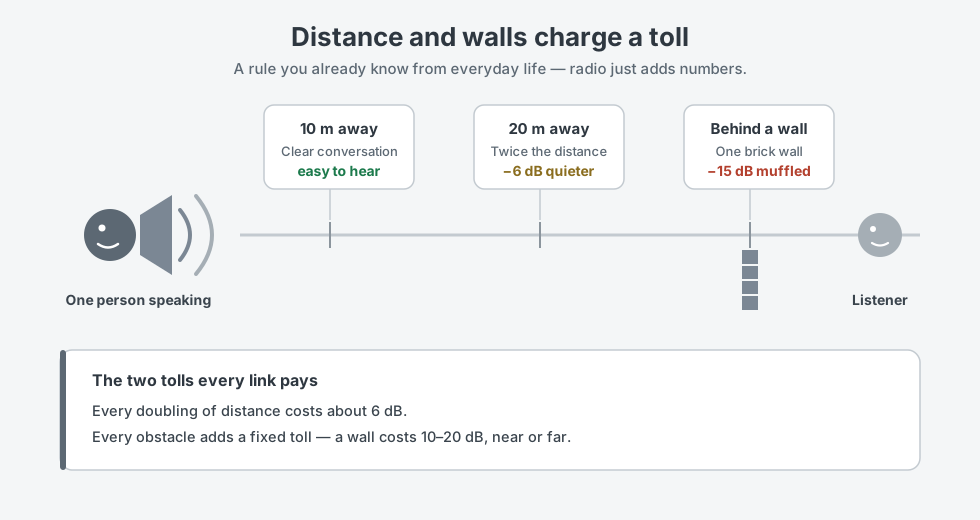
A radio wave spreads out like an inflating balloon: go twice as far, and the same energy is spread over four times the area, so your receiver catches a quarter as much. A quarter is two halvings, and each halving is −3 dB, so: every doubling of distance costs 6 dB. That is the whole physics. Walls are simpler still — each obstacle just subtracts a fixed toll (a house wall is roughly −10 to −20 dB).
Step 4 — Margin: the only number that matters
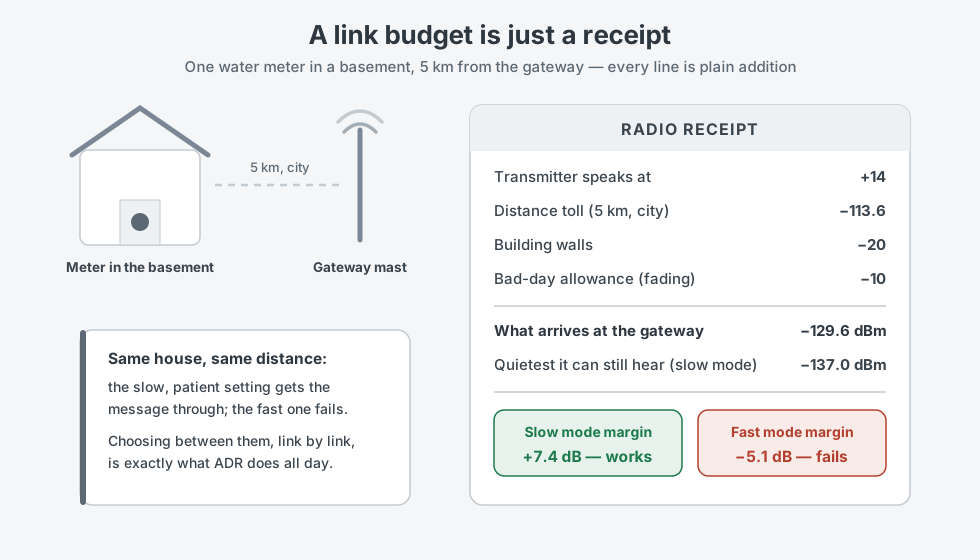
The receiver has a floor: the quietest whisper it can still understand (its sensitivity). Subtract the floor from what actually arrives and you get the margin. Positive margin = the link works. Negative = it fails. LoRa's special trick is that its slow mode (SF12) can hear whispers below the radio noise floor, giving it about 12 dB more margin than its fast mode (SF7) on the same link.
Try it — drive a real LoRaWAN link
One sensor, one gateway, EU868 band, 14 dBm transmit. Drag the sliders and watch the one-line budget update. Find the distance where the fast mode dies but the slow mode still works — you have just discovered why Adaptive Data Rate exists.
Fixed values under the hood: 14 dBm transmit, 868 MHz, 10 dB fade allowance, SF7 floor −124.5 dBm, SF12 floor −137.0 dBm — the same numbers derived in the chapter's Foundations panel.
You now know enough
| When you see… | You read it as… |
| +10 dB | ten times stronger |
| −6 dB | distance doubled |
| "link budget" | one line of adding and subtracting |
| "margin +7 dB" | works, with a 5× safety cushion |
| "margin −5 dB" | fails — slow down, boost power, or move closer |