 Phoebe guides
A field team faces an unresolved physical question: Where 530 days of battery life come from They must answer it before changing wi-fi transmissions per day on the real device. Predict the direction first.
See the relationship before changing it
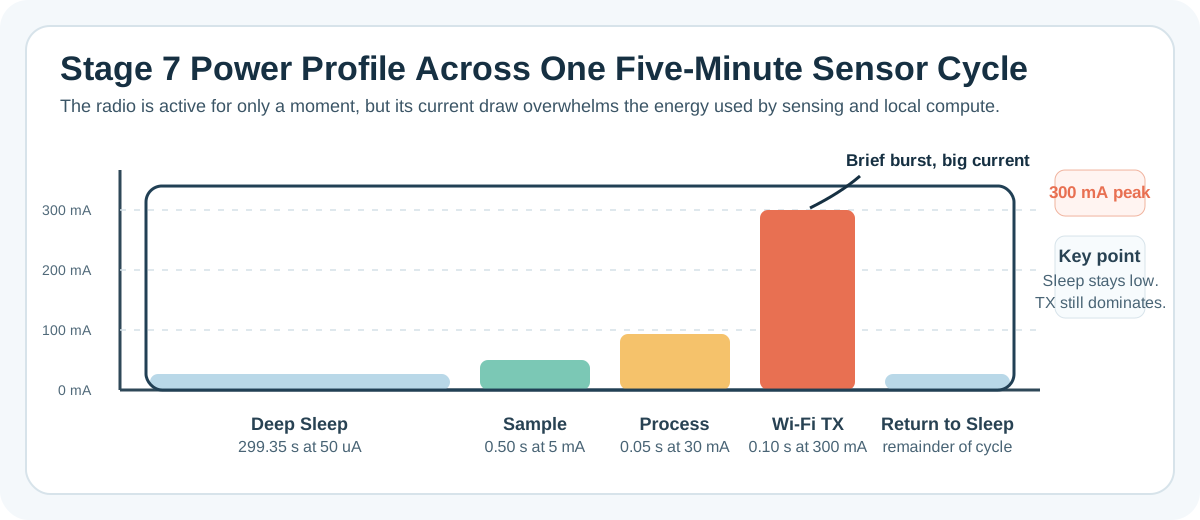
The chapter figure below shows: Wireless transmission power profile
The retained audit below checks several chapter fixtures. This added model holds every other chapter fixture fixed, so the numeric fixture does not switch without explanation.
Derive the baseline in four named moves
- 1
Name the input. The chapter baseline for wi-fi transmissions per day is 12.
- 2
Name the relationship. Q_day=Q_sensor+N_tx(I_wifi t_wifi/3600)+Q_sleep; days=C/Q_day
- 3
Substitute the chapter fixture. Set wi-fi transmissions per day to 12. The page ledger gives wi-fi as 1.13 mAh/day.
- 4
Read the result. Keep mAh/day beside the value. Use it only inside the technical boundary on this page.
Predict, then change wi-fi transmissions per day
Try Predict the direction of wi-fi. Move one control, calculate, then check your prediction.
Observe The widget repeats the same currentxtime sum and capacity division derived above. Reset the control to 12 and compare wi-fi.
Explain Only wi-fi transmissions per day moves here. The other chapter fixtures remain fixed.
Check yourself
What should you do before trusting a moved-control result?
What does this small model leave out?
1. Current is charge flow
A milliampere (mA) tells how fast charge leaves the cell. A milliamp-hour (mAh) is the charge used by 1 mA for one hour.
2. Count the daily cycles
The node wakes every 15 minutes, so the day contains 24×60/15 = 96 cycles. A 30 mA, 3 s sensor read costs 30×3/3,600 = 0.0250 mAh; 96 reads cost 2.40 mAh/day.
3. Add each state
Sensor96 × 0.0250 = 2.40 mAh/day.
RadioOne 170 mA, 2 s Wi-Fi burst costs 0.0944 mAh.
SleepThe chapter's long sleep intervals total about 0.239 mAh/day.
LifetimeEstimated days = capacity/daily charge.
4. Try batching the transmissions
TryMove from 96 separate transmissions to the chapter's 12 buffered transmissions.
ObserveAt 12 bursts the exact ledger is 3.77 mAh/day and 530 days, about 3.1× the unbuffered estimate.
ExplainThe widget repeats the same current×time sum and capacity division derived above.
The daily ledger keeps sensor reads, state currents and durations, sleep charge, and battery capacity fixed while radio transmission count changes. Cold, ageing, cutoff voltage, self-discharge, regulator losses, and radio retries are outside this ideal charge budget.
- cold
- Needs separate evidence
- aging
- Needs separate evidence
- cutoff voltage
- Needs separate evidence
- self-discharge
- Needs separate evidence
- regulator loss
- Needs separate evidence
- radio retries
- Needs separate evidence
Use field evidence or a deeper model before release.
5. Reproduce the chapter's answers
Buffered radio charge is 12×0.0944 = 1.13 mAh/day. Then 2.40+1.13+0.239 = 3.77 mAh/day and 2,000/3.77 = 530 days. A 3.7 V, 2,000 mAh cell stores 3.7×2,000/1,000 = 7.40 Wh before losses.
6. Keep the rounding honest
Rounding the daily total to 3.7 mAh before division gives 541 days. Carrying the displayed components gives 530 days. Both support the same design conclusion, but 530 is the reproducible component-led result.
7. Check yourself
How many 15-minute cycles fit in a day?
What does one Wi-Fi burst cost?
Why is 530 days not a field guarantee?
The daily ledger keeps sensor reads, state currents and durations, sleep charge, and battery capacity fixed while radio transmission count changes. Cold, ageing, cutoff voltage, self-discharge, regulator losses, and radio retries are outside this ideal charge budget.
- currents
- Sensor and radio state currents
- durations
- Sensor-read and radio-transmit state durations
- cycle counts
- Daily sensing and buffered transmission counts
- cell capacity
- Nominal battery charge capacity
- 3.7 V energy scale are the chapter's
- Assumed voltage for converting charge to energy
This is an ideal budget for comparing designs, not a warranted service life.