 Radio Remi guides
A technician must decide whether distance multiplier at n = 2 is safe before changing rssi swing on the real device. The result is unresolved until the rule and units are checked. Predict the direction first.
See the relationship before changing it
Set the input, apply the rule, then read the result with its unit.
The retained audit below checks several chapter fixtures. This model keeps those stated values fixed and changes only rssi swing, so the numeric fixture does not switch without explanation.
Derive the baseline in four named moves
- 1
Name the input. The chapter baseline is 8 dB.
- 2
Name the relationship. multiplier = 10^(RSSI swing / 20)
- 3
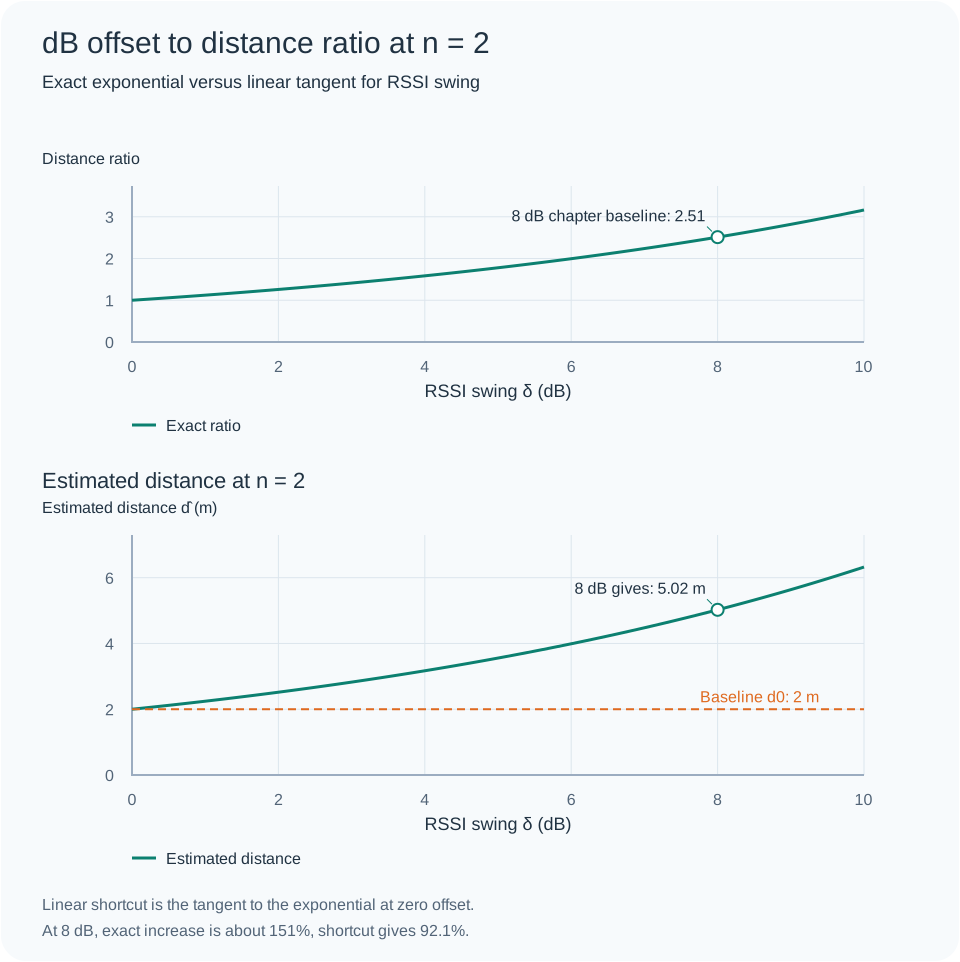
Substitute with units. 10^(8 / 20) = 2.512 times
- 4
Read the result. Keep the unit beside the value. Use it only inside the technical boundary on this page.
Predict, then change rssi swing
Try Predict the direction of multiplier = 10^(RSSI swing / 20). Test another rssi swing, then compare distance multiplier at n = 2.
Observe A larger RSSI error expands distance multiplicatively. Reset rssi swing to 8 and compare distance multiplier at n = 2.
Explain Received signal strength uses a logarithmic power scale, so a larger fade maps to an exponentially larger inferred distance multiplier under the fixed propagation exponent.
Check yourself
What should you do before trusting a moved-control result?
What does this small model leave out?
1. A logarithm turns multiplication into addition
A fixed drop in RSSI is written in decibels. Solving back for distance undoes the logarithm with a power of ten. That is why the same dB offset multiplies a range instead of adding the same number of metres.
2. Name every algebra move
Isolate the log term(RSSI0−RSSI)/(10n)=log10(d/d0).
Undo the logarithmd/d0=10^((RSSI0−RSSI)/(10n)).
Linearise only near zeroΔd/d≈ln(10)δ/(10n) when |δ| is small.
3. Exact curve first, tangent second
The straight-line formula is the tangent to the exponential at zero offset. It is useful for small, fast jitter; it is not a replacement for the exact equation at a large wall or body shadow.
4. Try one controlled change
TryMove from small frame-to-frame jitter toward the chapter’s full 8 dB swing.
ObserveAt 1 dB the exact curve stays near the 11.5% tangent. At 8 dB, the exact increase is about 151%, far above the 92.1% shortcut.
ExplainExponentials curve away from their tangent. The source’s 5.0 m upper claim fits n=2, but its 1.4 m lower claim would require n≈5.16, so one exponent cannot produce both ends.
The log-distance equation is exact only for its stated model.
- Reference power
- Needs device and channel calibration
- Path-loss exponent
- Changes with room, obstruction, and time
- Trilateration radii
- Remain biased when RSSI ranges are biased
Use measured distributions, antenna orientation, multipath evidence, and a position reference before claiming accuracy.
5. Reproduce the chapter values
For d0=2 m, n=2, and δ=8 dB, d̂=2×10^(8/20)=5.02 m. For δ=−8 dB, d̂=2×10^(−8/20)=0.796 m. The tangent gives ln(10)×8/20=92.1%, while the exact positive change is (10^0.4−1)×100=151%. Solving 1.4/2=10^(−8/(10n)) gives n≈5.16.
6. Carry the evidence forward
Keep beacon calibration, channel, path exponent fit, anchor coordinates, raw and filtered RSSI, orientation, body/wall state, residuals, holdout positions, and time-synchronised ground truth.
7. Check yourself
Why does each dB create a ratio?
Can n=2 produce both 5.0 m and 1.4 m from ±8 dB?
When is the linear shortcut useful?
The page keeps the stated equation and the chapter's 1.4 m shortcut separate.
- −14 dB at n=2
- Gives about 5.02 m exactly
- Linear shortcut
- Gives about 0.80 m locally
- 1.4 m chapter value
- Would imply a different exponent near 5.16
The source mismatch is disclosed rather than forced to agree.