 Bex guides
A technician must decide whether annual coap radio energy is safe before changing messages per minute on the real device. The result is unresolved until the rule and units are checked. Predict the direction first.
See the relationship before changing it
Set the input, apply the rule, then read the result with its unit.
The retained audit below checks several chapter fixtures. This model keeps those stated values fixed and changes only messages per minute, so the numeric fixture does not switch without explanation.
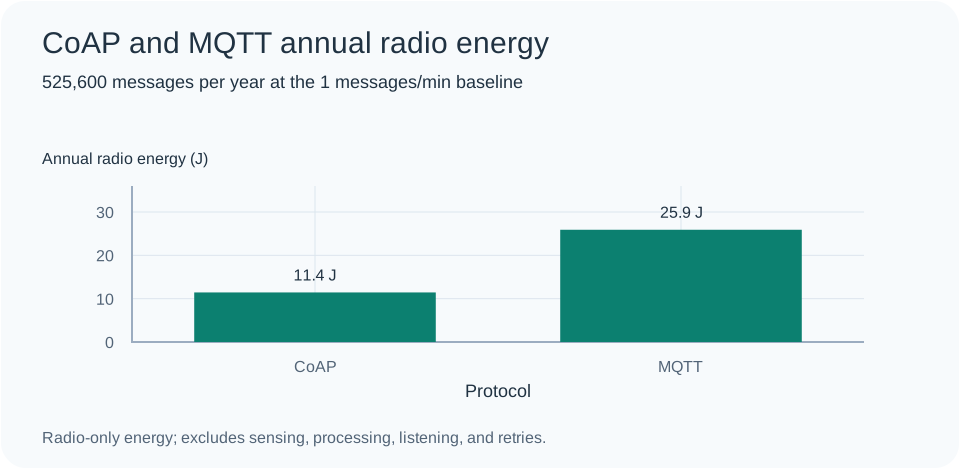
Derive the baseline in four named moves
- 1
Name the input. The chapter baseline is 1 messages/min.
- 2
Name the relationship. energy = rate x 525,600 x 0.00002176 J
- 3
Substitute with units. 1 x 525,600 x 0.00002176 = 11.4 J
- 4
Read the result. Keep the unit beside the value. Use it only inside the technical boundary on this page.
Predict, then change messages per minute
Try Predict the direction of energy = rate x 525,600 x 0.00002176 J. Test another messages per minute, then compare annual coap radio energy.
Observe More messages repeat the same bounded radio cost more often. Reset messages per minute to 1 and compare annual coap radio energy.
Explain Each message repeats the same radio transaction cost, so increasing messages per minute repeats that energy proportionally across the fixed year.
Check yourself
What should you do before trusting a moved-control result?
What does this small model leave out?
1. Energy per event becomes energy per year
Multiplication is enough only when the event count is known. One message each minute means 60 each hour, 1,440 each day, and 525,600 each year. The units cancel in a chain: joules per message times messages per year gives joules per year.
2. Name every algebra move
Count the eventsNyear=r×60×24×365.
Spend radio energyEyear=Nyear×Emessage.
Bound the yearstradio=Eusable/Eyear; this includes no other load.
3. The quotient is an upper bound
The first formula asks how many identical radio events fit in a derated energy budget. The second checks whether the nominal voltage stays available during the pulse. Neither formula includes the rest of the device.
4. Try one controlled change
TryIncrease only the message rate. The cell, derating, and per-message radio costs stay fixed.
ObserveAt one message per minute, the widget reproduces 525,600 messages, 11.4 J for CoAP, 25.9 J for MQTT, and radio-only bounds near 166 and 73.4 years.
ExplainDoubling the message rate doubles annual radio energy and halves each radio-only bound. It still says nothing about sleep current or shelf life.
The arithmetic uses an illustrative CR2032 model.
- Capacity and derating
- Need cell and temperature evidence
- Internal resistance
- Changes with pulse, age, and temperature
- Radio energy
- Excludes sensing, processing, listening, and retries
Measure pulse capability, cutoff, self-discharge, and converter loss before predicting service life.
5. Reproduce the chapter values
One message per minute gives 525,600 per year. CoAP uses 525,600×21.76 µJ=11.437 J/year; MQTT uses 525,600×49.28 µJ=25.902 J/year. The derated budget is 0.220 Ah×3.0 V×0.8=0.528 Wh=1900.8 J, so 1900.8/11.437=166 years and 1900.8/25.902=73.4 years. A 10 mW pulse draws 3.33 mA and sags about 0.050 V through 15 Ω.
6. Carry the evidence forward
Record payload size, headers, acknowledgements, retries, measured current trace, message rate, listening windows, sleep current, sensor and processor duty, cell lot, temperature, cutoff, and field packet results.
7. Check yourself
Why is 166 years not a battery forecast?
What happens at two messages per minute?
Why retain the sag check?
The comparison reproduces the chapter's radio-only teaching case.
- 220 mAh and 80%
- Illustrative usable capacity
- 15 Ω and 3.0 V
- Illustrative cell and voltage
- CoAP and MQTT totals
- Computed radio energy, not device energy
Correct arithmetic is not a complete battery-life claim.