The Cost of Listening Every Second
The Cost of Listening Every Second
Ada re-derives this chapter’s own numbers step by step, at full precision
 ADA · CALCULATION AUDIT
The Cost of Listening Every Second
A soil-moisture node sends only one useful reading per minute, yet wakes every second to check whether the channel is active, and each check holds the receiver on for 20 ms. Across a minute that is 60 channel checks costing 1.2 seconds of listening before a single sensor byte has moved. This audit asks the question that arithmetic invites: does the chapter’s 1.2-second figure actually check out, and what duty cycle and hourly listening cost does it imply?
Companion to the chapter Common WSN Design Mistakes — every number here comes from that chapter.
See the relationship before changing it
Set the input, apply the rule, then read the result with its unit.
The retained audit below checks several chapter fixtures. This model keeps those stated values fixed and changes only channel checks per minute, so the numeric fixture does not switch without explanation.
Derive the baseline in four named moves
- 1
Name the input. The chapter baseline is 60 checks/min.
- 2
Name the relationship. listening time = checks x 20 ms / 1,000
- 3
Substitute with units. 60 x 20 ms / 1,000 = 1.20 s/min
- 4
Read the result. Keep the unit beside the value. Use it only inside the technical boundary on this page.
Predict, then change channel checks per minute
Try Predict the direction of listening time = checks x 20 ms / 1,000. Test another channel checks per minute, then compare listening time.
Observe Frequent short checks accumulate into a measurable radio-on duty cycle. Reset channel checks per minute to 60 and compare listening time.
Explain Every channel check holds the receiver on for the same interval, so performing more checks adds listening time in direct proportion.
Check yourself
What should you do before trusting a moved-control result?
What does this small model leave out?
Multiply 60 channel checks/min by the 20 ms receiver-on time, then convert that listening time into duty cycle and an hourly total.
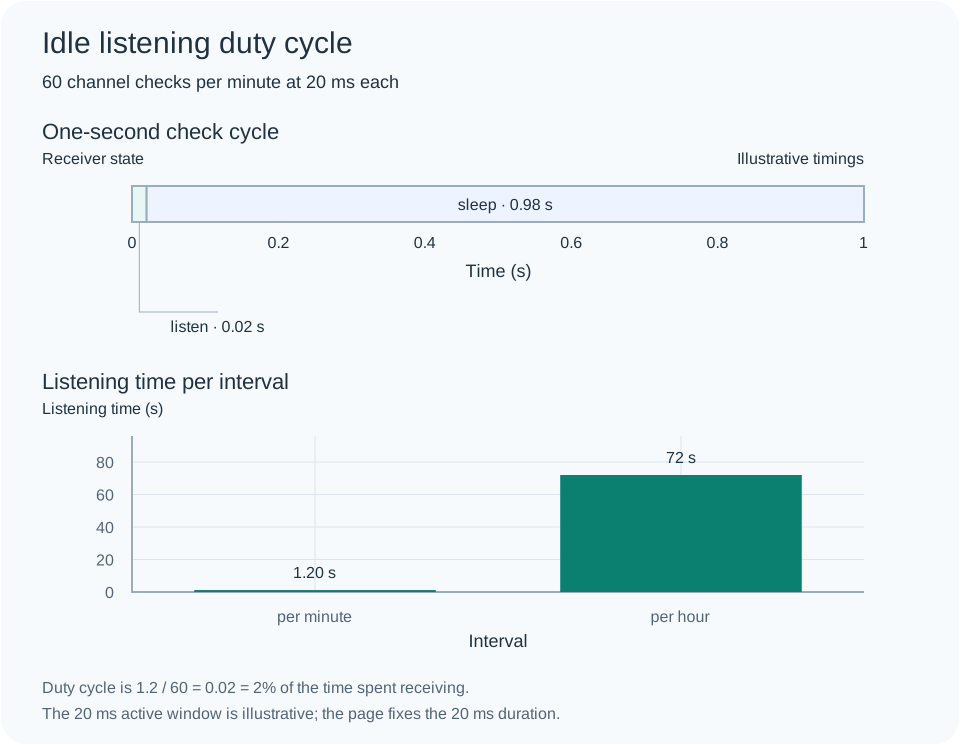
Idle listening consumes 1.2 s each minute, equal to a 2% receive duty cycle and 72 s of radio-on time per hour before payload transmission.
Every poll pays receiver energy whether traffic exists or not, so shortening or slowing the check schedule directly scales wasted listening time.
Ada: The soil-moisture node sends one useful reading a minute but wakes every second to check the channel, holding the receiver on for 20 ms each time. The chapter says that is 1.2 seconds per minute of listening - let me verify it and turn it into a duty cycle.
- Waking once a second gives
60channel checks per minute, and each keeps the radio on for20 ms = 0.020 s:60 x 0.020 = 1.2 sof listening every minute. The figure checks out. - As a duty cycle that is
1.2 / 60 = 0.02 = 2%of the time spent receiving before a single sensor byte has moved - and1.2 x 60 = 72 s, or 1.2 minutes, of idle listening every hour. - Set that against the workload of one short reading per minute: the radio burns roughly
1.2 sof listening for every reading it actually sends.
So the energy villain here is the wake schedule, not the traffic. Halving the check rate to every two seconds would halve idle listening to 0.6 s/min - which is why the chapter files this under idle listening and aims the repair at the listen-and-wake policy rather than the reporting rate.
Every number above is taken from the chapter’s own material and re-derived step by step.
Technical boundaries: This timing ledger omits receiver current, wake-transition energy, actual packet airtime, contention and retries, clock drift, preamble sampling, battery losses, and changing report traffic.