The Suppression Test and Interval Doubling
The Suppression Test and Interval Doubling
Ada re-derives this chapter’s own numbers step by step, at full precision
 ADA · CALCULATION AUDIT
The Suppression Test and Interval Doubling
A node with redundancy threshold k = 4 hears three consistent DIO messages and no conflicting DODAG information during the current interval. The chapter’s own practitioner check turns that into a scheduled-transmit-time decision: with c = 3 counted against k = 4, is that count enough to suppress the retransmission? This audit asks the question that comparison invites: does c = 3 actually clear the k = 4 threshold, and what does the strict count comparison say the node must do next?
Companion to the chapter Trickle: Timing RPL Messages — every number here comes from that chapter.
See the relationship before changing it
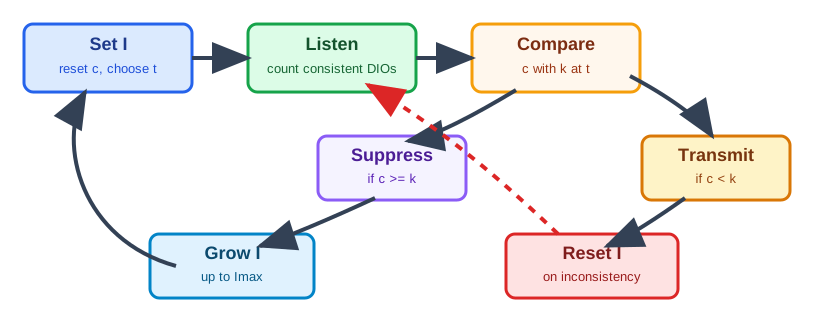
The chapter figure below shows: A Trickle interval starts by setting the timer and counter, listens for consistent DIOs, then either transmits, suppresses, grows, or resets.
The retained audit below checks several chapter fixtures. This model keeps those stated values fixed and changes only consistent dio count, so the numeric fixture does not switch without explanation.
Derive the baseline in four named moves
- 1
Name the input. The chapter baseline is 3 messages.
- 2
Name the relationship. gap = redundancy threshold 4 - consistent count
- 3
Substitute with units. 4 - 3 = 1 message
- 4
Read the result. Keep the unit beside the value. Use it only inside the technical boundary on this page.
Predict, then change consistent dio count
Try Predict the direction of gap = redundancy threshold 4 - consistent count. Test another consistent dio count, then compare messages below suppression.
Observe The node transmits below the threshold and suppresses when the remaining gap reaches zero. Reset consistent dio count to 3 and compare messages below suppression.
Explain Each consistent routing advertisement advances the counter toward suppression, so every additional message removes one from the remaining redundancy allowance.
Check yourself
What should you do before trusting a moved-control result?
What does this small model leave out?
Use redundancy constant k = 4 and compare c = 3 with c = 4, then press Check audit.
The action state transmits at c = 3 but suppresses at c = 4; six doubled intervals span approximately 63 s.
Trickle suppresses when c reaches k = 4 because enough consistent DIOs were heard, while interval doubling reduces steady-state traffic logarithmically.
Ada: This chapter turns on two numeric rules – suppress when c >= k, and double the interval while things stay consistent. The first I can check on the chapter’s own values; the second is symbolic, so I will mark the illustrative numbers as illustrative.
The suppression decision (the practitioner case, k = 4, c = 3):
c < kbecause3 < 4, so the node transmits its DIO. It would have suppressed only atc >= 4. The test is a strict count comparison, not “close enough.”
Interval doubling (symbolic, with one clearly-illustrative ladder). A Trickle node transmits at most once per interval, and each consistent interval doubles: I, 2I, 4I, and so on, so over a stable window the DIO count grows with log2 of elapsed time rather than linearly. Take an illustrative I_min = 1 s (RFC 6206 leaves the exact value configurable):
- Intervals
1, 2, 4, 8, 16, 32 ssum to1 + 2 + 4 + 8 + 16 + 32 = 63 s, using only6intervals. - So a stable node sends at most
6DIOs across roughly63 s, versus63DIOs from a fixed1 stimer – about a10xreduction, and the gap widens as the window grows because6 ~= log2(64).
The audit shows the saving is logarithmic, not a flat suppression rate: doubling is what lets a stable dense mesh fall almost silent, while the strict c >= k test still forces a copy exactly where redundancy is missing.
Every number above is taken from the chapter’s own material and re-derived step by step.
Technical boundaries: The interval sum omits random transmit-time selection, Imax clamping, inconsistent-message resets, packet loss, hidden nodes, and collisions among simultaneous DIO senders.