Read Completeness Is a Timing Budget
Read Completeness Is a Timing Budget
Ada re-derives this chapter’s own numbers step by step, at full precision
 ADA · CALCULATION AUDIT
Read Completeness Is a Timing Budget
A dock-door portal must confirm when a tagged pallet crosses from staging into a truck, and its release test logs both raw observations and the accepted event: 47 raw reads from antenna A, 39 from antenna B, resolving to exactly 1 accepted crossing. The chapter times a forklift moving at 1.2 m/s through the 2 m read zone against a reader that completes one inventory cycle every 120 ms. This audit asks the question that timing budget invites: how many inventory chances does that pallet get before it leaves the field, and how far does that number fall if the forklift speeds up?
Companion to the chapter RFID Hardware Integration — every number here comes from that chapter.
See the relationship before changing it
Set the input, apply the rule, then read the result with its unit.
The retained audit below checks several chapter fixtures. This model keeps those stated values fixed and changes only forklift speed, so the numeric fixture does not switch without explanation.
Derive the baseline in four named moves
- 1
Name the input. The chapter baseline is 1.2 m/s.
- 2
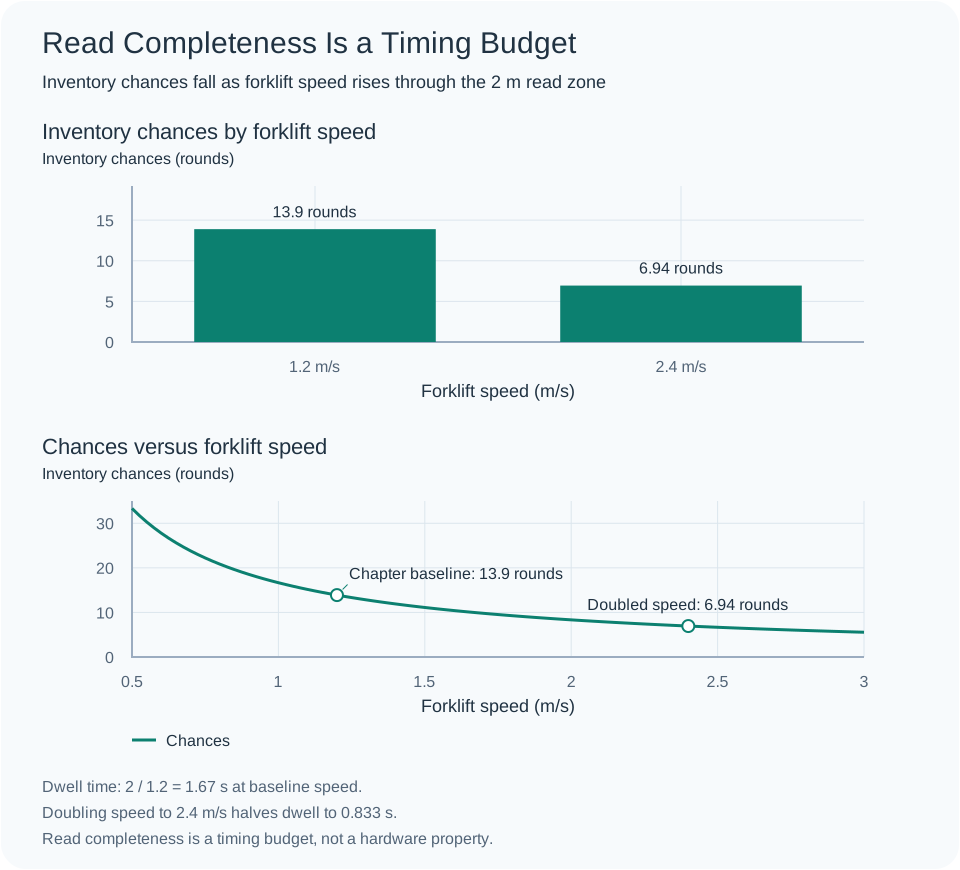
Name the relationship. chances = 2 m zone / speed / 0.12 s cycle
- 3
Substitute with units. 2 / 1.2 / 0.12 = 13.9 rounds
- 4
Read the result. Keep the unit beside the value. Use it only inside the technical boundary on this page.
Predict, then change forklift speed
Try Predict the direction of chances = 2 m zone / speed / 0.12 s cycle. Test another forklift speed, then compare inventory chances.
Observe A faster pallet spends less time in the read field and gets fewer inventory chances. Reset forklift speed to 1.2 and compare inventory chances.
Explain The reader must finish each inventory round before the pallet exits; faster motion shortens that available time inversely and therefore permits fewer rounds.
Check yourself
What should you do before trusting a moved-control result?
What does this small model leave out?
Ready: use the stated baseline inputs, then compare each displayed result.
Ada: The chapter’s timing budget decides whether a portal is usable, so let me re-run it and then push the one variable that matters most.
- Dwell time: a forklift at
1.2 m/scrossing a2 mread zone keeps a pallet in the field for2 / 1.2 = 1.667 s. - Inventory chances: at one useful cycle every
120 ms, that is1.667 / 0.12 = 13.9, about13chances to see each tag — enough for a sparse pallet. - Now double the forklift speed to
2.4 m/s: dwell halves to2 / 2.4 = 0.833 s, and chances fall to0.833 / 0.12 = 6.9, about6to7. One operational change quietly cut the read budget nearly in half.
The audit conclusion is that read completeness is not a hardware property but a timing budget, and item speed is its dominant lever — which is exactly why the release record must store the raw read count beside the accepted event (for example 47 and 39 raw observations resolving to 1 crossing), and why a speed change is a hardware-integration retest trigger, not a middleware tweak.
Every number above is taken from the chapter’s own material and re-derived step by step.