Audit the Stuffing Overhead and Marker Guarantee
Audit the Stuffing Overhead and Marker Guarantee
Ada measures byte- and bit-stuffing overhead and proves the boundary marker is unique
 ADA · CALCULATION AUDIT
Audit the Stuffing Overhead and Marker Guarantee
To find message boundaries, the chapter marks frames with the flag byte 7E and then must stop ordinary data from imitating it. Byte stuffing escapes any payload byte equal to 7E, while bit stuffing inserts an extra 0 after five consecutive 1 bits, so the data stream can never reproduce the marker. This audit measures the overhead each mechanism adds and proves the boundary guarantee holds: how many extra bits or bytes does stuffing cost, and can payload data ever look like the marker?
Companion to the chapter Packet Framing — every number here comes from that chapter.
A framing marker is a physical signal pattern as well as a parsing rule: count the bits or bytes the transmitter adds, then prove the data stream cannot imitate the boundary.
See the relationship before changing it
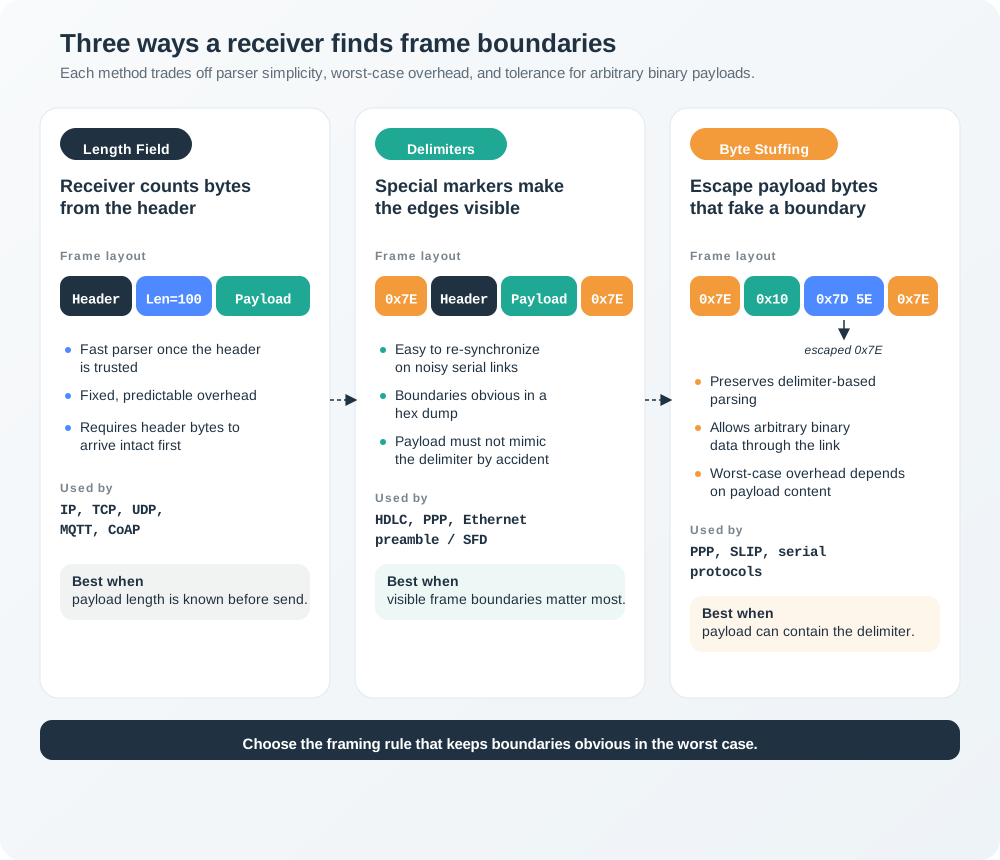
The chapter figure below shows: Boundary strategies: count bytes with a length field, scan for a delimiter, or protect delimiter bytes with escaping.
The retained audit below checks several chapter fixtures. This model keeps those stated values fixed and changes only consecutive-one run, so the numeric fixture does not switch without explanation.
Derive the baseline in four named moves
- 1
Name the input. The chapter baseline is 5 bits.
- 2
Name the relationship. run expansion = one inserted bit / run length x 100
- 3
Substitute with units. 1 / 5 x 100 = 20.0%
- 4
Read the result. Keep the unit beside the value. Use it only inside the technical boundary on this page.
Predict, then change consecutive-one run
Try Predict the direction of run expansion = one inserted bit / run length x 100. Test another consecutive-one run, then compare stuffing expansion.
Observe Bit stuffing pays one extra bit after the forbidden run so payload cannot imitate the flag. Reset consecutive-one run to 5 and compare stuffing expansion.
Explain One inserted bit is spread across the chosen run of original bits, so a longer run length reduces the fractional stuffing expansion inversely.
Check yourself
What should you do before trusting a moved-control result?
What does this small model leave out?
Ready: use the stated baseline inputs, then compare each displayed result.
1. Byte stuffing for the chapter's flag example
The escaping figure uses flag byte 7E. When a payload byte is itself 7E, the transmitter sends an escaped pair instead of the single data byte:
The overhead is local to ambiguous bytes: ordinary payload bytes still cost one transmitted byte each, while each flag-valued payload byte pays one extra escape byte.
2. Bit stuffing blocks a false marker
The chapter states that bit stuffing inserts one 0 after five consecutive 1 bits. A run of five payload ones therefore becomes six transmitted bits:
The common flag byte 0x7E is binary 01111110, which contains six consecutive ones. Because the transmitter inserts a 0 immediately after any five data ones, payload data cannot produce that six-one run on the wire.
| Mechanism | Chapter value | Audit result |
| Byte stuffing | Payload byte equals 7E | 1 extra byte for that ambiguous byte |
| Bit stuffing | Insert 0 after five 1 bits | 1 extra bit per five-one run, or 20% for that run |
| Boundary guarantee | 0x7E = 01111110 | Six consecutive data ones cannot appear unstuffed |
What the mathematics buys you: escaping is not magic; it is a measurable overhead paid to preserve a parser invariant. The receiver can trust a delimiter only because the transmitter proves that ordinary data cannot look like the delimiter.
Noise, clock recovery, CRC detection, escape-byte corruption, resynchronization, and retransmission are outside this deterministic stuffing audit; it counts only the fixed 7E and five-one fixtures.
Every number above is taken from this chapter's own worked example and re-derived step by step.