The 97% That Justifies 20 Gateways
The 97% That Justifies 20 Gateways
Ada re-derives this chapter’s own numbers step by step, at full precision
 ADA · CALCULATION AUDIT
The 97% That Justifies 20 Gateways
A smart city wires 10,000 environmental sensors to report every 30 seconds, sending 864 million messages to the cloud each month at a processing cost of $1,728. Edge filtering and zone aggregation collapse that stream to 26.8 million messages — a 97% cut — but only after buying 20 gateways for a one-time $10,000. This audit rebuilds the whole volume-and-cost chain to ask whether that 97% reduction really justifies the 20 gateways.
Companion to the chapter Diagnosing IoT Architecture Anti-Patterns — every number here comes from that chapter.
See the relationship before changing it
Set the input, apply the rule, then read the result with its unit.
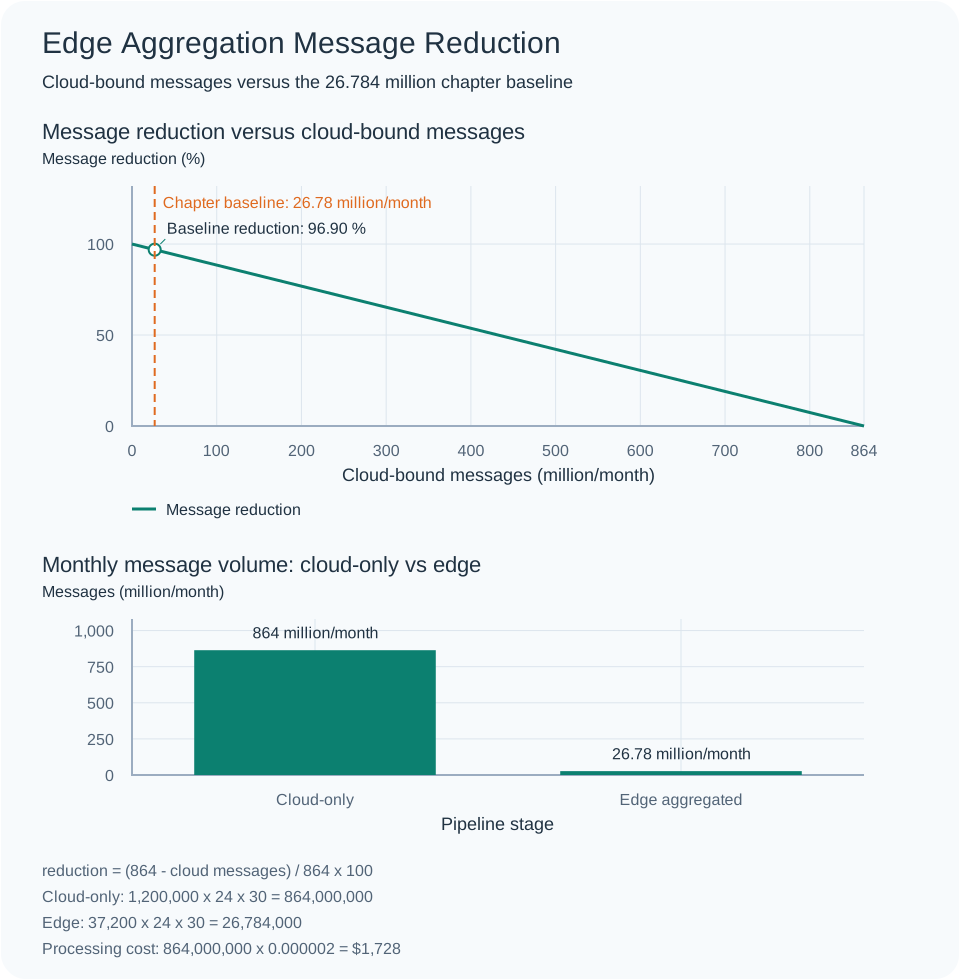
Derive the baseline in four named moves
- 1
Name the input. The chapter baseline is 26.784 million/month.
- 2
Name the relationship. reduction = (864 - cloud messages) / 864 x 100
- 3
Substitute with units. (864 - 26.784) / 864 x 100 = 96.90%
- 4
Read the result. Keep the unit beside the value. Use it only inside the technical boundary on this page.
Predict, then change cloud-bound messages
Try Predict the direction of reduction = (864 - cloud messages) / 864 x 100. Test another cloud-bound messages, then compare message reduction.
Observe Edge filtering helps only when the kept stream still preserves the required evidence. Reset cloud-bound messages to 26.784 and compare message reduction.
Explain Every additional message forwarded to the cloud removes one message from the avoided-traffic count, so the reduction percentage falls linearly against the fixed baseline.
Check yourself
What should you do before trusting a moved-control result?
What does this small model leave out?
Ada: The smart-city worked example claims edge aggregation cuts cloud traffic by 97% and pays for itself against 20 gateways. Message counts carry no unit ambiguity, so let me rebuild the volume and cost chain from the chapter’s own inputs – 10,000 sensors, a 30-second interval, and the filtering rules stated.
- Cloud-only rate:
10000 x (3600 / 30) = 1,200,000messages/hour, so1,200,000 x 24 x 30 = 864,000,000messages/month. - Edge rate: filtering keeps
1,200,000 x 0.6 = 720,000/hour; zone aggregation is10000 / 100 = 100zones x(3600 / 300) = 12=1,200/hour; alerts are720,000 x 0.05 = 36,000/hour; total1,200 + 36,000 = 37,200/hour =37,200 x 24 x 30 = 26,784,000/month. - Message reduction:
(864,000,000 - 26,784,000) / 864,000,000 = 0.9690 = 96.9%, the chapter’s “97%”. - Cloud message-processing cost at
$0.000002each: cloud-only864,000,000 x 0.000002 = $1728/month falls to26,784,000 x 0.000002 = $53.57/month. - Gateway capital:
10000 / 500 = 20gateways x$500 = $10,000one-time, amortized$10,000 / 36 = $277.78/month. - Payload volume confirms the same lever:
864,000,000 x 250 bytes = 216,000 MBof raw uplink drops to6,610 MB(aggregates129.6 MB+ alerts6,480 MB), a96.9%cut on raw byte count.
The audit conclusion is that a single ratio – 26,784,000 / 864,000,000 – drives every downstream saving, because processing cost and byte volume both scale linearly with messages that reach the cloud. The design meaning is that the recurring win (about 97% less to ingest, store, and bill) dwarfs the one-time $10,000 of gateways once amortized to $278/month: edge placement earns its keep by moving the multiply-by-messages term off the cloud, not by adding boxes to a diagram.
Correlated site outages, overlapping blind spots, backhaul failure, capacity, placement cost, and routing policy are outside this independence calculation.
Work the audit first, then check the displayed derivation.
Every number above is taken from the chapter’s own material and re-derived step by step.