The Revenue Is Solid, But Mind the Conversion Denominator
The Revenue Is Solid, But Mind the Conversion Denominator
Ada re-derives this chapter’s own numbers step by step, at full precision
 ADA · CALCULATION AUDIT
The Revenue Is Solid, But Mind the Conversion Denominator
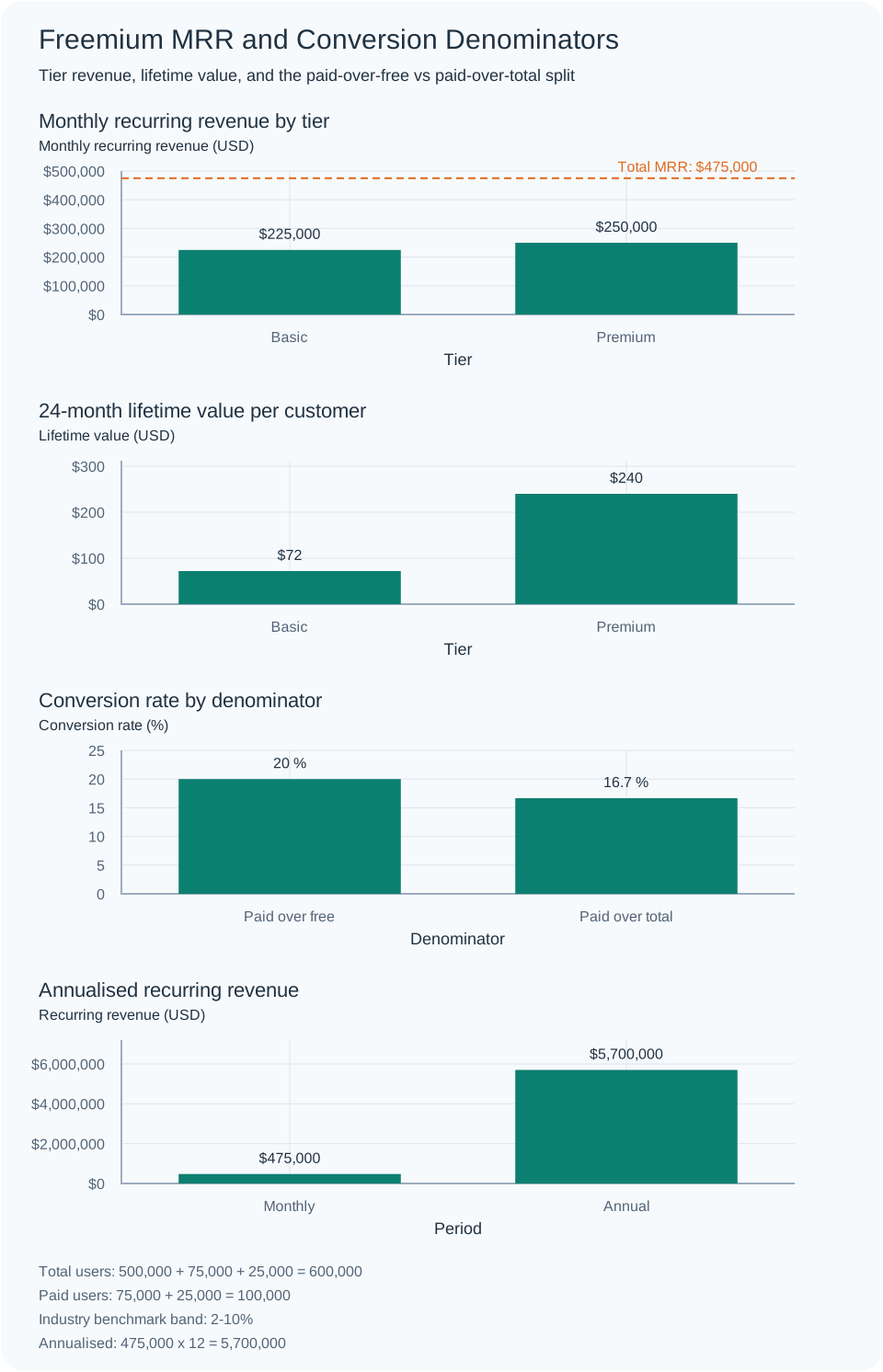
A security camera company runs freemium pricing with 500K free users, 75K Basic at $3/month, and 25K Premium at $10/month, for $475K in monthly recurring revenue — $5.7M a year. The chapter then reports a 20% conversion (100K paid over 500K free) and calls it excellent against a typical 2-10% band. The revenue math is clean, but this audit asks the harder question: which denominator should that conversion rate be measured against?
Companion to the chapter Pricing and Revenue Models — every number here comes from that chapter.
See the relationship before changing it
Set the input, apply the rule, then read the result with its unit.
Derive the baseline in four named moves
- 1
Name the input. The chapter baseline is 25000 customers.
- 2
Name the relationship. MRR = 225,000 USD basic revenue + 10 USD x premium customers
- 3
Substitute with units. 225,000 + 10 x 25,000 = 475,000 USD/month
- 4
Read the result. Keep the unit beside the value. Use it only inside the technical boundary on this page.
Predict, then change premium customers
Try Predict the direction of MRR = 225,000 USD basic revenue + 10 USD x premium customers. Test another premium customers, then compare monthly recurring revenue.
Observe Premium customers add ten dollars each; the basic-tier revenue stays fixed here. Reset premium customers to 25000 and compare monthly recurring revenue.
Explain Each premium customer pays the same monthly fee, so adding premium subscribers increases recurring revenue linearly above the unchanged basic-plan revenue.
Check yourself
What should you do before trusting a moved-control result?
What does this small model leave out?
Ada: The freemium camera example gives four hard numbers – two tier lifetime values, a monthly recurring revenue, and a conversion rate. The revenue arithmetic is clean; the conversion figure hides a choice of denominator worth making explicit.
- Basic tier lifetime value:
3 x 24 = 72per customer; Premium:10 x 24 = 240per customer. - Monthly recurring revenue:
75,000 x 3 + 25,000 x 10 = 225,000 + 250,000 = 475,000per month. - Annualised:
475,000 x 12 = 5,700,000, the stated $5.7M in recurring revenue. - Conversion, paid over free:
100,000 / 500,000 = 0.20, the stated 20%.
Those all hold. But notice the base: there are 500,000 + 75,000 + 25,000 = 600,000 total users, so conversion measured over the whole base is 100,000 / 600,000 = 16.7% – which is what the page’s own live calculator reports. Neither value is wrong; they answer different questions. The design meaning is that a conversion rate is only comparable to a benchmark once its denominator is named, so a pricing review should always label whether a rate is paid-over-free (20% here) or paid-over-total (16.7% here) before ranking it against the 2-10% industry band.
The pricing arithmetic deliberately does not simulate churn, free-tier servicing cost, upgrades, discounts, tax, payment failure, or cohort migration; it keeps the chapter's paid-over-free conversion denominator explicit.
Work the audit first, then check the displayed derivation.
Every number above is taken from the chapter’s own material and re-derived step by step.