Latency as Distance
Latency as Distance
Ada re-derives how far a car travels while the network thinks
 ADA · CALCULATION AUDIT
Foundations · optional physics
Latency as Distance
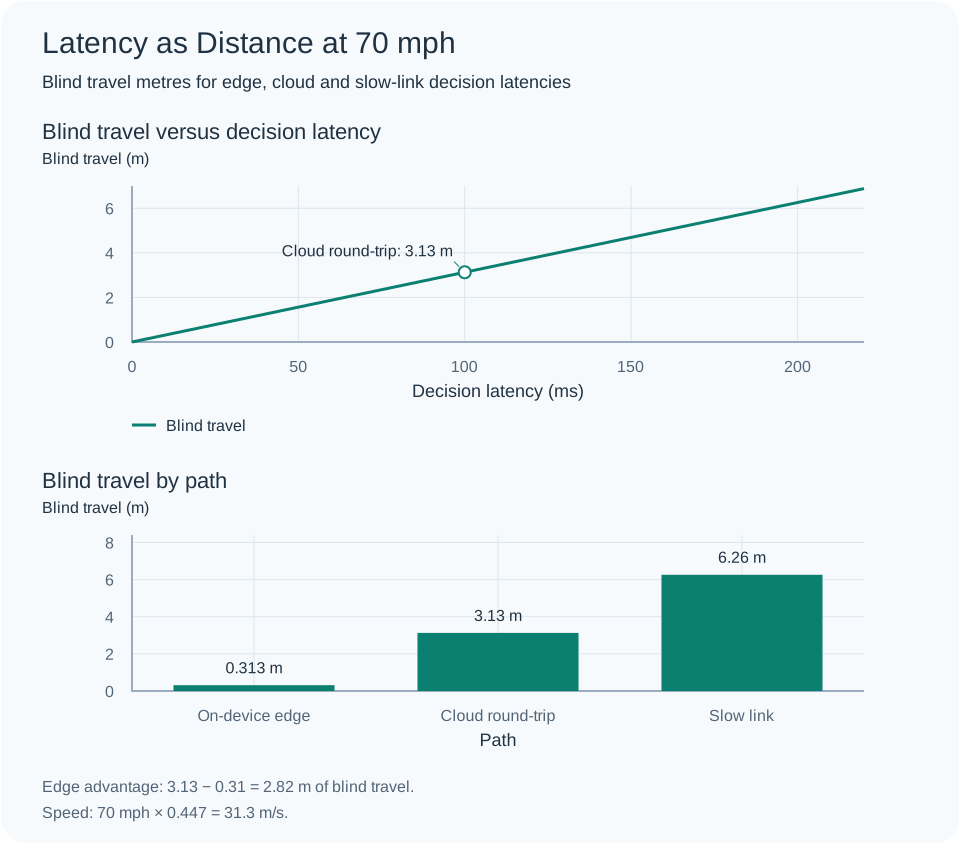
At highway speed a self-driving car travels 31.29 m/s (70 mph), so a 10 ms on-device decision passes in just 0.31 m of blind travel while a 100 ms cloud round-trip burns 3.13 m — a 2.82 m gap, more than a car length. The chapter’s latency spectrum already puts autonomous vehicles under 10 ms and calls a 100 ms delay catastrophic. This audit turns that budget into metres and asks whether the edge-versus-cloud choice is settled by the physics of distance rather than by price.
Companion to the chapter Comparing Domain Requirements — every number here comes from that chapter.
Ada's Calculation Audit: latency as distance — how far a car travels while the network thinks, ~3 minutes
A latency budget is really a distance budget. Kinematics turns milliseconds into metres of blind travel, and that is what decides edge versus cloud for a moving vehicle.
See the relationship before changing it
Set the input, apply the rule, then read the result with its unit.
The retained audit below checks several chapter fixtures. This model keeps those stated values fixed and changes only decision latency, so the numeric fixture does not switch without explanation.
Derive the baseline in four named moves
- 1
Name the input. The chapter baseline is 100 ms.
- 2
Name the relationship. distance = 31.29 m/s x latency / 1,000
- 3
Substitute with units. 31.29 x 100 / 1,000 = 3.13 m
- 4
Read the result. Keep the unit beside the value. Use it only inside the technical boundary on this page.
Predict, then change decision latency
Try Predict the direction of distance = 31.29 m/s x latency / 1,000. Test another decision latency, then compare blind travel at 70 mph.
Observe Longer decision latency turns directly into more blind travel at the same road speed. Reset decision latency to 100 and compare blind travel at 70 mph.
Explain The vehicle keeps moving while the decision is delayed, so extra waiting time adds distance in direct proportion at the fixed travel speed.
Check yourself
What should you do before trusting a moved-control result?
What does this small model leave out?
Press Calculate for 31.29 m/s travel speed and compare 10 ms edge latency with a 100 ms cloud round-trip.
The distance readout grows from 0.31 m to 3.13 m, leaving a 2.82 m edge advantage.
Distance traveled equals speed times latency, so the extra 90 ms becomes 2.82 m of blind motion and rules out a remote collision-avoidance loop.
Technical boundaries
For the latency budget, excluded from this fixed arithmetic are driver reaction, braking dynamics, road geometry, packet-loss tails, clock error, or scheduling jitter beyond the stated latency.
The working
1. First convert speed, then apply constant-velocity kinematics. 70 mph × 0.44704 (m/s per mph) = 31.29 m/s.
2. Multiply by each latency. At an edge budget of 10 ms, d = 31.29 × 0.010 = 0.31 m (1.03 ft). At a cloud round-trip of 100 ms, d = 31.29 × 0.100 = 3.13 m (10.27 ft). At 200 ms, d = 6.26 m.
3. The decision is the difference. The extra latency of the 100 ms cloud path over the 10 ms edge path is 3.13 − 0.31 = 2.82 m of travel before the car even begins to react.
| Path | Latency | d = 31.29 m/s × t | Distance |
|---|---|---|---|
| On-device edge | 10 ms | 31.29 × 0.010 | 0.31 m (1.0 ft) |
| Cloud round-trip | 100 ms | 31.29 × 0.100 | 3.13 m (10.3 ft) |
| Slow link | 200 ms | 31.29 × 0.200 | 6.26 m (20.5 ft) |
| Edge advantage | 90 ms | 3.13 − 0.31 | 2.82 m |
What the audit buys you: at highway speed a 90 ms latency difference is 2.82 m — more than a car length of blind travel — which is why the chapter puts collision-avoidance on-device: it is the physics, not the price, that rules out the cloud round-trip.
Every number above is taken from the chapter's own latency-as-distance example and re-derived step by step.