Where a Store-Carry-Forward Collar Spends Its Charge
Where a Store-Carry-Forward Collar Spends Its Charge
Ada re-derives this chapter’s own numbers step by step, at full precision
 ADA · CALCULATION AUDIT
Where a Store-Carry-Forward Collar Spends Its Charge
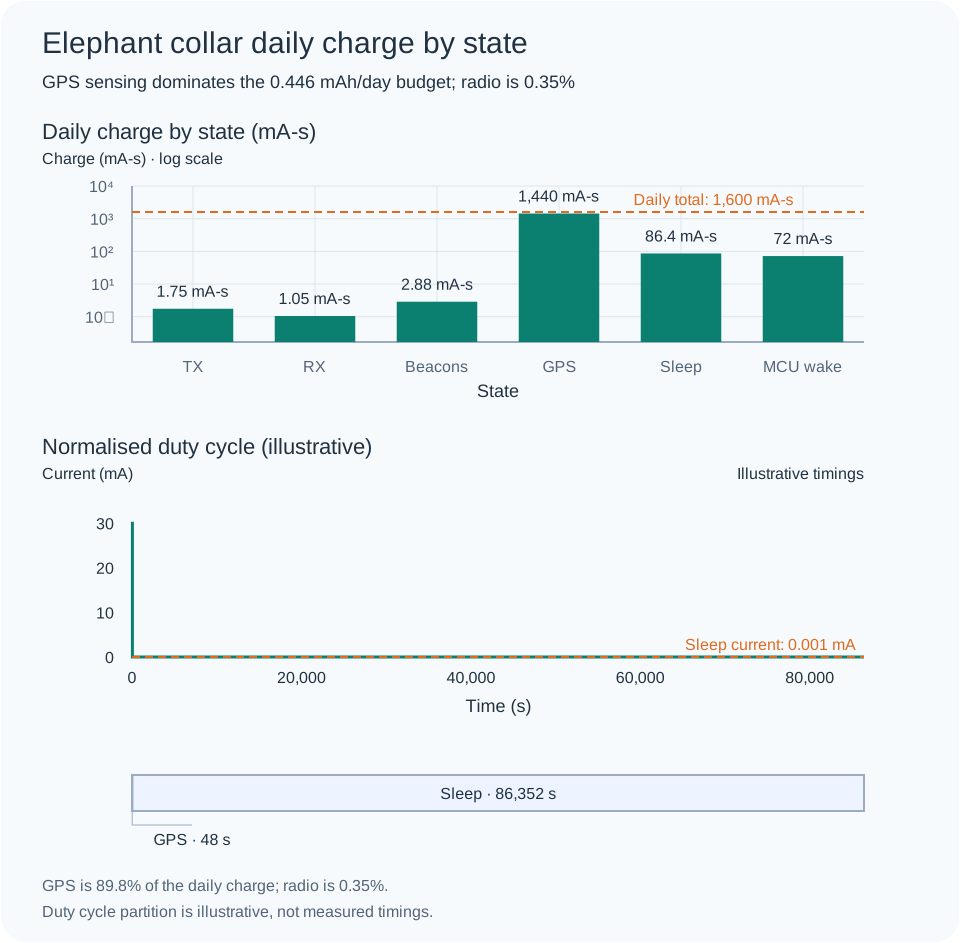
An elephant’s GPS collar runs on a 19,000 mAh D-cell and spends only 0.446 mAh/day, which leaves a 38.9x safety margin across a three-year mission. The obvious worry is the DTN radio that carries every reading. This audit totals the daily charge state by state and asks whether that radio is really what drains the collar, or whether sensing — the GPS fixes at 89.8% of the budget — quietly dominates the ledger.
Companion to the chapter DTN Store-Carry-Forward — every number here comes from that chapter.
See the relationship before changing it
Set the input, apply the rule, then read the result with its unit.
The retained audit below checks several chapter fixtures. This model keeps those stated values fixed and changes only gps active time, so the numeric fixture does not switch without explanation.
Derive the baseline in four named moves
- 1
Name the input. The chapter baseline is 36 s/day.
- 2
Name the relationship. GPS charge = 40 mA x active seconds / 3,600
- 3
Substitute with units. 40 x 36 / 3,600 = 0.400 mAh/day
- 4
Read the result. Keep the unit beside the value. Use it only inside the technical boundary on this page.
Predict, then change gps active time
Try Predict the direction of GPS charge = 40 mA x active seconds / 3,600. Test another gps active time, then compare gps charge.
Observe The GPS fix time dominates the stated daily charge even though the DTN radio carries the data. Reset gps active time to 36 and compare gps charge.
Explain The satellite-positioning receiver draws current throughout each fix, so extending its daily active time increases daily charge consumption proportionally.
Check yourself
What should you do before trusting a moved-control result?
What does this small model leave out?
Ada: This chapter’s reliability claim is that a DTN radio barely touches the battery — a 0.446 mAh/day budget that leaves a 38.9x margin on a 19,000 mAh D-cell over three years. That only holds if sensing, not the radio, dominates the ledger. Let me total the daily charge to the microamp-second and carry every digit to the end, using the chapter’s own per-state numbers.
- TX:
1.3 contacts x 0.135 s x 10 mA = 1.755 mA-s - RX:
1.3 x 0.135 s x 6 mA = 1.053 mA-s - BLE beacons:
288/day x 0.01 mA-s = 2.88 mA-s - GPS fixes:
48 x 30 mA x 1 s = 1,440 mA-s - Sleep:
86,400 s x 0.001 mA = 86.4 mA-s - MCU wake:
48 x 3 mA x 0.5 s = 72 mA-s - Daily total:
1.755 + 1.053 + 2.88 + 1,440 + 86.4 + 72 = 1,604.088 mA-s/day - Convert:
1,604.088 / 3,600 = 0.445580 mAh/day, which rounds to the chapter’s 0.446. - Three years:
0.445580 mAh/day x 1,095 days = 487.9 mAh(488 mAh from the rounded daily figure). - Safety factor:
19,000 / 487.9 = 38.9x. - Where it goes: GPS is
1,440 / 1,604.088 = 89.8%of the charge; the entire radio stack (TX + RX + beacons) is only5.688 / 1,604.088 = 0.35%.
The ledger confirms the counter-intuitive point: the DTN radio that carries the whole mission is not what drains the collar. Sensing outweighs communication by more than two hundred to one, which is exactly why store-carry-forward can afford to wait days for a contact — delayed delivery costs almost no energy.
Every number above is taken from the chapter’s own material and re-derived step by step.
Audit result
The arithmetic yields 487.9 mAh over three years and a 38.9x nominal capacity margin, before omitted battery losses.