Beacon Timing and Reserved Airtime
Beacon Timing and Reserved Airtime
Ada re-derives this chapter’s own numbers step by step, at full precision
 ADA · CALCULATION AUDIT
Beacon Timing and Reserved Airtime
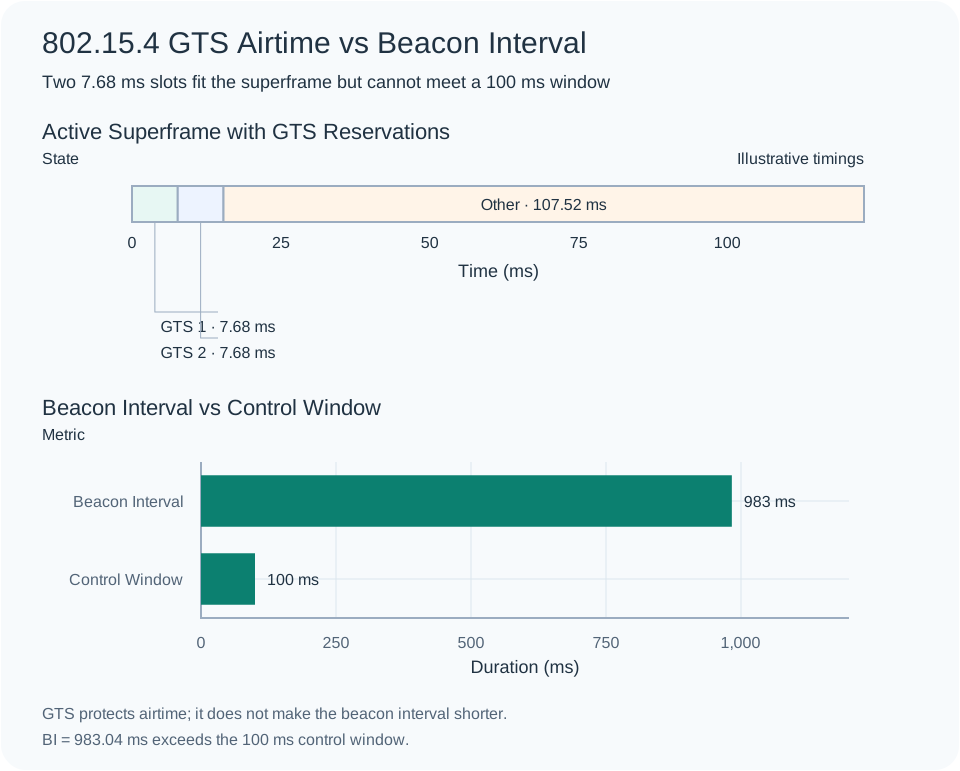
Twelve shelf sensors report by contention while two safety sensors must each land one status frame inside a 100 ms control window, so the coordinator reserves one Guaranteed Time Slot for each sensor. At BO = 6, SO = 3 every slot is 7.68 ms, so two one-slot reservations consume 15.36 ms — 12.5% of the active superframe — yet the beacon interval itself stays at 983.04 ms. This audit re-derives that two-sensor schedule and asks whether reserving a GTS actually meets the 100 ms deadline, or only protects airtime while the roughly one-second beacon interval never gets shorter.
Companion to the chapter 802.15.4 Collisions and Scheduling — every number here comes from that chapter.
See the relationship before changing it
Set the input, apply the rule, then read the result with its unit.
The retained audit below checks several chapter fixtures. This model keeps those stated values fixed and changes only reserved gts slots, so the numeric fixture does not switch without explanation.
Derive the baseline in four named moves
- 1
Name the input. The chapter baseline is 2 slots.
- 2
Name the relationship. reserved airtime = slots x 7.68 ms
- 3
Substitute with units. 2 x 7.68 ms = 15.36 ms
- 4
Read the result. Keep the unit beside the value. Use it only inside the technical boundary on this page.
Predict, then change reserved gts slots
Try Predict the direction of reserved airtime = slots x 7.68 ms. Test another reserved gts slots, then compare reserved airtime.
Observe Reserved slots protect active airtime but do not shorten the beacon interval. Reset reserved gts slots to 2 and compare reserved airtime.
Explain Each guaranteed time slot reserves another equal transmission window, so reserved airtime grows directly with the number of slots.
Check yourself
What should you do before trusting a moved-control result?
What does this small model leave out?
Ada: The beacon schedule is not just a MAC feature; it is a clock budget. Keep the symbol arithmetic visible before accepting a low-power or bounded-latency claim.
- Base superframe:
960 symbols * 16 us/symbol = 15360 us = 15.36 ms. - Low-duty cycle,
BO = 6, SO = 0:BI = 960 * 2^6 = 61440 symbols;61440 * 16 us = 983040 us = 983.04 ms;SD = 960 symbols = 15.36 ms; active fraction15.36 / 983.04 = 0.015625 = 1.5625%; inactive time983.04 - 15.36 = 967.68 ms. - Slot-sizing case,
BO = 6, SO = 3:SD = 960 * 2^3 = 7680 symbols;7680 * 16 us = 122.88 ms; slot time122.88 / 16 = 7.68 ms. - Two one-slot GTS reservations consume
2 * 7.68 = 15.36 ms, which is2 / 16 = 12.5%of the active superframe and leaves122.88 - 15.36 = 107.52 msfor the rest of the active-period work.
The physics check is the conclusion: a 983.04 ms beacon interval can be excellent for sleeping nodes, but it cannot guarantee that either sensor starts its reserved slot inside the stated 100 ms control window unless the schedule changes. A GTS protects airtime; it does not make the beacon interval shorter.
Every number above is taken from the chapter’s own material and re-derived step by step.
Audit result
The two slots fit the active superframe, yet BI = 983.04 ms exceeds the 100 ms control window, so this schedule cannot prove that deadline.