12 SDN Use Cases for IoT
12.1 Start With the IoT Service Problem
Do not start with the instruction to use SDN. Start with the service problem: a set of devices needs a path, a policy, an exception rule, and proof that forwarding changed for the right reason.
Start simple: choose one traffic class or gateway behavior and state what should happen when conditions change. SDN earns its place when it can coordinate that behavior and make the result auditable. ## Minimum Viable Understanding {.depth-l0}
Do not start with “use SDN.” Start with the IoT operating problem: which device group needs which service path, under which policy, with which exceptions, and how the result will be verified. SDN helps when a controller can coordinate that behavior across forwarding devices and leave a traceable proof trail.
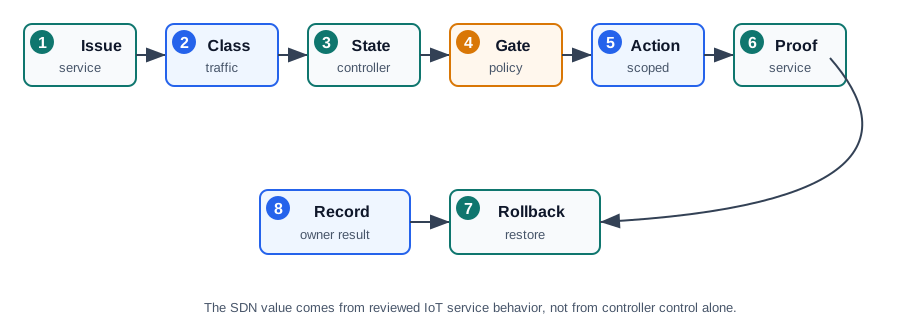
Use this route:
- State the IoT service problem: alert delivery, telemetry path, management access, update window, video pressure, mobility, or containment.
- Classify the traffic: device group, service, direction, urgency, expected destination, and required exceptions.
- Check controller state: topology, gateways, links, hosts, rule ownership, counters, and recent changes.
- Gate the request: policy, service risk, conflicts, exception paths, scope, expiry, and rollback.
- Program narrowly: path, queue, meter, mirror, redirect, or deny behavior only inside the approved scope.
- Verify the result: switch acknowledgement, counter movement, receiver proof, and operator check.
- Record ownership: reason, owner, affected services, rollback, and next check trigger.
12.2 Application Fit Map
SDN fits IoT best when the network decision affects multiple forwarding points or needs a shared proof record.
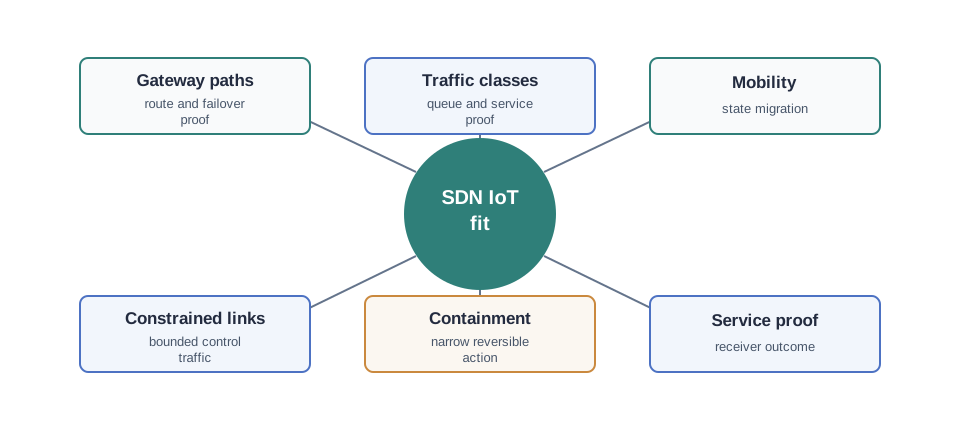
Gateway path control
Use SDN when gateways need consistent routing, failover, path separation, or temporary steering during maintenance.
Traffic class separation
Use SDN when alarm, telemetry, management, update, and video traffic need different forwarding and queue behavior.
Constrained networks
Use SDN carefully when sensor nodes or gateways need policy changes without firmware churn, and controller overhead is bounded.
Mobility and roaming
Use SDN when device movement needs path migration, session continuity, or access-point coordination with proof.
Containment
Use SDN when suspicious traffic needs a narrow, reversible response that preserves required management and recovery paths.
Service assurance
Use SDN when counters and receiver outcomes must prove whether a controller-driven change improved the service.
12.3 Traffic Class Separation
Many IoT networks carry traffic that should not be treated the same way.
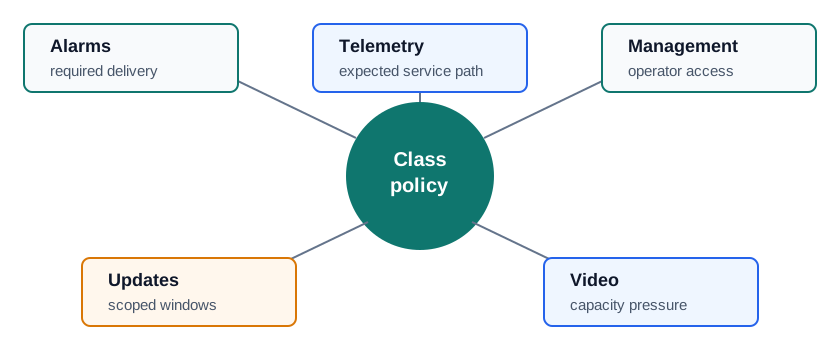
Check these classes explicitly:
- Alarms: required delivery paths and receiver confirmation.
- Telemetry: expected destinations, sampling behavior, and normal quiet periods.
- Management: operator access paths and recovery exceptions.
- Updates: scoped windows, rollback paths, and temporary shaping.
- Video or bulk data: capacity pressure, queue behavior, and impact on required services.
The goal is not to give every class a fancy policy. The goal is to make the required differences visible, enforceable, and verifiable.
12.4 Gateway Path Control
Gateways are natural SDN check points because they aggregate device traffic and connect local device groups to services.
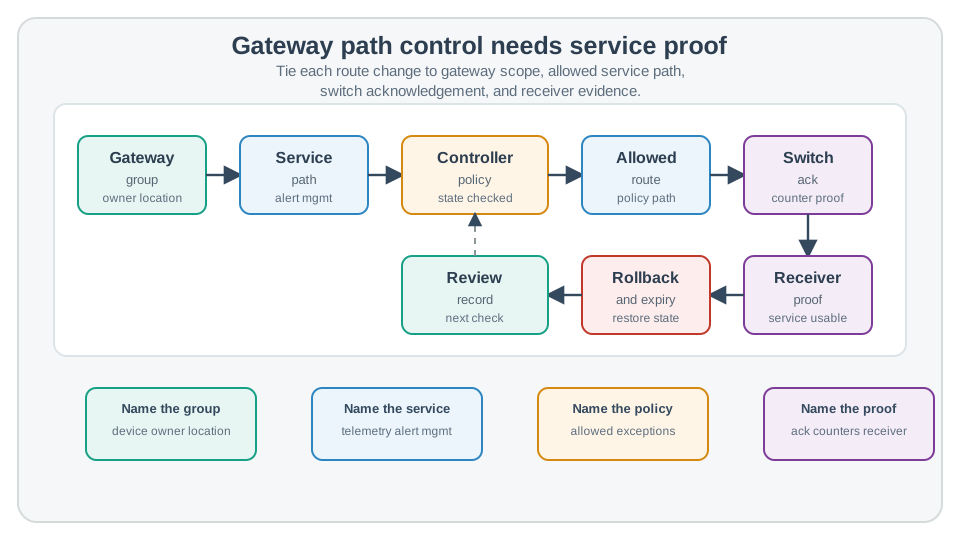
Useful gateway check questions:
- Which service path changed? Telemetry, alert, management, update, video, or recovery?
- Which gateway group is affected? Identify device group, owner, location, and required exceptions.
- Which path is allowed? Tie controller state to service policy, not just shortest path.
- What proves success? Switch acknowledgements, counters, receiver proof, and operator check.
- What restores the prior state? Keep rollback and expiry visible before temporary steering is applied.
12.5 Constrained Sensor Networks
SDN ideas can apply to constrained networks, but only when the controller burden and device limitations are respected.
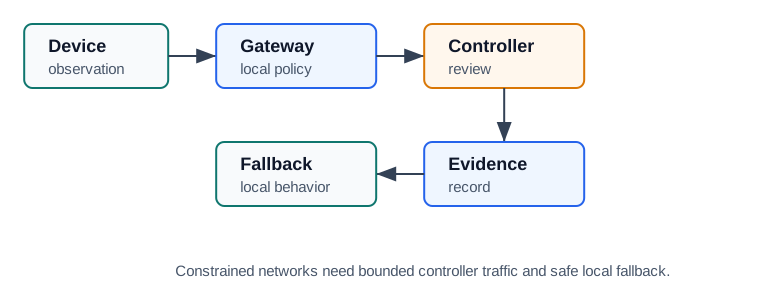
Practical constraints include:
- Limited device memory for rule tables.
- Limited energy for control traffic.
- Intermittent links and delayed acknowledgements.
- Need for local fallback behavior when the controller is unreachable.
- Gateway responsibility for translating policy into safe local behavior.
Use SDN to reduce operational friction, not to force tiny devices into a heavy control model.
12.6 Mobility and Roaming
Mobile IoT devices, portable assets, and roaming gateways need path changes without losing ownership or policy context.
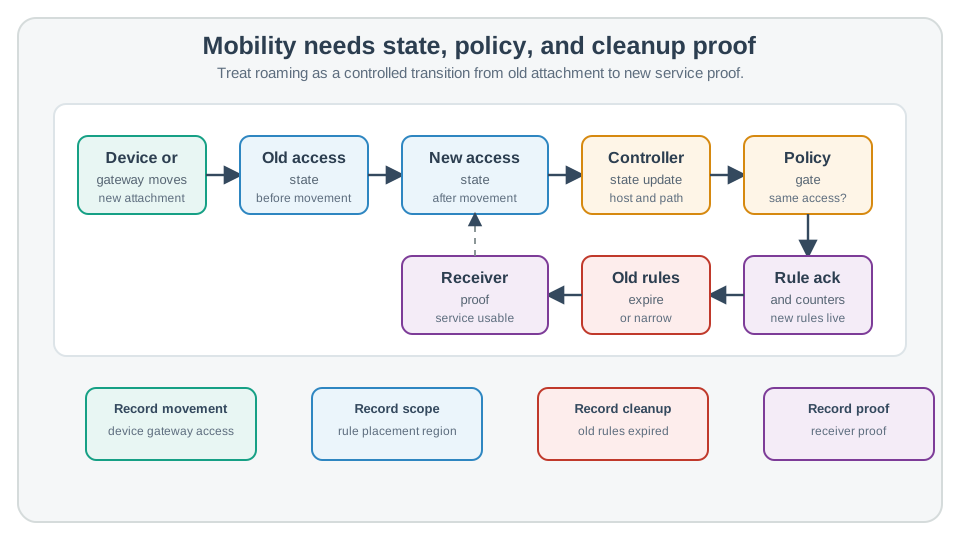
Check mobility as a state transition:
- Device or gateway moves to a new attachment point.
- Controller updates host and path state.
- Policy checks whether the same service access is still allowed.
- Old rules are expired or narrowed.
- New rules are acknowledged.
- Receiver-side proof confirms the service remained usable.
Mobility is not only a handoff problem. It is also a policy, state, and cleanup problem.
12.7 Named WSN and Mobile SDN Variants
Use named research variants as examples of the proof questions above, not as labels that approve a design by themselves. Sensor OpenFlow and SDN-WISE move SDN ideas toward wireless sensor networks by putting rule-like forwarding decisions near constrained nodes or gateways. The useful claim is not the protocol name. It is whether value-centric or ID-centric forwarding, sensor management, sleep-state control, and topology changes improve delivery without spending too much memory, energy, or control traffic.
Mobile SDN variants focus on access-point and base-station attachment. ODIN uses a lightweight virtual access point idea so client state can follow the user while the controller coordinates physical access points. Ubi-Flow partitions the wireless infrastructure so mobility management, flow scheduling, fault tolerance, and load balancing can be scoped to the right controller region. Mobi-Flow makes the mobility claim more predictive: it estimates where a user will attach next and pre-places flow rules at candidate access points or base stations.
When you review any of these variants, record the same evidence: attachment state before and after movement, rule placement scope, old-rule cleanup, packet-in or control-message overhead, receiver proof, protected traffic exceptions, and failure behavior when the controller or access point is unavailable. A variant is useful only if those records show better service, lower overhead, or safer recovery for the specific IoT traffic class.
12.8 Containment and Recovery
SDN containment should be narrow, reversible, and exception-aware.
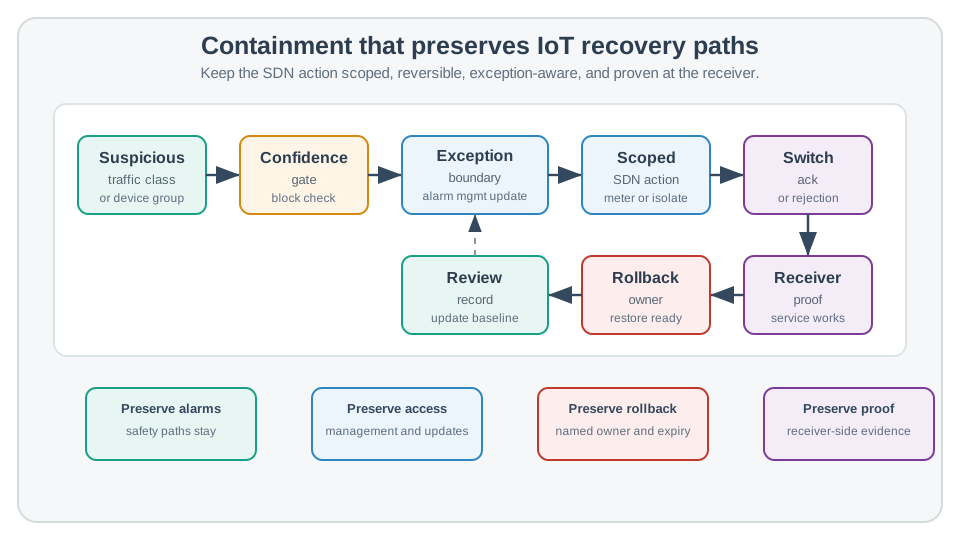
Containment options include:
- Metering a suspicious traffic class.
- Redirecting traffic to inspection.
- Mirroring traffic for inspection.
- Blocking a narrow destination or service.
- Isolating a device group while preserving management and recovery paths.
Avoid broad deny rules that cut off alarms, updates, operator access, or rollback mechanisms.
12.9 Service Assurance
An SDN IoT application is only useful if the affected service behaves better or remains protected.
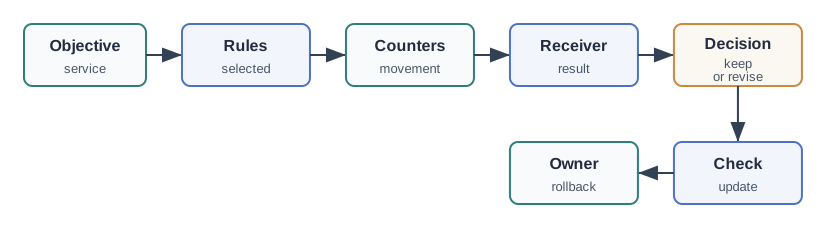
Useful proof includes:
- Affected device group and service.
- Controller state used for the decision.
- Rule diff, scope, priority, and expiry.
- Switch acknowledgement, timeout, or rejection.
- Counter movement for the affected class.
- Receiver-side result at the gateway, application, or service.
- Rollback and owner.
The final question is not “did the controller change a rule?” The final question is “did the required IoT service behave correctly after the checked change?”
12.10 Walkthrough: Cold-Room Gateway Traffic
A cold-room monitoring system has gateways sending temperature telemetry, door alarms, operator management traffic, and periodic update traffic. During an update window, alarms are delayed.
Operating question
Did update traffic interfere with alarm delivery, and can SDN isolate or shape update traffic without breaking telemetry, management, or rollback?
Required proof
Affected service: cold-room door and temperature alarms
Device group: cold-room gateways
Traffic classes: alarms, telemetry, management, updates
Controller state: gateway attachments, allowed destinations, rule owner, queue/counter proof
Policy gate: update window, alarm exception, management exception, rollback owner
Candidate action: narrow update shaping or alternate path, not a broad gateway block
Receiver proof: alarm delivery, telemetry continuity, management access, update completion or rollback
Check steps
- Confirm which gateways and alarm receivers are affected.
- Separate alarm, telemetry, management, and update traffic classes.
- Check queue, port, flow, or meter proof for the update window.
- Verify required exceptions before compiling any new rule.
- Apply a scoped path, queue, or meter change for update traffic.
- Confirm switch acknowledgement and counter movement.
- Verify alarm delivery and management access at the receiver side.
- Record owner, result, rollback, and next update-window check trigger.
Good outcome
The check does not say “SDN fixed alarms” because a rule changed. It shows which traffic class changed, what exceptions remained, whether the switches accepted the change, what counters moved, whether alarms recovered, and how to reverse the change.
12.11 Proof Loop
Every SDN IoT application should leave a proof loop from service problem to result.
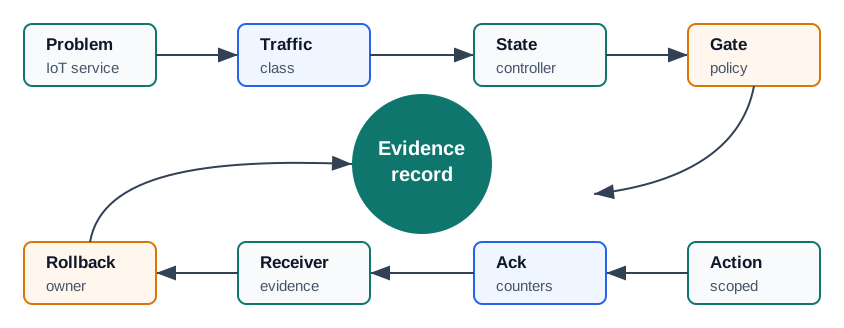
Capture:
- IoT service problem and affected device group.
- Traffic class and required exceptions.
- Controller state and rule ownership.
- Policy gate and conflict check.
- Scoped forwarding, queue, meter, mirror, redirect, or deny action.
- Switch acknowledgement and counter movement.
- Receiver proof.
- Rollback and next check trigger.
12.12 Common Pitfalls
- Starting with an SDN feature instead of a service problem: the check should begin with the affected IoT service and required proof.
- Using broad blocks during containment: narrow actions should preserve alarm, management, update, and recovery exceptions.
- Ignoring controller overhead in constrained networks: small devices and lossy links need local fallback and bounded control traffic.
- Confusing traffic separation with proof: a path or queue rule is not proof that the receiver saw better service.
- Leaving temporary rules without owners: update-window and incident rules need expiry, rollback, and next-check triggers.
12.13 Start With the IoT Service
SDN is useful in IoT when a controller can coordinate different network behavior for different device groups and prove that the service outcome improved or remained protected. The starting point is not the SDN feature. The starting point is the affected alarm, telemetry, management, update, video, mobility, or containment service.
A strong use case names the traffic class, gateway group, policy gate, allowed exceptions, scoped network action, receiver proof, rollback path, owner, and review condition. Without those details, a controller rule is just a network change, not an IoT application decision.
Consider a cold-room gateway fleet that publishes temperature telemetry every minute, sends door-open alarms immediately, accepts operator management from a site console, and downloads firmware during a planned update window. If alarm delivery slows during the update, the SDN question is not whether the controller has a queue feature. The question is whether update traffic can be shaped or moved while alarm, telemetry, management, and rollback paths remain usable.
The fit check should name the gateway group, receiver, traffic class, expected destination, and protected exceptions before any rule changes. Flow counters, queue counters, or meter counters can show update pressure. Receiver proof from the alarm service can show whether alarms recovered. Controller state can show attachment points, rule ownership, and conflicting policy. If those facts do not line up, the better answer may be a gateway update schedule, protocol retry change, or local fallback rule rather than an SDN action.
Fit rule: use SDN when the network action crosses shared infrastructure, needs consistent policy across forwarding points, and can leave evidence from request to receiver-side result.
- Gateway path control: steer telemetry, alert, management, update, or recovery paths with an owner and rollback.
- Traffic separation: give alarms, telemetry, updates, management, and video different checked behavior.
- Containment: apply narrow reversible isolation while preserving required exceptions.
- Service assurance: compare switch records with counters, receiver behavior, operator proof, and closure state.
12.14 SDN IoT Proof Record
The proof record should make the controller action reviewable after the event. It should show which service problem justified the action, which exceptions were preserved, which switch-side evidence was collected, what the receiver observed, and how the temporary change ends.
Use the same record for positive and negative decisions. “No SDN action” is often the correct result when local fallback, protocol behavior, or operational process is the real control.
In the cold-room example, a useful proof record might say that cold-gw-west update traffic to fw-update on 443 was metered for a 30-minute window, alarm traffic to alarm-core remained unmetered, telemetry to mqtt-core on 8883 stayed on the normal path, and management from ops-console remained allowed. Acceptance proof would include the controller rule diff, switch acknowledgement, queue or meter counters, alarm receiver latency, telemetry continuity, and an owner who can remove the temporary rule.
The negative case matters just as much. If receiver proof shows alarms were delayed by application-side processing or a gateway firmware lock, shaping the network may add risk without solving the problem. The record should then close with “no SDN action” and point to the local owner, protocol owner, or firmware owner. That prevents future teams from treating every alarm delay as a controller-policy issue.
12.15 Local Limits Decide Safety
SDN can coordinate gateway and switch behavior, but it cannot remove constrained-device limits, wireless loss, energy budgets, duty-cycle limits, local process timing, or the need for safe fallback. The controller is strongest when it coordinates shared network policy while local devices and gateways retain behavior that must not wait for a remote decision.
This matters during containment, mobility, and update windows. A controller can narrow a path, meter a class, or isolate a device group, but it must preserve alarm paths, management recovery, rollback signals, and receiver-side proof. Otherwise the control action can make the IoT service less safe even when the network rule is technically correct.
Under the hood, the controller sees a partial model of the system. It can know attachment points, policy intent, rule priority, counters, and topology state. It usually cannot know that a door alarm reached the operator workflow, that a local gateway queue is backing up, that a battery-powered sensor will miss the next receive window, or that an installer has unplugged a backup link. Those facts come from gateways, brokers, applications, and operations records.
A reliable design therefore keeps local safety and remote policy separate. Local gateway behavior should preserve alarm buffering, store-and-forward telemetry, update rollback, and operator recovery even if controller contact is degraded. The SDN policy can shape update traffic, steer a gateway path, or isolate a suspicious group, but the receiver proof and rollback path must work without assuming the controller remains reachable throughout the incident.
Controller proof is not service proof. A switch acknowledgement must be paired with counters, receiver behavior, exception checks, and rollback evidence before the IoT application claim is closed.
- Local fallback: safety and time-critical local behavior should not wait for a remote controller.
- Constraint boundary: SDN does not remove range, energy, payload, timing, or gateway translation limits.
- Exception boundary: containment and shaping must preserve required alarm, management, update, and recovery paths.
- Proof boundary: controller state, switch acknowledgements, counters, receiver proof, rollback, and owner records must agree.
12.16 Summary
SDN supports IoT applications when a controller can coordinate traffic behavior across shared infrastructure and prove the result. Strong fits include gateway path control, traffic class separation, constrained-network policy through gateways, mobility checks, containment, and service assurance. Each application should be checked as a proof workflow: service problem, traffic class, controller state, policy gate, scoped action, acknowledgement, counters, receiver proof, owner, and rollback.
12.17 Key Takeaway
Use SDN for IoT only when the service problem, traffic class, controller action, required exceptions, receiver proof, rollback, and local fallback are explicit enough to review.
12.18 See Also
- SDN Introduction and Architecture: SDN boundaries and rule lifecycle.
- SDN APIs and High Availability: API contracts, failover, and service proof.
- SDN IoT Variants and Challenges: variants, limits, and design tradeoffs.
- SDN Analytics Architecture: telemetry context and proof gates.