4 Cloud Deployment Models for IoT
4.1 Start With the Boundary That Must Hold
A deployment model is not a brand of cloud. It is the boundary around data, control, latency, ownership, and recovery for a specific IoT workload.
Start simple: follow one message from device to decision and mark where it may leave the site, where it must stay local, and who must be able to inspect it later. Public, private, community, and hybrid choices then become boundary choices instead of labels.
4.2 Learning Objectives
By the end of this chapter, you will be able to:
- Compare public, private, community, and hybrid deployment models for IoT workloads.
- Separate cloud deployment decisions from edge placement decisions.
- Classify IoT data and control paths before choosing where each workload runs.
- Design hybrid boundaries that preserve latency, governance, resilience, and auditability.
- Produce a placement record that explains the deployment choice without depending on brittle provider or pricing assumptions.
4.3 Quick Check: Workload Placement Proof
4.4 Deployment Models Are Boundary Choices
The useful question is not “which cloud is best?” The useful question is “which boundary should this workload cross, and what record proves that boundary is safe enough?” A single IoT system can include device firmware, gateways, site services, private cloud resources, public cloud analytics, and shared partner workflows. Treat each part separately.
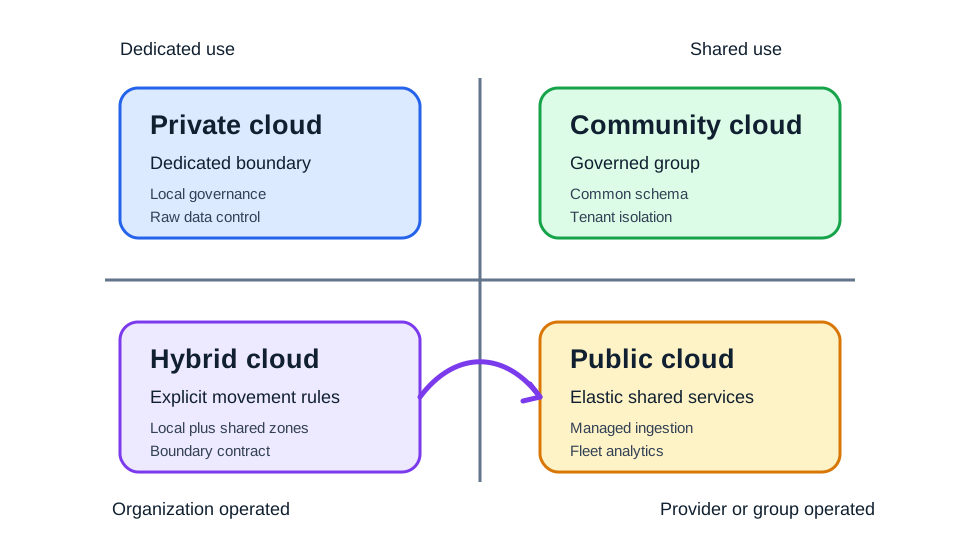
4.4.1 Public Cloud
Public cloud is provider-operated infrastructure shared across many customers. It is usually the simplest way to get managed ingestion, durable storage, elastic analytics, identity integration, monitoring, and global access.
Use public cloud when the workload is approved to leave the site boundary and benefits from elasticity or managed services:
- Device onboarding, telemetry ingestion, dashboard delivery, and long-term storage.
- Batch analytics, fleet reporting, model training, and cross-site comparison.
- Prototype or growth workloads where demand is uncertain.
- Non-sensitive data products shared with customers, partners, or operations teams.
Evaluate public cloud carefully when raw data reveals sensitive locations, production timing, patient context, safety state, or proprietary process behavior. Encryption and identity controls are necessary, but they do not replace a placement decision.
4.4.2 Private Cloud
Private cloud is dedicated infrastructure operated for one organization, either on site or in a hosted environment. It is useful when the organization needs direct control of data location, network boundary, change windows, or operational recovery.
Use private cloud when the workload depends on local governance or predictable site behavior:
- Local historian, plant operations dashboard, or gateway management inside a facility boundary.
- Workloads that must continue when the wide-area network is degraded.
- Raw telemetry that exposes regulated, confidential, or operationally sensitive information.
- Integration with site systems that should not be exposed directly to public networks.
Private cloud still needs cloud discipline: automation, patching, identity management, backup, monitoring, capacity planning, and incident response. It is not automatically safer just because it is dedicated.
4.4.3 Community Cloud
Community cloud is shared infrastructure for organizations with aligned requirements and common governance. In IoT, this can appear in municipal services, research networks, utility collaborations, sector-specific testbeds, or shared infrastructure across related agencies.
Use community cloud when participants need a common operating model:
- Shared data schema, retention policy, and access rules.
- Cross-organization dashboards or event exchange.
- Common onboarding rules for devices, gateways, and partner applications.
- Governance that is stronger than ad hoc bilateral integrations.
Community cloud fails when the governance model is vague. The architecture must define who operates the platform, who approves schema changes, how tenants are isolated, and how disputed data is corrected.
4.4.4 Hybrid Cloud
Hybrid cloud combines two or more placement zones with explicit movement, identity, observability, and governance rules. It is common in IoT because different workloads have different timing and sensitivity.
Use hybrid cloud when the same system has conflicting needs:
- Local fault detection must run near machines, while long-term model training benefits from cloud compute.
- Identifiable or sensitive raw data stays private, while aggregate or de-identified summaries are shared.
- Gateways buffer and filter telemetry locally, while fleet dashboards and reporting run centrally.
- Site operations need continuity during network outages, while headquarters needs cross-site comparison.
Hybrid is not “use everything.” It is a design contract. Define exactly what stays local, what moves, what is transformed before moving, who can see it, and what happens when the interconnect fails.
4.5 The Placement Route
Workload placement should follow evidence. Start with the data and control path, not the cloud product list.
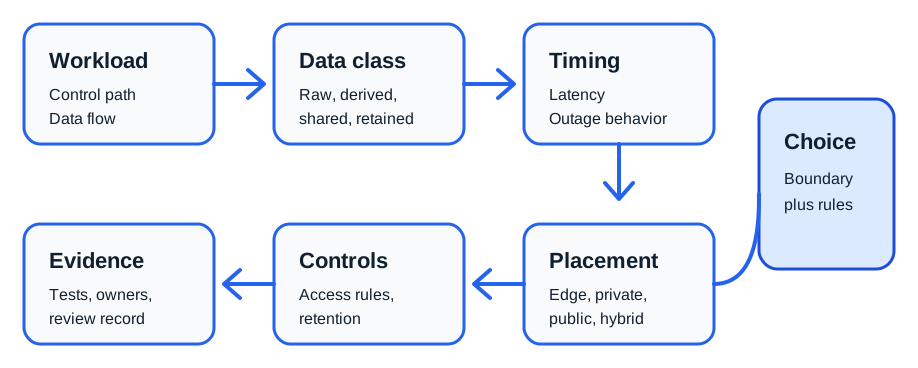
Use this sequence for each IoT workload:
- Name the workload. Examples: emergency stop decision, five-minute telemetry summary, maintenance dashboard, model training job, partner report.
- Classify the data. Identify raw sensor readings, derived summaries, identifiers, operational context, calibration records, and audit records.
- Define timing. Separate hard real-time control, near-real-time operations, delayed analytics, and archival inspection.
- Check connectivity assumptions. Decide what continues locally during outage, what can queue, and what can be dropped.
- Choose the placement. Assign edge, private cloud, public cloud, community cloud, or a hybrid path.
- Attach controls. Identity, encryption, network segmentation, data minimization, retention, monitoring, backup, and change review.
- Record validation. Keep a short placement note with assumptions, tests, failure behavior, and accountable owners.
4.6 Edge Is The First Deployment Boundary
Edge is not one of the four classic cloud deployment models, but it is often the first boundary an IoT architect must decide. A deployment model that ignores the edge usually becomes unreliable or expensive.
Use edge or site-local processing for:
- Safety, actuation, or equipment protection paths.
- Filtering, compression, and data-quality checks before transmission.
- Offline buffering when connectivity is intermittent.
- Local dashboards used by operators during an incident.
- Data minimization before sending information outside the site.
Use cloud-side processing for:
- Cross-site analytics and long-range trend detection.
- Fleet-wide dashboards and reporting.
- Model training, simulation, and historical replay.
- Shared data products that require controlled access from many locations.
The cloud should not be in the critical path for a decision that must complete faster than the network can reliably support. The edge should not be forced to store or analyze years of data when central systems can do that better.
4.7 Hybrid Boundary Pattern
In a strong hybrid design, raw events do not drift casually between zones. The architecture defines a boundary and a transformation rule.
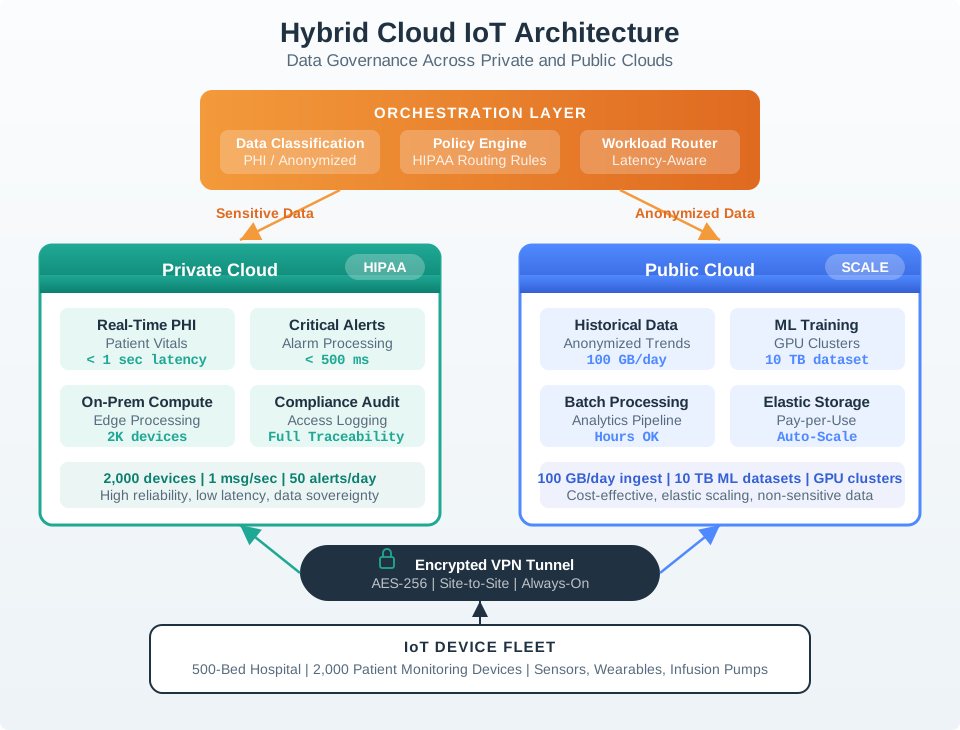
A durable hybrid boundary includes:
- Ingress rule: which devices and gateways can write data into the local system.
- Classification rule: how raw, sensitive, aggregate, and public data are tagged.
- Transformation rule: what must be filtered, summarized, anonymized, or signed before movement.
- Movement rule: which zone receives each data class and under what schedule.
- Return rule: what can come back from cloud to site, such as models, dashboards, or configuration.
- Failure rule: how the site behaves when the interconnect, cloud service, or identity provider is unavailable.
- Change rule: who can change the placement policy and how the change is tested.
4.8 Scenario: Cold Storage Across Many Sites
Consider an organization that monitors cold rooms across many facilities. Sensors report temperature, door status, power state, and maintenance events. The system needs local alarms, central maintenance planning, and shared compliance evidence.
4.8.1 Workload Placement
Local edge and private site services
- Door-open alarm, compressor fault detection, and local siren.
- Short-term raw telemetry buffer for outage recovery.
- Maintenance tablet view used by on-site staff.
- Calibration and device health records before upload.
Central public or shared cloud
- Cross-site trend dashboards.
- Fleet maintenance prioritization.
- Long-term summaries and signed daily validation packages.
- Model training using approved historical summaries.
Community or partner zone
- Limited validation reports for auditors, logistics partners, or shared operations teams.
- Access controlled by role, time, purpose, and data class.
- No direct access to device credentials or local control paths.
4.8.2 Why Not One Placement?
Public-only placement would make local alarms dependent on connectivity. Private-only placement would make cross-site analysis and partner reporting harder to operate. Community-only placement would create governance and isolation risks for raw operational data. A hybrid design fits because each workload has a different boundary.
Placement note: Local control and raw records remain at each facility. The central cloud receives hourly summaries, signed daily validation packages, and device-health aggregates. Partner access uses reports, not raw telemetry or control APIs. If the network is down, sites continue alarming locally and upload queued records after recovery.
4.9 Governance Matrix Without Wide Tables
Avoid a single wide comparison table. For review, use compact placement cards that fit on mobile and desktop.
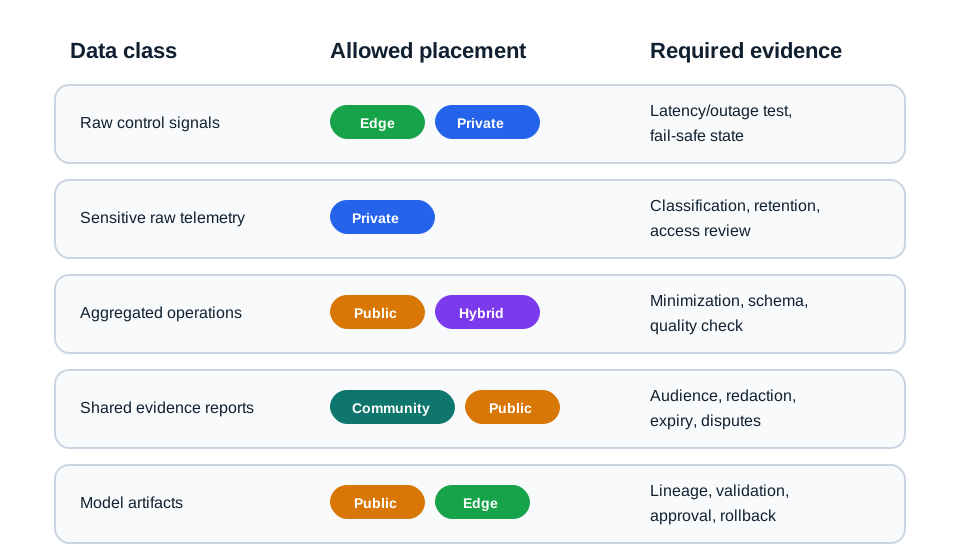
4.9.1 Raw Control Signals
Best placement: edge or private site services.
Validation record: latency test, outage behavior, fail-safe state, operator handoff, and local audit log.
4.9.2 Raw Sensitive Telemetry
Best placement: private cloud or site-local store unless a policy explicitly allows movement.
Validation record: classification tag, retention rule, access role, encryption boundary, and deletion process.
4.9.3 Aggregated Operations Data
Best placement: public cloud or hybrid analytics after minimization.
Validation record: aggregation rule, data-quality check, schema version, and reconciliation path.
4.9.5 Model Artifacts
Best placement: trained centrally, validated before site deployment.
Validation record: training data lineage, version, approval gate, rollback plan, and drift monitoring.
4.10 Interaction: Placement Decision Check
4.11 Match Models to Boundary Records
4.12 Interaction: Order The Placement Steps
4.13 Readiness Record
The final design should leave a short record that another architect can challenge. A deployment decision is weak if it only says “we chose cloud” or “we chose hybrid.” It should identify the workload, boundary, assumptions, controls, and validation results.
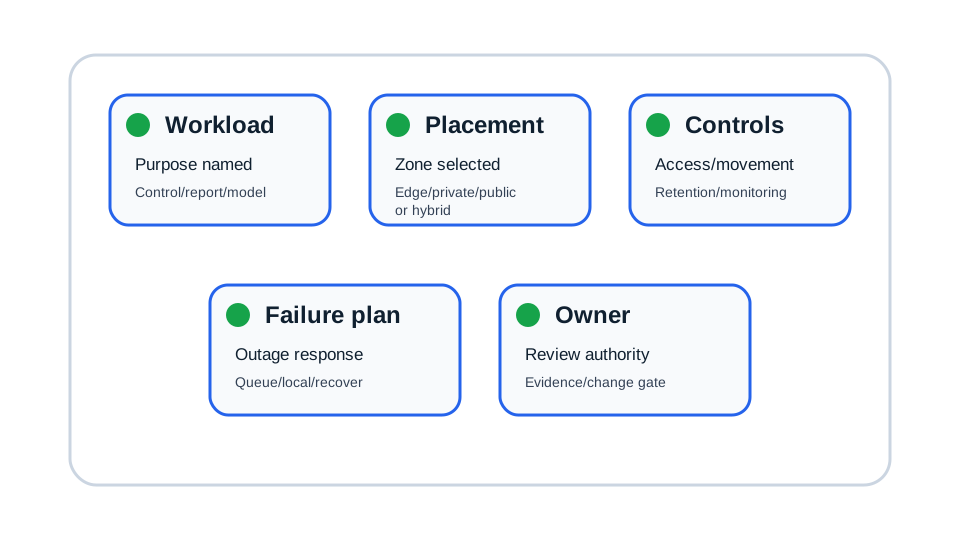
Use these review prompts:
- Workload: What decision, data flow, report, or model job is being placed?
- Boundary: Which zone owns the raw data, derived data, and control path?
- Timing: What latency is required, and what test result proves it?
- Connectivity: What happens when the network, identity provider, or cloud service is unavailable?
- Data movement: What transformations occur before data crosses a boundary?
- Access: Which roles can read, write, approve, or export each data class?
- Operations: Who patches, monitors, backs up, restores, and changes the workload?
- Validation: Which tests, logs, or screenshots prove the design works?
4.14 Common Failure Patterns
A line between site and cloud is not enough. Hybrid needs named data classes, movement rules, identity controls, observability, recovery behavior, and change ownership.
If a control action must happen faster than the network can reliably support, the control decision belongs at the edge or site layer. Cloud can observe, analyze, and improve the loop, but it should not be the only path for immediate protection.
Raw IoT telemetry can expose location, production state, occupancy, behavior, or proprietary process details. Classify and minimize it before sending it outside the local boundary.
Private cloud still needs patching, access review, monitoring, backup, capacity planning, and incident response. Dedicated infrastructure without disciplined operations becomes fragile.
Community cloud depends on shared rules. Without tenant isolation, schema ownership, dispute handling, and change control, it becomes an unclear shared database rather than a reliable deployment model.
4.15 Placement as Boundary Contract
A deployment model is not a provider label. It is a boundary contract for a specific workload: who owns the infrastructure, which data can cross the boundary, which decisions must stay local, which controls are required, and which failure mode has already been tested.
The same IoT product can use multiple placement answers. A local shutdown loop, a raw historian, a fleet dashboard, and an auditor report do not have the same latency, sensitivity, owner, or recovery requirement.
For a cold-storage fleet, write the boundary as four workloads before choosing a provider zone. The alarm workload is edge or private because compressor shutdown and local sirens must work when WAN service is down. The raw-record workload stays in private site services because temperature traces, door openings, and maintenance timing expose operations. The analytics workload can use public cloud after the gateway emits hourly aggregates with schema version, data-quality flags, and approved site identifiers. The auditor workload can use a community or partner zone only for signed reports with expiry, redaction, and dispute rules.
The deployment model is therefore not “hybrid” as a slogan. It is a set of allowed crossings. Raw traces do not cross. Summary features cross one way. Validated model artifacts may return only after release approval. Local control never waits for the cloud path. These statements give engineers, security reviewers, and operations teams something concrete to test when network links, identity services, storage queues, or dashboard services are degraded.
That boundary contract is also the learner’s inspection checklist: identify the workload, name the owner, state the allowed movement, and attach the test that proves the placement still works when a dependency fails.
Control Path
Safety or protection decisions stay at edge or site when network latency or cloud availability cannot be trusted.
Raw Record
Sensitive or high-fidelity telemetry stays local until classification, minimization, retention, and access rules are approved.
Shared Insight
Summaries, reports, and model jobs can move to public or community cloud when their transformation and audience are clear.
A strong architecture can explain both movement and non-movement: what crosses the boundary, what stays behind, and what evidence would force a new placement decision.
For a cold-storage fleet, the compressor shutdown loop belongs at the edge because it must work during a WAN outage. Raw temperature and door telemetry may stay in a private site store because it exposes operational timing and maintenance behavior. Hourly temperature summaries, device-health aggregates, and signed compliance packages can move to public or community cloud when their audience, retention, and redaction rules are explicit.
The boundary contract should also describe reverse movement. A cloud-trained anomaly model or configuration change is not allowed back into the gateway just because it was produced centrally. It needs a version, validation result, rollback path, and local owner. Without those fields, the design has only named zones, not a deployment model that can survive operations.
4.16 Workload Placement Record
Make one placement record per workload. Do not approve a whole system as public, private, community, or hybrid in one sentence. The record should let a reviewer challenge the exact boundary being crossed.
Write the record in concrete nouns. “Public cloud for analytics” is too vague; “hourly aggregate compressor-health features from sites A through F, written to the central analytics account after identifier removal and schema validation” is reviewable. The record should name the producer, destination, data class, transformation, owner, retention period, and the evidence that proves the route worked under normal and degraded conditions.
For the cold-storage scenario, the local alarm workload needs a latency and outage drill, not a dashboard screenshot. The raw telemetry workload needs data classification, encryption boundary, retention, and restore proof. The summary-export workload needs a schema version, aggregation method, reconciliation check, and access log. The model-return workload needs staged deployment, gateway compatibility checks, drift monitoring, and rollback evidence. Those are different records because they fail in different ways.
4.17 Hybrid Fails at Movement Rules
Hybrid designs usually fail when the boundary is drawn but the movement rule is vague. If raw data, model artifacts, commands, dashboards, and reports all move through the same path, the deployment model stops expressing risk. The architecture needs separate rules for direction, transformation, identity, outage behavior, and rollback.
For example, an MQTT gateway in a cold room can write raw sensor events to a site historian and local object store, then publish only hourly feature rows to a cloud ingestion service such as AWS IoT Core or Azure IoT Hub when policy allows. The outbound message should carry the schema version, device group, aggregation window, quality flags, and release status, not the full raw trace. A cloud analytics job can train or score models against those approved rows, but a model artifact returning to the gateway should travel through a release service with signing, compatibility checks, staged rollout, and a known previous version.
The same movement rule has to survive failure. If the MQTT broker, private link, identity provider, or cloud queue is unavailable, the gateway keeps local alarm logic running and stores bounded summaries for later upload. If the summary queue fills, the system marks missing windows rather than inventing continuous coverage. If a returned model causes unstable alarms, the gateway rejects or rolls back that version and records the reason. The deployment model is operational only when these enforcement points are visible in gateway configuration, queue policy, storage retention, cloud IAM, release metadata, and incident procedures.
These controls make the boundary executable: firmware, broker policy, storage policy, identity roles, model-release metadata, and operator runbooks all encode the same movement decision.
Direction
Telemetry moving out of a site and configuration moving back into a site have different risk. Treat them as different flows.
Transformation
Filtering, aggregation, signing, anonymization, and validation should happen before data crosses into a broader zone.
Rollback
Cloud-trained models or configuration changes need versioning, local validation, and a safe return path if field behavior drifts.
In practice, the movement rule often has to be enforced by more than policy text. Gateways tag records before export, queues separate raw telemetry from approved summaries, object storage buckets use different retention and access rules, and cloud analytics jobs reject unknown schema versions. Identity also has to be directional: the cloud analytics service may read approved summaries, while only a validated release service can push a model artifact back to gateways.
Failure handling is part of the same rule. If the interconnect is unavailable, gateways buffer summaries locally, keep alarms running, and mark late uploads. If the identity provider is unavailable, local control continues with cached permissions while administrative changes wait. If a returned model performs badly, the gateway falls back to the previous approved version. These mechanics are what make hybrid a working deployment pattern instead of a diagram.
“Hybrid” is not evidence. The evidence is the movement policy plus proof that the site behaves safely when the interconnect, identity provider, queue, or cloud service is degraded.
4.18 Summary
Cloud deployment models help IoT architects decide where workloads belong:
- Public cloud fits approved elastic workloads and shared analytics.
- Private cloud fits raw, sensitive, local, or site-controlled workloads.
- Community cloud fits governed collaboration among related organizations.
- Hybrid cloud fits systems that need more than one boundary.
- Edge placement protects time-critical control, local continuity, and data minimization.
The strongest design is not the one with the most cloud services. It is the one that can explain why each workload crosses or does not cross a boundary, and can prove the decision with validation records.
4.19 Key Takeaway
Deployment-model choice should follow data sensitivity, latency, connectivity, regulatory, resilience, and operations requirements across public, private, hybrid, and edge patterns.
4.20 What’s Next?
Now that you can place IoT workloads across deployment models, continue with:
- Cloud Security for IoT: identity, encryption, segmentation, and monitoring controls for cloud-connected IoT.
- Cloud Platforms and Message Queues: ingestion, queues, and platform patterns that implement the placement decisions from this chapter.